
Trusses and Structural
How roof truss setting actually sequences
In Short
Trusses go up in a sequence dictated by bracing. The first few are the slow ones. The crane is committed for the whole block, not per pick.
February 24, 20265 min read1061 words
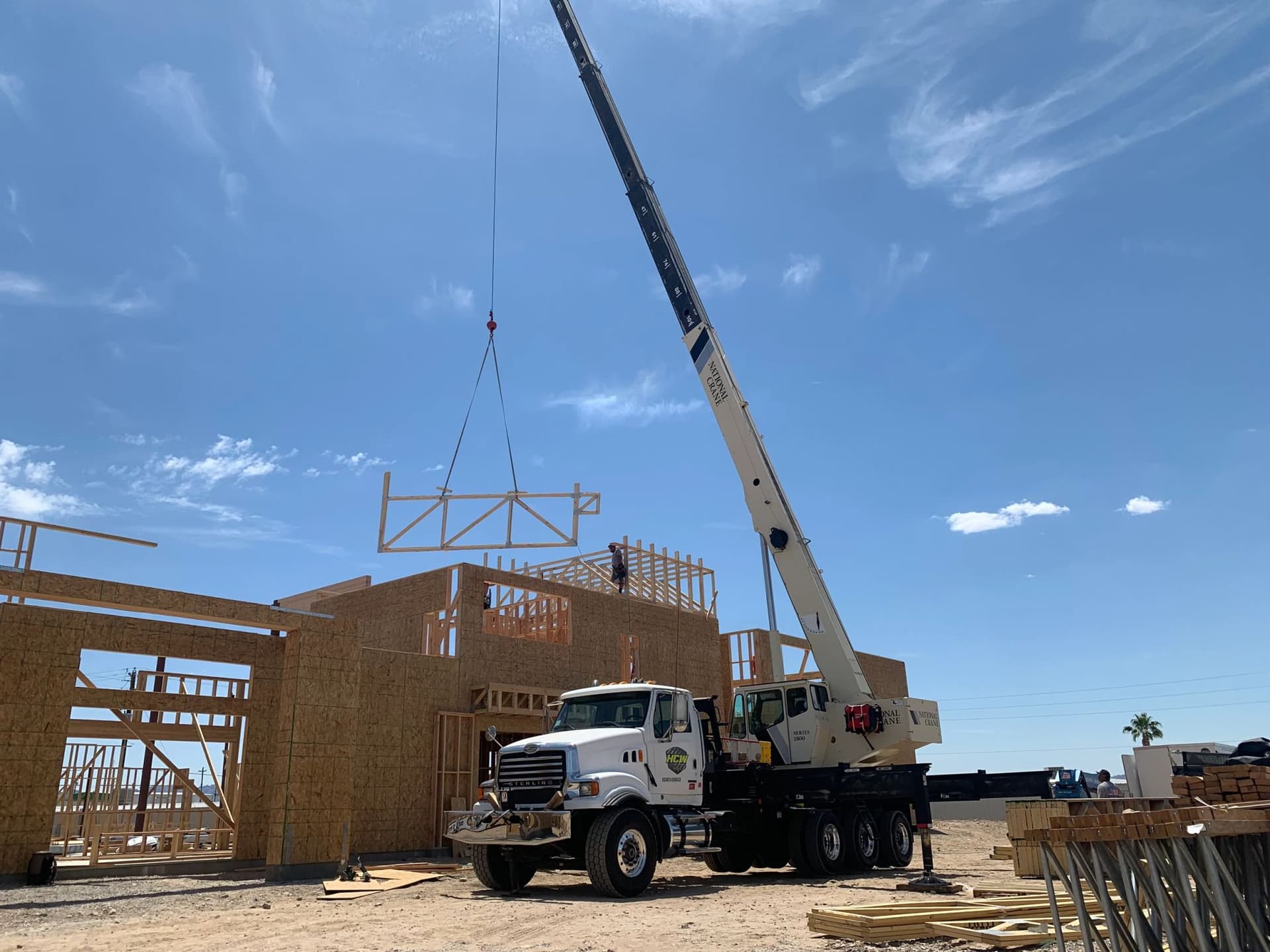
Truss setting starts with a braced first truss that everything else references, then proceeds truss by truss with temporary bracing installed as you go. The crane holds each one until it is fastened and braced. Because the sequence cannot be interrupted safely, the crane is committed for the whole run.
The First Truss Is the Slow One
The first truss up has nothing to lean against. It gets set, fastened at both bearing points, and then braced back to something solid, usually diagonal bracing down to the framing below.
That first one has to be plumb and it has to be right, because every truss after it will be spaced and braced off it. An error in the first truss propagates all the way down the roof, and by the tenth truss you are fighting an accumulation nobody can find the source of.
So the first truss takes ten or fifteen minutes on the hook while the crew gets it plumb, fastened, and braced. That is normal. The picks after it get much faster.
On a gable end, the end truss often has additional bracing requirements and sometimes a different profile. Worth knowing which one is which before it comes off the stack.
Bracing Is What Makes the Sequence
Trusses are not stable individually. What makes a roof stable is the whole assembly acting together, and that only exists once bracing ties them into a unit.
Temporary bracing goes in as you go: lateral bracing along the top chord at the spacing the manufacturer specifies, diagonal bracing to stop the whole assembly racking, and web member bracing where it is called for.
The temptation on a hot morning is to set several trusses and brace them all at once. That is how a row of trusses goes over like dominoes, and it takes the crew with it. Bracing keeps pace with setting, truss by truss.
Permanent bracing is a separate matter and it goes in later according to the design. Temporary bracing is what keeps everybody alive during the set, and it is the framing crew's responsibility to have the material for it on site.
Why the Crane Is Committed for the Block
A partly set roof cannot be left. A run of trusses that is up but not fully braced is unstable, and it is unstable in exactly the conditions that make people want to stop, which is when the wind comes up.
So a truss set gets planned as a continuous block of work. The crane arrives, the crew is already there and organized, and the run goes until it reaches a natural stopping point where everything up is braced and stable.
That is what people mean when they say the crane is booked for a half day rather than for six picks. The machine is not being paid to lift for six minutes. It is being held available for the crew for as long as the sequence takes.
It also means the pace is set by the framing crew, not by the crane. A three-person crew and a six-person crew produce very different days on identical roofs.
Where the Trusses Should Be Stacked
Truss delivery decides more about the day than most people realize. Where the bundle lands, which way it faces, and what order it is stacked in all feed directly into how many minutes each pick takes.
Ideally the bundle is within the crane's radius from its setup position, oriented so the trusses come off in the order they will be set, and on ground firm enough to walk on. That is not always what a delivery driver does on his own.
It is worth a call to the truss supplier before delivery, not after. Tell them where the crane will sit and where the trusses should land. A bundle in the wrong corner of the lot adds a long swing to every single pick, and on a fifty truss roof that is an hour.
Also worth checking on arrival: that the load is complete, that the trusses match the layout, and that nothing was damaged in transit. Finding a missing girder truss at pick twelve is a bad day.
Girders and Hips Break the Rhythm
Not every truss weighs the same. Girder trusses that carry other trusses can be several times the weight of a common truss, and they are often multi-ply, meaning two or three trusses fastened together as a unit.
Those get their own plan. Different rigging, sometimes a different pick point arrangement, and a much more careful set because they are heavy and they are usually landing on a hanger or a post rather than a plate.
Hip sets have their own order, with the step-down trusses going in a particular sequence that only makes sense if you have the layout in front of you. This is where having the truss layout drawing on site matters, and where a framing crew that has read it in advance saves everybody an hour.
The general point is that a truss run is not uniform. Knowing where the heavy and awkward pieces fall in the sequence lets us plan the setup position for the hardest pick rather than the average one.
Signals, Sight Lines, and the Wall
The operator often cannot see the bearing points at all. From the street or the pad, the wall line is edge-on and the crew is standing behind it.
One person signals. That person is positioned where they can see the truss, the wall, and the operator, and everybody else stays off the radio.
The last part of every pick is the same: the truss comes down to just above the plate, gets positioned by hand, and is fastened while the crane is still supporting most of its weight. Nobody lets go of a truss that is not fastened and braced.
- Have the truss layout drawing on site and read before the day
- Confirm the delivery location and stacking order with the supplier
- Have bracing material on site before the crane arrives
- Identify the girder and hip trusses in advance
- Have the wall plates snapped and marked for truss spacing
- Agree one signal person before the first pick
- Start early in summer and watch the wind forecast
When to Stop
Wind is the reason truss days end early. A truss is a large flat panel with little weight, and gusts move it far more than the weight suggests they should.
The stopping point is not arbitrary though. You stop at a place where what is standing is fully braced and stable overnight. That may mean pushing on for another twenty minutes to reach a safe point, or it may mean stopping earlier than the wind strictly requires because the next natural stopping point is a long way off.
That judgment gets made together between the crane and the framing crew, and it gets made before conditions force it rather than during.
Filed under Trusses and Structural. Published February 24, 2026.
Answers
Frequently Asked Questions
How many trusses can you set in a day?
It depends almost entirely on the framing crew and the roof. The crane is rarely the limiting factor. Tell us the truss count, the spans, and your crew size and we will give you a realistic window.
Can we set trusses over two separate days?
Yes, provided the first day ends at a point where everything up is fully braced. Plan the stopping point rather than discovering it, and expect a second setup on the return day.
Do you supply bracing material?
No. Temporary bracing is the framing crew's responsibility and it needs to be on site before the crane arrives, because the sequence stops without it.
What if the trusses are delivered in the wrong place?
We work with it, but every pick gets longer. It is worth calling the truss supplier before delivery to tell them where the crane will sit.
Do you need the truss layout drawing?
It helps a lot. It tells us where the heavy girders fall in the sequence, which drives the setup position and sometimes the machine choice.
Keep Reading
- Why long span trusses need a spreaderA long truss is stiff in one direction and floppy in every other. A spreader keeps it from folding, twisting, or cracking on the way up.
- Setting beams and columns on a Havasu siteSteel goes up in an order, and the order is not negotiable. How fit-up, plumb, and crew coordination decide how long the crane is committed.
- What happens in a pre-lift briefingBefore anything comes off the ground, everyone on site gets the same short conversation. Here is exactly what gets covered and why each item is on the list.
- Truss and Structural PlacementRoof trusses, beams, columns, steel, precast, and modular sections set to your framing crew's pace.
- Lift Planning and Site SupportWeight, radius, ground and overhead worked out before the truck rolls, by the operator who runs the crane.
- What to Expect on Lift DayA walkthrough of lift day from arrival to departure, including how long each stage takes, what you can do, and why setup takes longer than the pick.
Ready to schedule your lift?
Tell us the load, the site and the timing. We will confirm capacity, access and a window.