Service
Lift Planning and Site Support in Lake Havasu City
6 min readUpdated July 2026
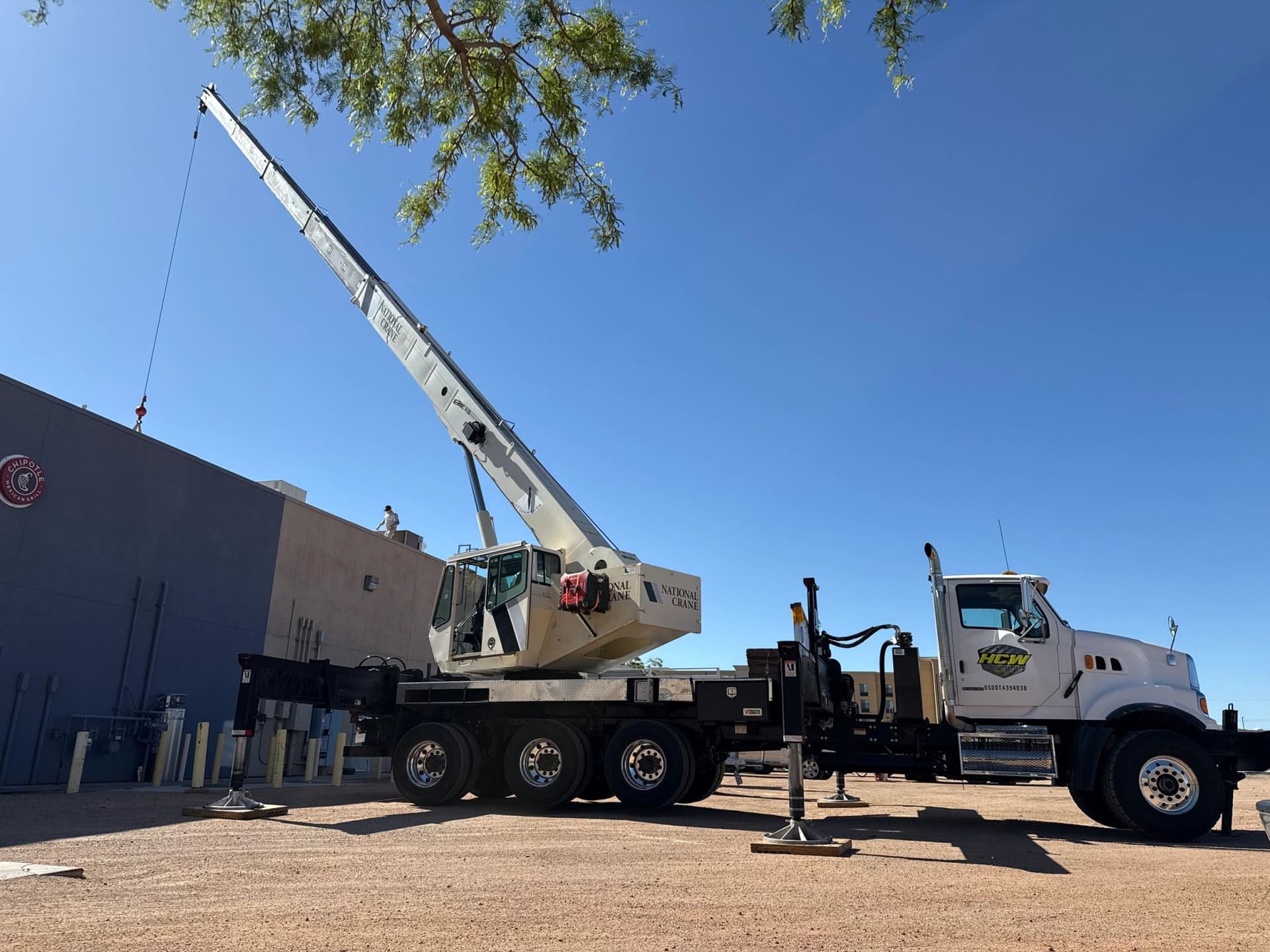
Lift planning is the work done before a crane arrives. HCW Crane Service confirms the weight of the load, the radius it has to travel, what the truck will stand on and what hangs overhead. The plan is built by the operator who will run the crane in Lake Havasu City.
The four questions that decide every lift
A lift is settled by four answers, and none of them will cover for the others. How much does the load weigh. How far out from the crane does it have to travel. What is the truck standing on. What is in the air above and around the work. Get one of those wrong and the other three stop mattering.
Weight and radius are joined at the hip. A boom truck holds far less at forty feet out than it does at fifteen, so a load that is easy in the driveway can be flatly impossible in the back corner of the yard. The ground answer decides whether the outriggers stay where you set them. The overhead answer decides whether the boom can go up at all.
Most jobs that go sideways were decided long before anybody touched a lever. Somebody guessed at a weight. Nobody walked the side yard. A service drop got treated as a detail. Planning is nothing more than the habit of asking those four questions out loud, in order, while there is still time to change the answer.
Why the answer arrives before the truck does
Something worked out in advance costs a phone call. The same thing worked out on site, with a loaded delivery trailer sitting in the roadway and a customer watching, costs everybody's morning. That is the entire argument for planning, and it does not need dressing up.
Expect questions when you call. Make and model of the unit, weight off the nameplate or the shipping ticket, where the truck delivering it will stop, where the load has to land, how tall the building is, how wide the gate is. Photos carry more than descriptions do. A picture of the side yard with a tape measure held across it settles an argument that ten minutes of talking will not.
Sequencing counts as much as measuring. A crane that shows up before the pad is poured, or before the old unit has been cut loose, is a crane standing still while somebody makes phone calls. The plan puts the crane, the delivery and the person receiving the load on the property within the same hour instead of across three of them.
By the time the crane rolls, the setup spot is picked, the truck is chosen, the rigging is already on board and the order of operations is known. The morning of the lift turns into an ordinary morning. That is the point. Nobody wants an interesting crane job.
What a site visit finds that a phone call cannot
Some things do not survive being described. Driveway slope is the classic one. Everyone says their driveway is fine, and plenty of the driveways above the channel drop hard enough at the apron that a long wheelbase truck drags before it ever reaches the gate. Standing there with a level and a tape ends the debate in about a minute.
A visit also turns up what nobody thinks to mention, because to the person who lives there it is furniture. The block wall that pinches the side yard down to thirty inches. The neighbor's carport hanging over the property line. The septic lid hiding under the gravel. The low service drop crossing the front yard in an older part of town.
Not every job needs a drive out. A straightforward yard pick with a wide gate, a known weight and clear sky overhead can be planned from photos and a few measurements. A rooftop set, a pinched lot, anything within reach of a power line, or a load nobody can produce a real weight for gets looked at in person first.
One more thing a visit produces is an honest opinion about how long the crane will be tied up. A pick that takes eight minutes in the air can still hold the truck for two hours if the mechanical contractor wants the unit suspended while connections are made. Knowing that in advance keeps everyone's day realistic and stops the crane from being double booked into somebody else's afternoon.
- Gate width, side yard pinch point and any fixed obstruction in the path
- Driveway slope, the break over at the apron and turnaround room
- Overhead lines, service drops, roof overhangs and mature limbs
- Ground under the planned outrigger positions, including buried structures
- Where the delivery truck stages and whether it can reach that spot
What gets rescheduled, and why that is a good outcome
Not every lift happens on the day somebody wanted it to. Sometimes the confirmed weight comes back higher than the chart allows at the radius the site forces on you. Sometimes the only place the truck can set up sits over a leach field. Sometimes the wind is up. Hearing that before the truck rolls is far cheaper than discovering it with a load in the air.
There is no clever way around a capacity problem. Bringing the bigger crane only helps if the bigger crane fits, and the 40 ton truck wants more room to spread its outriggers than the 22 ton does. On a narrow lot the smaller truck standing close will often beat the bigger truck forced to sit back at the curb.
When the answer is no, you get told why, and usually what would change it. Pull the fence panel and the truck gets ten feet closer. Get the utility out to cover the line and the swing path opens up. Move the pick to first light and the wind stops being a factor. A postponed lift is still a lift that happens.
Wind, heat and the monsoon
Wind postpones more work here than weight ever has. A load hanging off a long line is a sail. A flat panel or an empty tank catches a gust far worse than a compact steel machine does, and once the load starts to swing it pulls the radius out past where you planned to be working. The chart number you counted on is no longer the number you are actually at.
Monsoon afternoons build fast. A morning that started dead calm can be blowing dust twenty minutes later, and dust brings its own trouble when a signal person is trying to keep eyes on a load over a roof line. Summer work gets pushed to early hours for the plain reasons: steel left in the sun gets too hot to hand, and the hydraulic oil and the operator both run hotter by noon.
Wind gets watched during the lift, not only before it. If it comes up in the middle of a pick, the plan already says where the load goes down. Sorting that out while the load is swinging is not deciding anything, it is just reacting.
The person who plans it is the person who runs it
On a lot of crane work the plan is drawn up by an office and handed to whoever turns up. Detail leaks out at every handoff. Here the same operator does the site walk, works the chart numbers, picks the truck, hangs the rigging and sits in the seat. There is no translation step for something to fall out of.
It also means the crane gets matched to the load. There are two trucks, a 22-ton and a 40-ton, with reach out to 142 feet, and the person picking between them is the one who stood in the yard and measured the radius. Nobody sends the bigger truck because it happened to be free, or the smaller one because it was cheaper to dispatch.
Call outs are answered at any hour. How quickly the crane gets there depends on where the truck is and what it is in the middle of, and you will get a straight answer about that on the phone instead of a number that sounds good and then slips.
How the job runs
Our Process
Step 1: First call and load facts
We ask what the load is, what it weighs and where that number came from. Nameplate, shipping ticket or a cut sheet beats a guess every time, because a guess is always low. We also ask where it is now, where it has to end up and when the delivery lands.
Step 2: Chart math at real radius
The weight gets checked against the load chart at the radius the site forces, not at the crane's shortest reach. Block, hook, slings and any spreader come off the gross number. What is left is what is truly available at the hook, and that decides which truck comes.
Step 3: Site walk and measurements
Somebody drives out and measures the gate, the pinch points, the driveway slope and the turnaround. Overhead lines get identified. The planned outrigger positions get looked at for backfill, trenches, lids and slope. Photos and dimensions go in the job file so the plan never rests on memory.
Step 4: Setup and rigging plan
The setup spot gets marked with full outrigger spread and enough room behind for tail swing. Pads or cribbing get sized to the ground. Slings, shackles and any spreader are chosen for the pick points and the angles they will actually work at, then loaded before the truck leaves.
Step 5: Weather call and briefing
The forecast gets checked the morning of, and the wind gets checked again on arrival. Before the outriggers go down everyone hears the same sequence out loud: who signals, who tags, who receives, where the exclusion zone sits and where the load goes if the pick has to stop halfway.
Step 6: Lift, set and hand off
The load comes up slow, gets checked at a few inches off the ground, then swings on the planned path. Once it is set and derigged, photos of the finished work and any notes from the job go to the customer before the truck pulls off the property.
Scope
What Is Included
- Load weight confirmed from nameplate, ticket or cut sheet
- Load chart worked at the site radius, not shortest reach
- Deductions taken for block, hook, slings and spreader
- Setup position marked with outrigger spread and tail swing
- Ground checked and pads or cribbing sized to suit
- Overhead lines identified and clearance distance planned around
- Access route measured from gate to final landing point
- Photos and measurements kept on file for the job
- Wind call made the morning of the lift
Answers
Frequently Asked Questions
How far ahead should I call to get a lift planned?
Sooner is better, but the honest answer depends on the job. A simple yard pick with a known weight can often be planned the same week from photos. Anything that needs a drive out, a landing point that is still being built, or a utility coming to cover a line needs more lead time. Call and we will tell you which one yours is.
Do you charge to come look at the site first?
Call and we will talk it through. Most jobs get planned from photos and a few measurements you take yourself, and a drive out only becomes necessary when the pictures leave real questions open. If the site is tight, the weight is unknown or there are lines overhead, looking first saves everyone a wasted morning.
What information do you need from me before the lift?
The weight of the load and where that number came from, the make and model if it has one, overall dimensions, where the pick points are, where it is being delivered and where it has to finish. Then gate width, driveway slope and anything overhead. Photos of the approach and the landing spot answer half of it without a word.
What happens if the wind comes up on the day?
The lift stops. Wind is the most common reason a pick here gets moved, and it is not a judgement call made with a load swinging. If the forecast looks unsettled we start early. If it comes up mid pick, the load goes to the spot already agreed on in the briefing, and we finish when it lays back down.
Can you plan a lift over a house into a back yard?
That is normal work here, because almost every back yard in town is walled. The plan comes down to where the truck can stand out front, the radius from there to the landing spot, the height needed to clear the roof and whatever runs overhead in between. Maximum reach on our equipment is 142 feet, which covers most of them.
Do I need to be on site during the lift?
Somebody who can make decisions should be. Not to help with the load, but to confirm the landing point, unlock a gate, move a vehicle or answer a question about which side the connections face. The area under and around the load stays clear, so anyone who is there watches from outside the exclusion zone.
What if the load turns out to be heavier than I said?
Then we recheck the chart at the radius the site allows and see what is left. Sometimes moving the setup ten feet closer recovers enough capacity to go ahead. Sometimes it means the other truck, and sometimes it means the pick is not ours. You will hear that before anything is hooked, not after.
Do you rent out a crane without an operator?
No. Every crane goes out with the operator who planned the lift, and there is no version of this where the machine gets dropped off. That is deliberate. The chart math, the ground call and the swing path all live in the same head that works the controls, so nothing is lost between the plan and the seat.
All Lift Planning and Site Support Services
- Capacity MatchingCrane capacity matching in Lake Havasu City. We read the load chart at your real radius and pick the 22 ton or 40 ton boom truck that fits the site.
- Reach and Radius PlanningReach and radius planning in Lake Havasu City. Where the boom truck can stand sets the radius, and radius decides what the crane can lift over your house.
- Site AssessmentCrane site assessment in Lake Havasu City. Gates, driveway slope, turnaround room, overhead lines and the landing point checked before the day of the lift.
- Ground Condition EvaluationGround condition evaluation in Lake Havasu City. Outrigger bearing pressure, caliche crust, backfill, buried vaults and pads sized before the crane sets up.
- Power Line Clearance PlanningPower line clearance planning in Lake Havasu City. Minimum approach distance, full swing path clearance and utility coordination settled before a crane sets up.
- Pre-Lift Safety BriefingPre lift safety briefing in Lake Havasu City. Roles, signals, exclusion zone, stop authority and the abort plan agreed out loud before the outriggers go down.
- Post-Lift DocumentationPost lift documentation in Lake Havasu City. Photos of the set unit, fasteners used, level readings and notes on anything found, sent before we pull out.
- Rigging SupportRigging support in Lake Havasu City. Sling angles, hitch types, spreader beams, edge protection and center of gravity settled before the load leaves the ground.
- Signal Person AssistanceSignal person assistance in Lake Havasu City. Standard hand signals, radio checks and one voice for blind picks over rooflines and into walled back yards.
- Capacity MatchingCrane capacity matching in Lake Havasu City. We read the load chart at your real radius and pick the 22 ton or 40 ton boom truck that fits the site.
- Site AssessmentCrane site assessment in Lake Havasu City. Gates, driveway slope, turnaround room, overhead lines and the landing point checked before the day of the lift.
- Heavy Lifting and Equipment PlacementMobile crane work that sets heavy equipment in its final position, once.
- Rigging and Construction LiftsCrane picks for material, machines, containers, signs, and landscape, rigged and run by the owner.
Ready to schedule your lift?
Tell us the load, the site and the timing. We will confirm capacity, access and a window.