Service
Truss and Structural Placement in Lake Havasu City
6 min readUpdated July 2026
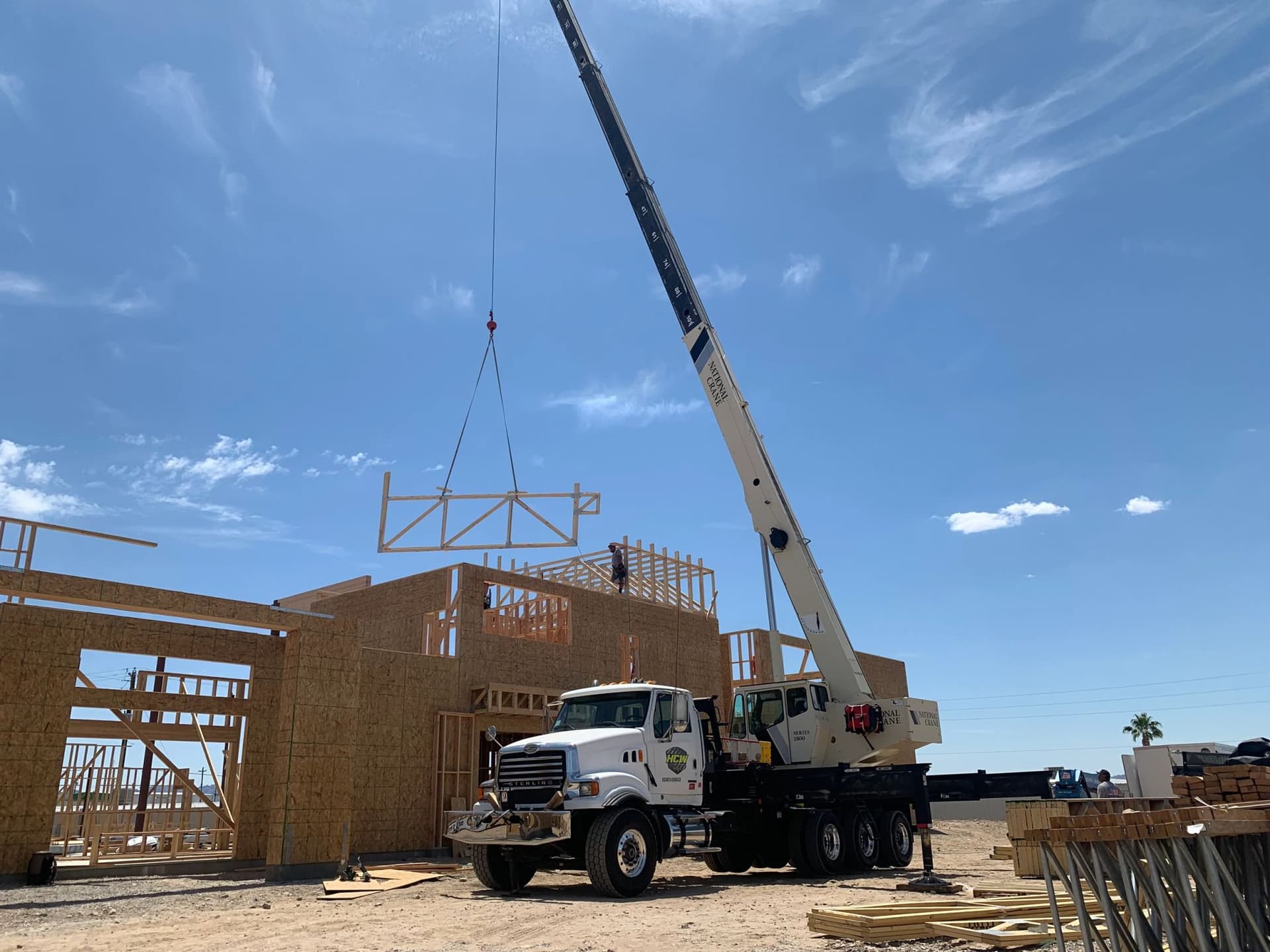
HCW Crane Service sets roof trusses, beams, columns, steel members, precast panels, and modular sections in Lake Havasu City. Structural work is sequence-driven. The crane hands members to a framing or steel crew in the order they can brace and connect them, and holds the load until the connection is made.
Structural Work Runs on Sequence, Not Weight
A roof truss does not weigh much. Neither does a steel purlin or a glulam header on a small house. Yet these are among the more demanding crane jobs, because the order the members go up in is fixed by the structure and by what the crew can brace.
You cannot set the fifth truss before the fourth. You cannot set a beam before its columns are plumb and anchored. You cannot pull a precast panel off the truck out of order without moving three others first. So the crane works the sequence the structure dictates, and the whole day is planned backward from that.
That is why the first conversation on structural work is with the crew lead, not just about the load. What is the order, how many hands are on the wall, what gets braced as it goes, and where does the day have to stop safely.
It also means a structural day is booked differently. An HVAC set is a fixed window. A framing day is a block of time whose length depends on your crew, the span, and how the material is stacked. We plan for the day rather than for a slot, and we would rather know the realistic version up front.
Long, Flexible Members Behave Badly
A wood truss is strong in its own plane and floppy across it. Pick one from a single point in the middle and it will bow, twist, and in the worst case break at a plate. Long steel, tall precast panels, and glulam beams have their own versions of the same problem.
The fix is spread pick points and, on longer spans, a spreader bar so the sling legs stay vertical. Pick points go at panel points on a truss, near bearing points on a beam, and at the manufacturer's designated inserts on precast. Not wherever the sling happens to sit.
The same length that makes a member flexible also makes it a lever in the wind. A thirty-foot truss picks up a lot of air, and even a light gust will rotate it. Two tag lines rather than one is standard on anything long.
Damage in transit is worth a look before anything gets picked. Members shift on a truck, bands cut into edges, and a truss that took a hit somewhere between the plant and your lot is not something to discover halfway up a wall. A walk of the pile before the first pick costs a few minutes.
Hold Time and the Connection
On most structural picks the crane does not simply set the load and walk away. It holds the member in position while the crew makes a connection, plumbs a column, drives a drift pin, or lands a hanger. That hold time is real time, and it is when the crew and the operator have to be working together closely.
We keep tension on the load until the crew says it is secure and braced, and not a second earlier. Coming off too soon is how a truss goes over on a windy morning, and how a column ends up a quarter inch out of plumb with the bolts already snugged down on it.
Because that is the pattern, we plan for the crane to be on site longer per member than an HVAC set takes. A framing day is a rhythm, not a single event, and we plan the day in time rather than in picks.
The practical consequence is that a well-organized crew gets far more out of a crane day than a short-handed one. Bracing material staged, layout marked, hardware on the wall, and enough hands to receive. Those four things decide how much structure goes up before the heat or the wind ends the day.
Ground Conditions on a New-Construction Lot
A new build is the worst ground we work on anywhere in this town. Footing trenches still open, utility runs backfilled and never compacted, spoils piled exactly where nobody expected a crane to sit, and a pad edge that was built up out of whatever came out of the excavation last week.
So the setup walk is more careful here than anywhere else. We want to know where the trenches ran, where the septic or sewer lateral goes, and how recently the pad edge was built up. Mats go under every pad, and we look again after the first loaded swing over each side.
Access adds to it. Many Havasu lots are on a slope, and the flat area near the house is usually the pad itself. Sometimes the right answer is to stay on the street with more boom rather than drive onto ground that has not settled.
Delivery ruts are worth mentioning too. A loaded material truck crossing soft ground leaves compacted tracks in some spots and churned ground in others, and the churned ground is exactly where an outrigger will find trouble. We look at where the trucks drove before we decide where the crane parks.
Delivery, Laydown, and Where the Bundle Landed
Trusses and structural members arrive on a truck, and where that truck unloads decides half of the crane day. A bundle dropped in the wrong corner of the lot means either a second crane position or dragging material across a site.
The best outcome is the delivery landing inside the same working radius as the structure, so the crane picks straight from the pile to the wall. Where we can, we ask to be on site for the delivery or to have the driver told exactly where to stage.
Banding is the other thing to plan. Bundles are banded for transport, and bands get cut in a controlled way at the pile, not while a bundle is hanging. A band cut under tension with a load in the air is how people get hurt.
Where the pile sits also affects the crew, not just the crane. Material stacked on the far side of the lot means every member gets carried or dragged before it can be picked, and that is time nobody planned for. It is worth twenty minutes of thought before the delivery truck arrives rather than a morning of walking afterward.
Wind, Bracing, and Knowing When to Stop
A partly framed roof with a few trusses up and minimal bracing is a fragile thing. Wind gets into it, and if one goes over it can take the run with it. That is the specific risk on truss days here in monsoon season and on windy spring afternoons.
So the crew braces as they go, and we plan the day to reach a stable stopping point rather than a convenient one. If the wind builds, the right move is to finish bracing what is up and stop setting, not to hurry the last few members.
Early starts help with all of it. Mornings here are usually the calm part of the day, which is why framing crews and crane operators both like being on the wall at first light. By early afternoon in spring the wind is often up, and in summer the heat has already taken the edge off everybody.
The judgement call belongs to the operator and the crew lead together. He knows what his people can brace and how fast, and we know what the load is doing on the line. When either one of us says stop, we stop, and the rest of the run waits for a better morning.
How the job runs
Our Process
Step 1: Talk to the Crew Lead
Member list, weights, span, the set sequence, and how many hands will be receiving. We are building the day around the crew's rhythm, so this conversation happens before anything else.
Step 2: Plan Delivery and Laydown
Where the material truck unloads decides the crane position. We aim to get the pile and the structure inside one working radius so we are not repositioning midday.
Step 3: Set Up on Broken Ground
Trenches, backfill, spoils, and slope all get checked. Mats under every pad, machine leveled, and a second look after the first loaded swing over each side.
Step 4: Rig for the Member
Spread pick points at panel points or bearings, spreader bar on long spans, and two tag lines on anything with span or sail area. Bands cut at the pile, never in the air.
Step 5: Set and Hold
The member goes to position and stays under tension while the crew connects, plumbs, and braces. We come off the load when they say it is secure, not before.
Step 6: Reach a Stable Stop
The day ends at a point where what is standing is braced and safe overnight. If wind builds, we stop setting and let the crew catch up on bracing.
Scope
What Is Included
- Crane and operator working to your crew's sequence
- Spreader bars and multi-point rigging for long members
- Two tag lines on trusses, panels, and long steel
- Hold time while connections are made and members are braced
- Ground assessment and mats for new-construction lots
- Coordination on delivery staging and laydown position
- Controlled band cutting at the pile
- Early start scheduling to work in the calm part of the day
Real HCW jobs
From the Job Site
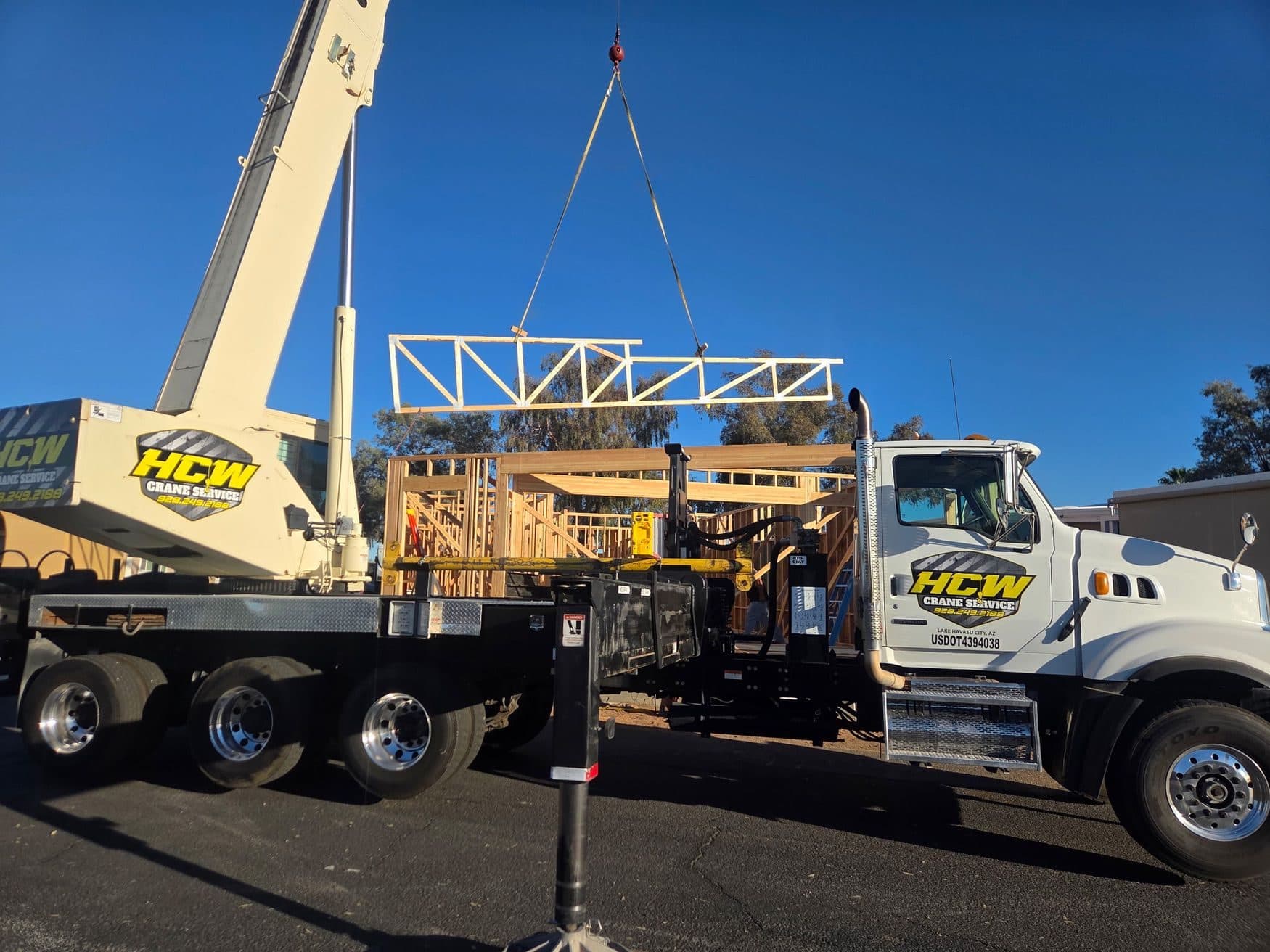
Roof truss lifted over new framing 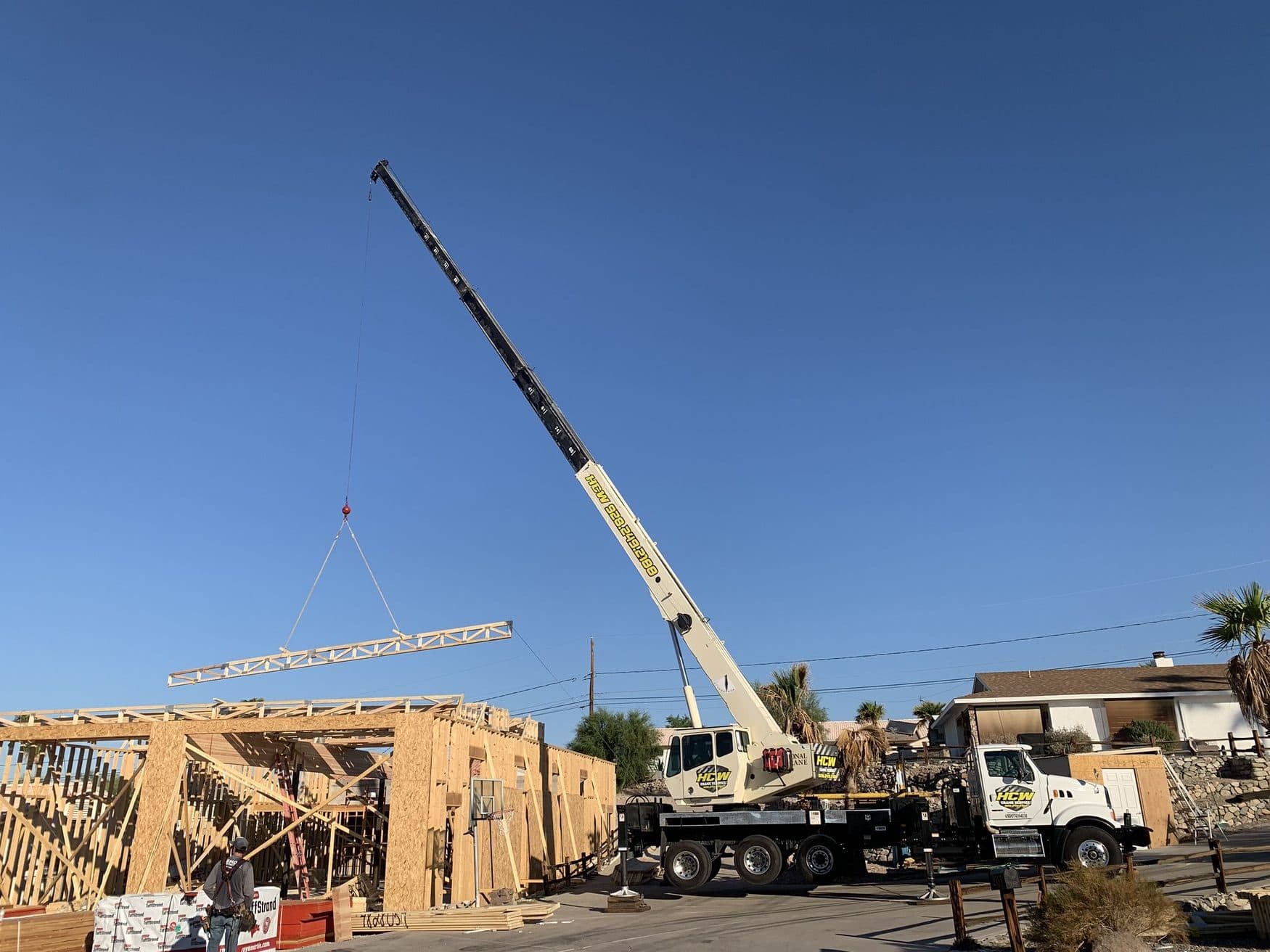
Roof truss lifted over new walls 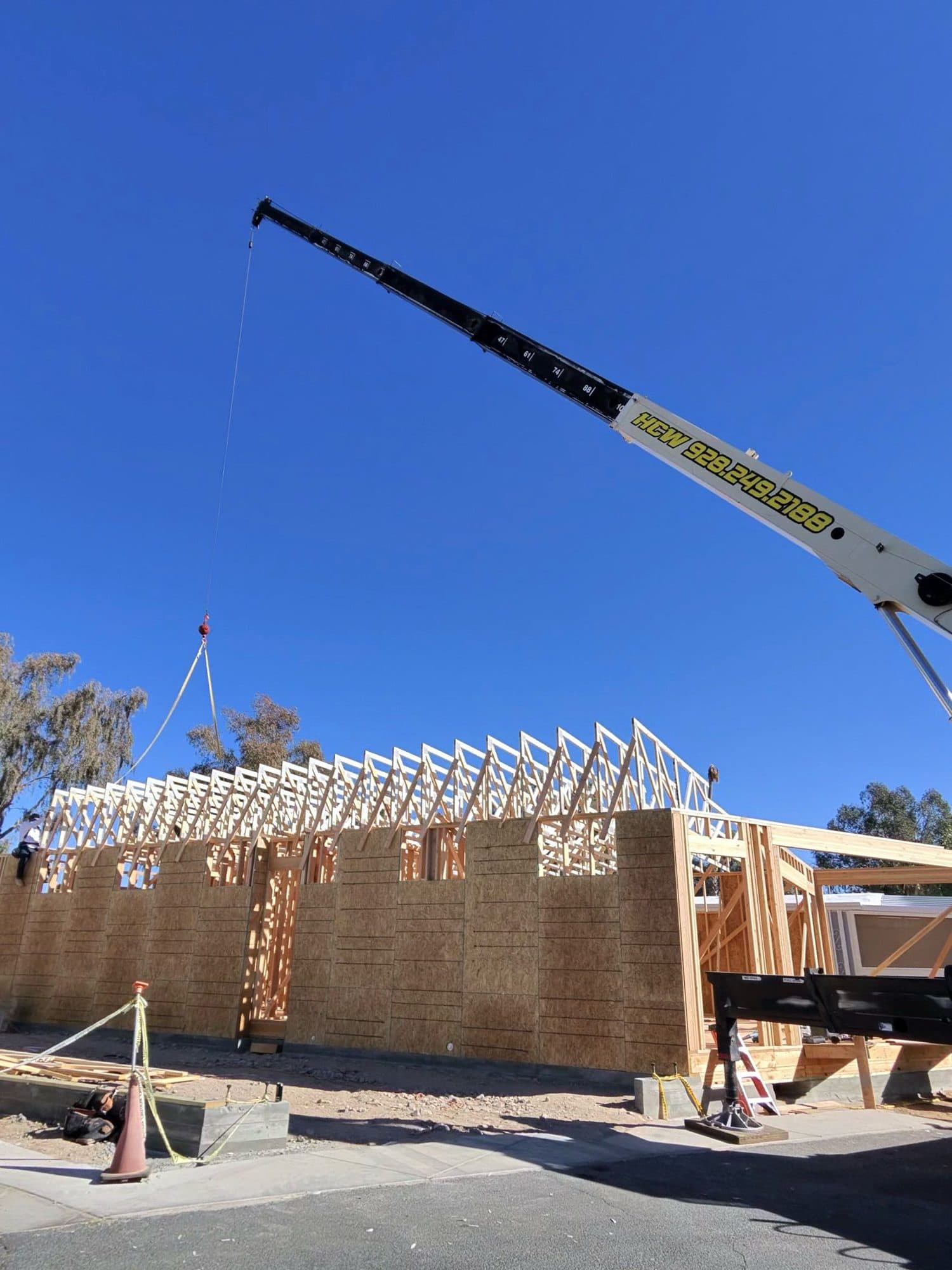
HCW boom over freshly set trusses 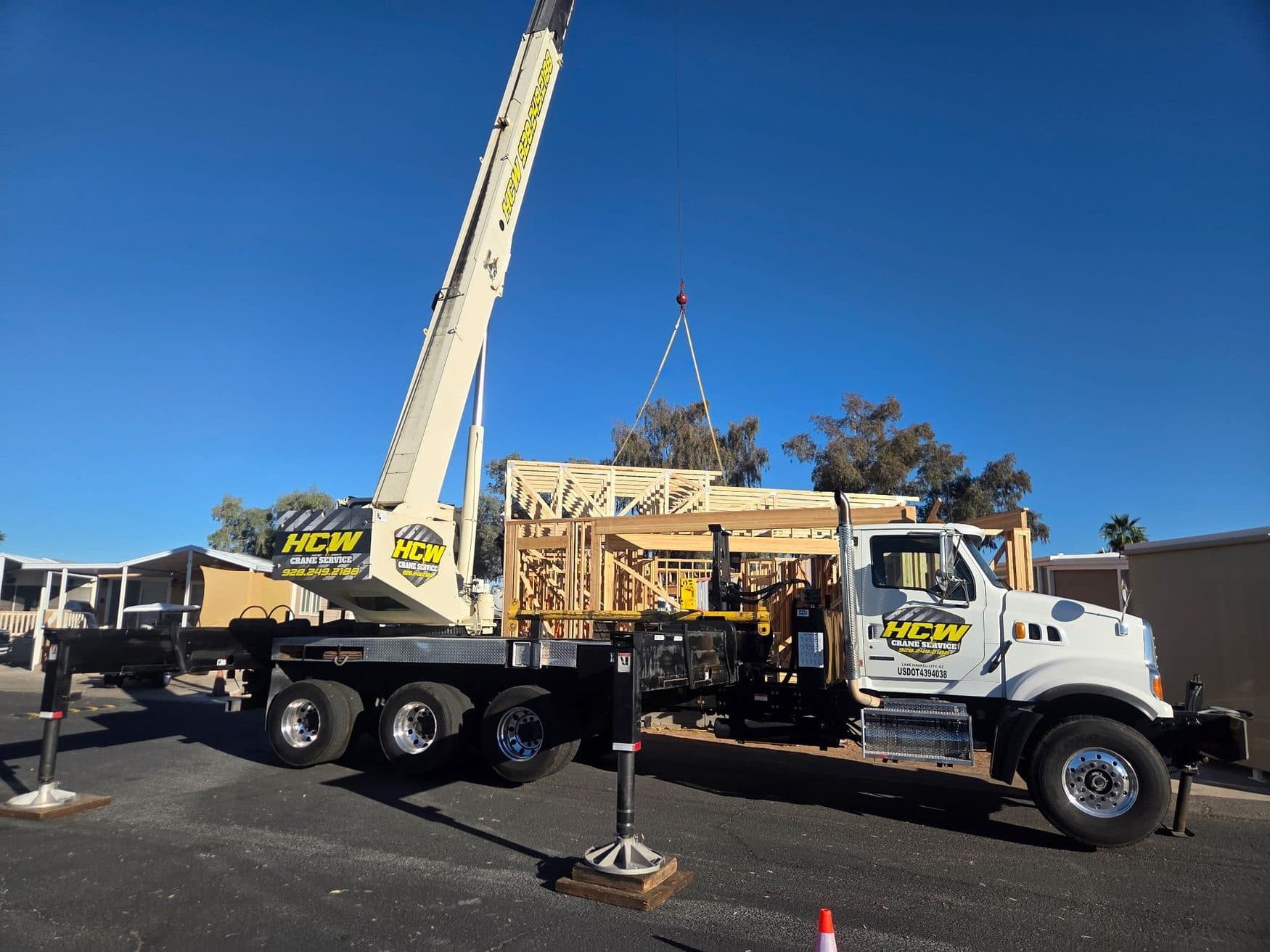
Full rig set up for a truss lift
Answers
Frequently Asked Questions
How many trusses can you set in a day?
That is set by the framing crew, not the crane. A crew with enough hands to brace as they go moves quickly. A short-handed crew is the bottleneck. Tell us the crew size and the span and we can estimate the day with you.
Do you supply the framing crew?
No. We supply the crane, the operator, and the rigging. The framing, steel, or setting crew is yours. We coordinate closely with them, and most of this work comes to us through contractors.
Can you set trusses if the delivery has not arrived?
There is nothing to pick. Coordinate the delivery to land before or at the same time as the crane, and make sure the driver knows where to stage the bundles.
What happens if the wind picks up mid-day?
We stop setting and the crew catches up on bracing. A partly braced roof is the vulnerable state, so the goal is always to reach a stable stopping point rather than push through gusts.
Will the crane hold a beam while we bolt it?
Yes. Hold time is normal on structural work. We stay under tension until you confirm the connection is made and the member is braced or plumbed.
Can you get onto a rough graded lot?
Often, but it depends on the ground. Fresh backfill, open trenches, and unsettled pad edges are the concerns. Sometimes the better answer is to stay on the street and use more boom.
All Truss and Structural Placement Services
- Roof Truss LiftingTrusses arrive banded and go up floppy. Spread pick points, two tag lines, and a crew that braces as it goes. Crane and operator supplied.
- Beam and Column PlacementGlulam and steel beams onto post seats, columns plumbed on anchor bolts. The crane holds the member while your crew makes the connection.
- Steel Member PositioningPurlins, joists, tube steel, and framing members positioned for bolted connections. Drift pins, tight tolerances, and steel that gets hot to touch.
- Precast Panel PlacementPrecast panels are heavy, flat, and all sail. Rated inserts, panels kept vertical, and bracing to the slab before the crane ever comes off.
- Modular Section PlacementFactory-built sections set onto foundations and piers. One pick per section, alignment marks that have to match, and rigging that will not rack the box.
- Structural Component LiftsCanopies, stair sections, mezzanine framing, headers, awnings, and retrofit steel. The odd structural pieces that do not fit a standard category.
- Mobile Crane Service22-ton and 40-ton boom trucks with an operator on every call, reaching up to 142 feet.
- HVAC and Mechanical LiftsRooftop units, air handlers, condensers, and mechanical equipment set for HVAC contractors and homeowners.
- Spa and Residential Specialty LiftsSpas, hot tubs, and awkward residential loads flown over block walls into finished backyards.
Ready to schedule your lift?
Tell us the load, the site and the timing. We will confirm capacity, access and a window.