Emergency and Same Day Service
Urgent Crane Placement in Lake Havasu City
2 min readUpdated July 2026
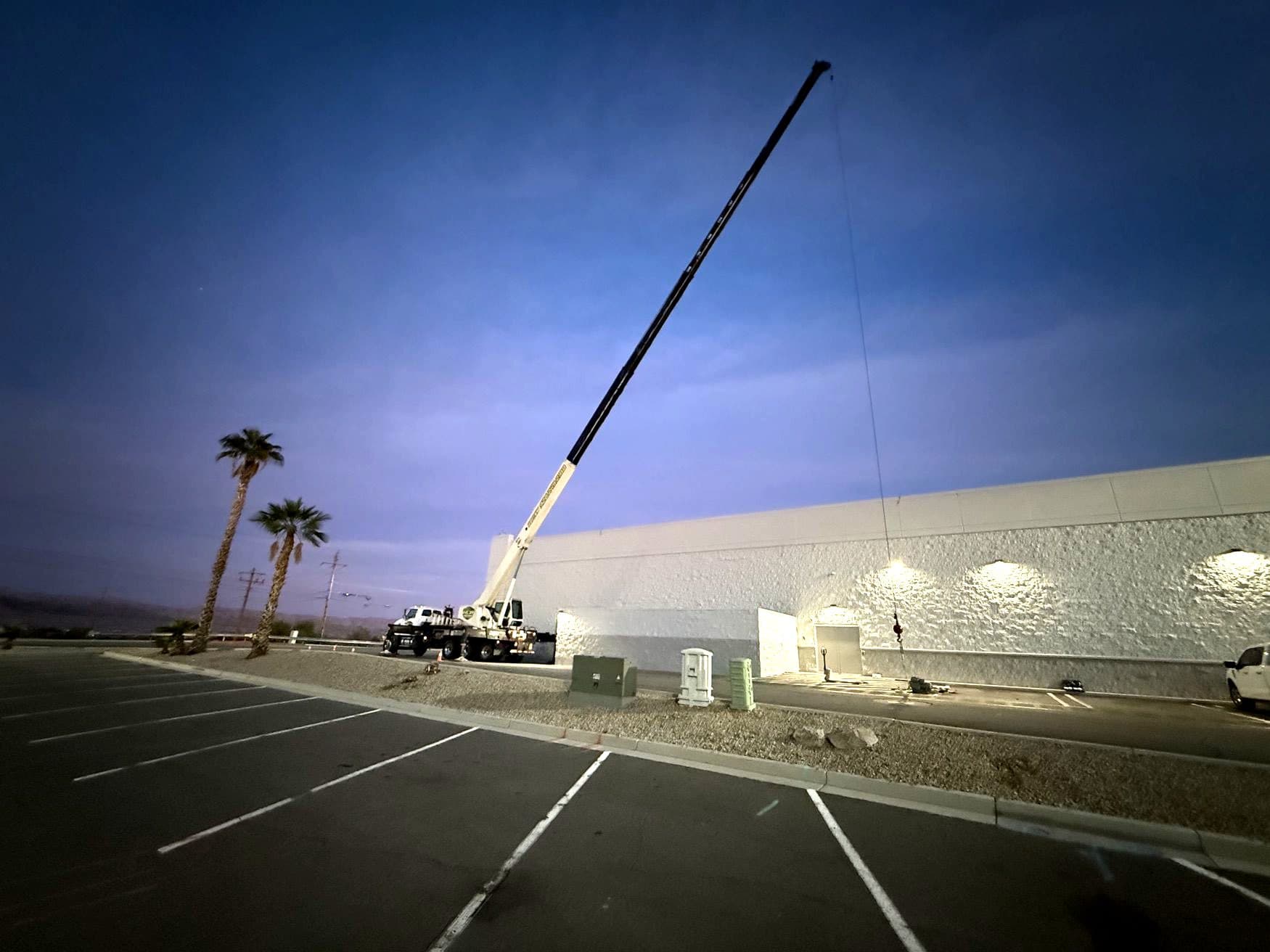
Urgent placement service moves a load that is already on site and holding something up: a flatbed with a driver waiting, a unit blocking a bay, a machine that has to be in place by morning. Sometimes the piece gets set now, and sometimes it gets staged clear until the landing point is ready.
The Load Is Here and Something Is Waiting
This is a different problem from an emergency. Nothing is broken. A piece is simply sitting where it cannot stay. A flatbed is parked with a driver on the clock. A rooftop unit is taking up half a loading area. A skid landed on the outside of a block wall and the pad for it is in the backyard. A machine has to be down and bolted before a crew starts in the morning.
The clock on these jobs belongs to somebody else, usually a driver, a crew, or a bay that has to be open when the doors open. Say that on the call. Knowing what is actually waiting changes which answer is the right one, because the goal is not always to finish the placement today.
When Staging Beats Placing
Sometimes the right answer is not to place it now. If the slab has not cured, the curb is not poured, or the anchor bolts are not set, dropping the piece into that landing point buys an hour and costs a day. It has to come back off, which means a second pick, second rigging and a second setup on the same ground.
The better move is often to get the load off the critical spot and onto a staged position. Unload the flatbed and send the driver, clear the bay, set the piece on blocking somewhere flat and out of the way, then come back and set it properly once the landing point is genuinely ready. Nobody loses a morning waiting on concrete.
Picking a Staging Spot That Works Twice
A staged spot has rules of its own. It has to be firm enough that the load does not settle into caliche crust overnight, level enough that the piece is not resting on one corner of its frame, and clear of the swing path for the real set later. Blocking goes underneath so slings can get back around it without anybody digging.
It also has to be somewhere a crane can reach a second time. There is no sense staging a unit in the one place the concrete crew needs tomorrow, or where the only setup position for the final pick would be standing on top of it. Choosing that spot takes a minute of looking and saves a return trip.
How the job runs
Our Process
Step 1: Find Out What Is Waiting
The call starts with what is being held up and by when. A driver on the clock, a blocked bay, a crew arriving at six. That sets the real deadline, which is often different from the deadline on the placement itself, and it decides whether staging or setting is the right call.
Step 2: Check the Landing Point
The intended spot gets looked at before the load moves. Is the concrete cured, are the anchors placed, is the curb there, is the bay empty. If any of that is missing, the piece gets staged instead. That decision gets made before the rigging goes on, not with the load in the air.
Step 3: Free Up the Blocked Spot
The load comes off whatever it is holding up first. Flatbed gets unloaded, the bay gets cleared, the drive lane opens. Blocking goes down at the staged spot so the piece sits on wood and not on dirt, and so slings can get back under it later.
Step 4: Set It Properly Later
When the landing point is actually ready, the piece gets picked from the staged spot and set for real. It goes down level, on its intended points, aligned to the bolt pattern or curb, and gets checked before the slings come off rather than after.
Scope
What Is Included
- Flatbeds and trailers unloaded so drivers can leave
- Loads moved off blocked bays and drive lanes
- Pieces set over block walls into tight side yards
- Staged placement on blocking until the pad is ready
- Final set aligned to anchor bolts or curb
- Operator and crane together on the same call-out
Answers
Frequently Asked Questions
The delivery driver is waiting right now. What is fastest?
Almost always unloading to a staged spot rather than trying to make the final placement immediately. Getting a trailer empty takes one pick. Threading the same piece into its exact final position can take setup moves, alignment and a wait on somebody else. Free the truck first, then do the placement properly.
Why not just set it on the pad and slide it over later?
Because sliding a heavy piece into position usually damages either the piece or the pad, and the frames on most equipment are not built to be dragged. If it goes down in the wrong place it has to be picked again. One correct set costs less time than a set, a re-rig and a second set.
Can you get a unit over a block wall into a back yard?
Often, and that is a routine picture around here. It comes down to where the truck can stand, how far the load has to travel out from the boom, and what is overhead between the two. Distance out from the crane cuts capacity fast, so the weight and the reach get worked out before anybody commits.
How long can something sit staged?
As long as the staged spot is sound and nobody needs it. Blocking underneath keeps the frame out of the dirt and keeps the slings accessible. What matters is that it is not sitting somewhere it will be in the way, and that it is not resting on a corner or an unsupported section of its own frame.
Related Services
- Machinery PlacementMobile crane machinery placement in Lake Havasu City, Arizona. Lathes, presses, and shop equipment rigged to frame lift points and set on the pad.
- Rapid Response LiftsRapid response crane lifts in Lake Havasu City. What happens between the phone call and the outriggers, and what actually slows an arrival down.
- Ground Condition EvaluationGround condition evaluation in Lake Havasu City. Outrigger bearing pressure, caliche crust, backfill, buried vaults and pads sized before the crane sets up.
- Rapid Response LiftsRapid response crane lifts in Lake Havasu City. What happens between the phone call and the outriggers, and what actually slows an arrival down.
- Same Day Crane ServiceSame day crane service in Lake Havasu City. An honest look at what fits inside one day, what needs a permit, and why you get a window.
- Emergency Crane SupportEmergency crane support in Lake Havasu City after wind damage, a failure or a dropped load. Stabilize first, then lift, with the owner on the controls.
Ready to schedule your lift?
Tell us the load, the site and the timing. We will confirm capacity, access and a window.