Service
Mobile Crane Service in Lake Havasu City
6 min readUpdated July 2026
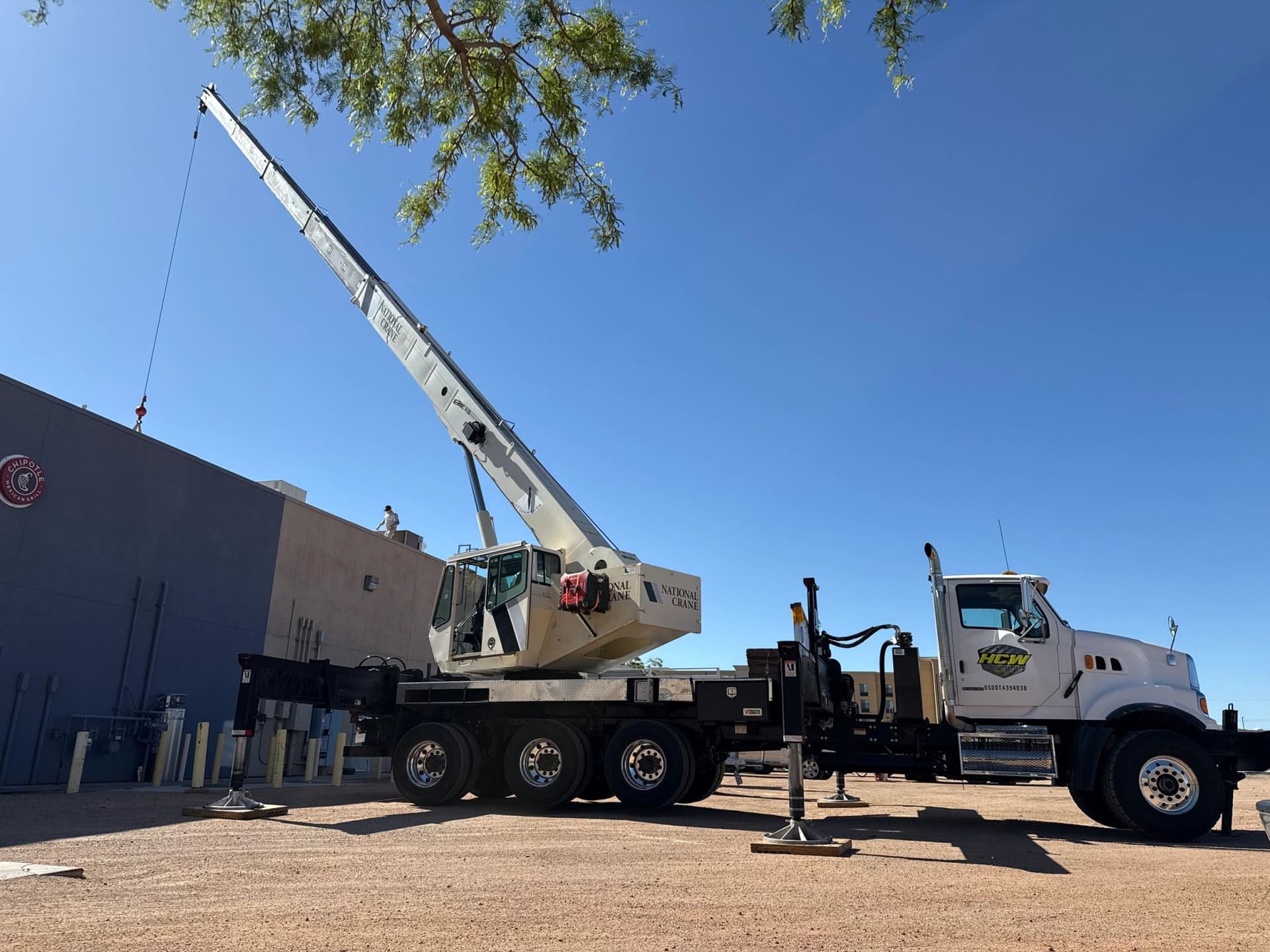
HCW Crane Service provides owner-operated mobile crane service in Lake Havasu City, Arizona. We run a 22-ton and a 40-ton mobile crane, both boom trucks, with a maximum reach of 142 feet. An operator comes with every crane. We are not a bare equipment rental. The phone is answered 24 hours.
Owner Devan Decastro is NCCCO certified: Telescopic Boom Crane, Swing Cab (TLL). CCO ID 444146986.Verify on NCCCO(opens verifycco.org in a new tab)
What an Owner-Operated Crane Call Looks Like
When you call, you talk to the operator who will run the crane. The details you give on the phone are the details that show up on site. Weight, where the load sits now, where it has to land, and what stands in between. Nothing gets lost in a handoff between an office, a dispatcher, and a driver who has never seen the address.
We are not a bare equipment yard. The crane does not leave without an operator on it. You do not need a qualified operator on your own payroll, and you are not signing for a machine that becomes your problem the moment it rolls off the trailer.
Most calls are short. One pick, an hour or two on site, and the truck is gone. Others run a half day of repeat picks alongside a framing or mechanical crew. We plan the day either way so nobody is standing around waiting on the crane, and the crane is not waiting on anybody.
The other thing worth knowing is that we know the roads. Distances to the outlying towns are quoted in real road miles, not straight lines across the water, and some routes do not work for a crane truck at all. The Oatman road over Sitgreaves Pass prohibits vehicles over 40 feet, for one. That gets figured in before anyone gives you an arrival time.
Two Cranes, and How We Choose One
We run a 22-ton boom truck and a 40-ton boom truck. Capacity is only half the answer. What actually picks the machine is radius, meaning how far out from the center of the crane the load has to travel, and how much room the site gives us to set up.
The 22-ton has the smaller footprint. It works on tight residential streets, needs less outrigger spread, and blocks less of the road. For a single-story change-out, a spa going over a standard block wall, or a short set of trusses, it is usually the right machine.
The 40-ton holds more weight far out from the truck and gets more height out of the boom, with reach up to 142 feet. When the load has to clear a two-story house, or land in the middle of a deep lot, or come off a street that sits well back from the building, the extra reach is the entire job.
Both machines are boom trucks, which means they drive to the job under their own power. There is no lowboy, no escort, and nothing to assemble in your driveway. That is what makes a single pick worth doing at all, and it is why a second job across town the same afternoon is routine rather than exceptional.
Reach, Radius, and Why We Ask for a Weight
A crane does not have one capacity. It has a load chart. Capacity drops off fast as the boom extends and the load moves away from the machine. A pick that is easy at twenty feet of radius can be flatly impossible at sixty feet with the same crane on the same day.
That is why the first two questions are always the weight of the load and the distance from where we can park to where it lands. A guessed weight is the single most common reason a job stops. Pull the number off the data plate, the spec sheet, or the shipping paperwork if you can get to it.
When a weight cannot be confirmed, we plan conservatively and bring the larger machine. That beats a wasted trip and a second day. If the number turns out to be well under what you told us, nothing is lost. If it turns out to be well over, everything is.
Height uses the same boom that reach does. A load that has to climb over a two-story roof before it can come down the other side is spending boom on elevation that is then not available for distance. So when you describe a job, tell us what the load has to get over as well as how far out it has to travel.
Ground, Outriggers, and Havasu Dirt
The crane only works if the outriggers sit on ground that will hold. We check that before anything comes off the deck. Lots around Lake Havasu are a mix of caliche, blow sand, and imported fill, and those three do not behave alike under a point load.
Caliche is hard and stable. Loose fill along the edge of a new pad is not. A buried irrigation line, a septic lid, or a utility trench backfilled last month will settle the moment the load swings over that side. On residential sets we put mats under every pad as a matter of course.
Hard surfaces need the same attention. Concrete cracks near an unsupported edge, pavers rock and sink, and stamped or colored surfaces chip where the pad bites. Mats spread the pressure out. If the only place to set the crane is a paver driveway, say so on the phone so we bring enough cribbing.
Asphalt has its own summer problem. A commercial lot that is firm in March will take a pad impression in July, and a hot patch over an old trench will sink further than the ground around it. On parking lots we look for the seams and the patched areas first, then set the outriggers away from them.
Heat, Wind, and Scheduling in the Desert
Summer here is long and it is hot. A crew working a roof at two in the afternoon in July gets sloppy, and sloppy is where people get hurt. On summer jobs we start early, often at first light, so the pick is finished before the roof surface turns untouchable and before the afternoon wind builds.
Monsoon season brings gusts that show up with very little warning. Wind is a load control problem, not a capacity problem. A flat panel, a spa shell, or a banded stack of trusses catches air like a sail and starts to swing. We watch the forecast, and we will set a load back down and wait if the gusts build.
The phone is answered around the clock. A rooftop unit that quit in August, a boat that has to move at night, an emergency lift with a crew already standing by. Call and we will tell you straight whether it is a tonight job or a first-light job, and why.
Blowing dust is the other desert factor people forget. A wind event picks up enough grit to turn a normal pick into one where the spotter genuinely cannot see the load. If visibility drops that far, the load comes down and we wait. There is no version of a lift that works without clear sightlines.
What We Need Before the Truck Rolls
Most delays come from missing information, not from missing equipment. A short list up front is the difference between a one-hour visit and a return trip on another day. None of it is complicated, and most of it you either already know or can find out in about ten minutes.
If you do not have all of it, call anyway. We can usually work a weight back from a model number and read access off a satellite view, then confirm the rest on a quick site visit before the day of the lift.
One more thing worth saying out loud. If the job changes between the phone call and the day, tell us. A heavier unit, a different landing spot, or a delivery that shifted are all easy to plan around in advance, and all awkward to solve with a crane already leveled in your driveway.
- Weight of the load, and where that number came from
- Overall dimensions, including anything that sticks out
- Where the load sits now and exactly where it has to land
- Overhead power lines, service drops, and tree canopy in the flight path
- Street width, gate width, and whether cars can be moved
- Roof access and who will be up there to receive the load
- Any timing constraint, such as a delivery truck window or a crew schedule
How the job runs
Our Process
Step 1: The Phone Call
We ask what the load is, what it weighs, where it sits, and where it lands. Then we ask about the path in between. Ten minutes on the phone settles the machine, the rigging, and roughly how long we will be on site.
Step 2: Site Check
On anything tight or unfamiliar we come look first. We stand where the crane will sit, look up for power lines and tree limbs, look down for soft ground and buried lids, and measure the radius from setup point to landing point.
Step 3: Setup and Outriggers
The truck is positioned, the outriggers come down onto mats, and the machine is leveled. Nothing gets picked until the crane is level and every pad is bearing. We walk the swing path once more and set the work area so nobody wanders into it.
Step 4: Rigging the Load
We choose slings and shackles for the weight, the shape, and the pick points. Soft slings where a finish can be marred, chain or wire where edges are sharp, a spreader bar when squeeze would damage the load. Tag lines go on before the load leaves the ground.
Step 5: The Pick
The load comes up a few inches first and stops. We check that it hangs level and that nothing has shifted, then boom and swing at a controlled speed. One person gives signals. The load stays under control the whole way, not just at the ends.
Step 6: Set, Release, and Teardown
The load lands where it belongs and stays in the rigging until whoever is receiving it confirms it is seated, bolted, or braced. Then we come off the load, pull the rigging, raise the outriggers, and walk the site with you before we leave.
Scope
What Is Included
- A crane and an operator on every call, never bare equipment
- Load chart planning against the actual weight and radius
- Slings, shackles, spreader bars, and tag lines suited to the load
- Outrigger mats and cribbing for soft ground and hard surfaces
- A site walk before setup, including overhead and underground checks
- One person giving signals and a defined work area under the swing
- Coordination with your crew, your trade, or your delivery driver
- A final walkthrough with you before the truck leaves
Real HCW jobs
From the Job Site
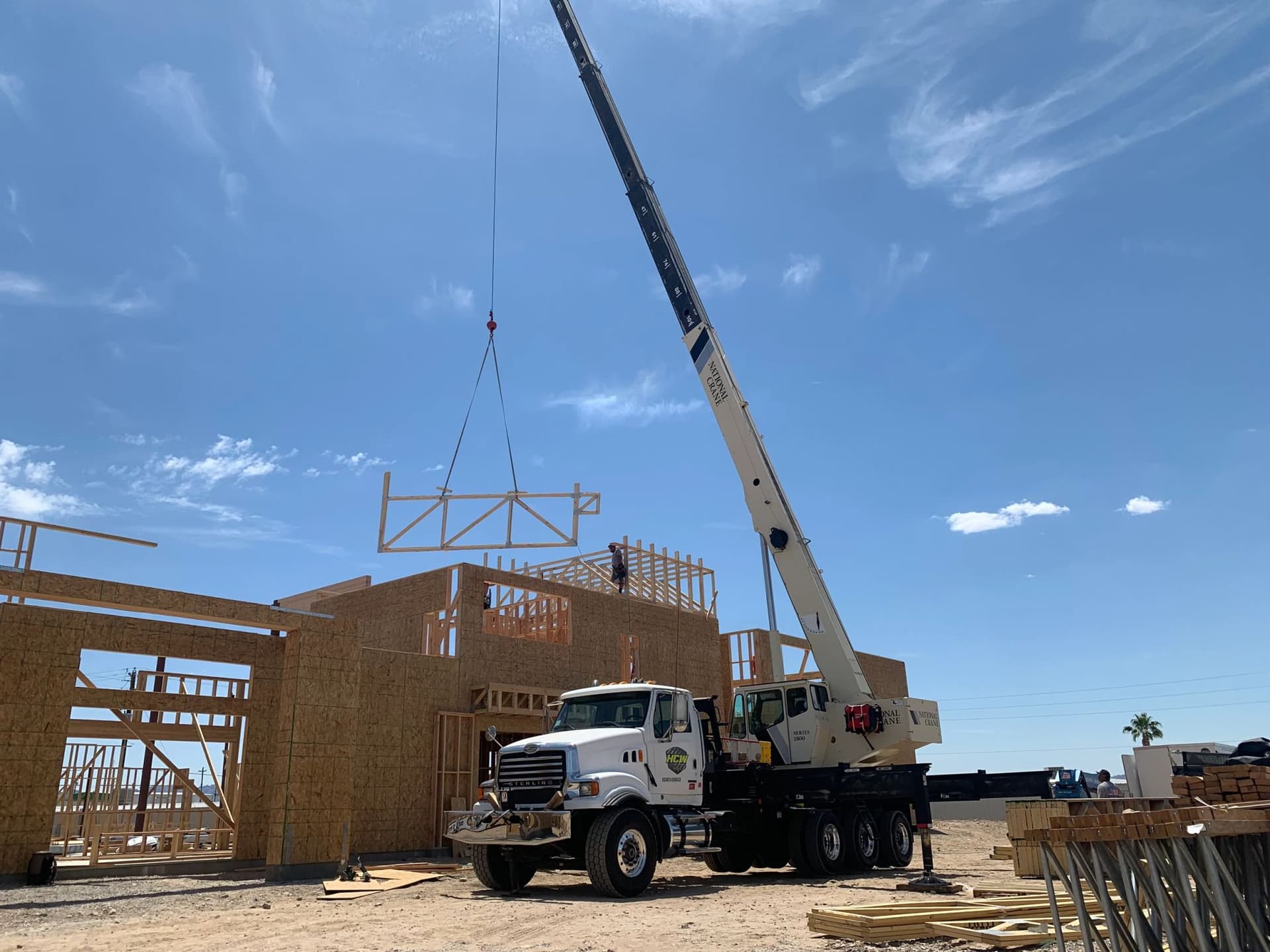
Roof truss set on a two-story frame 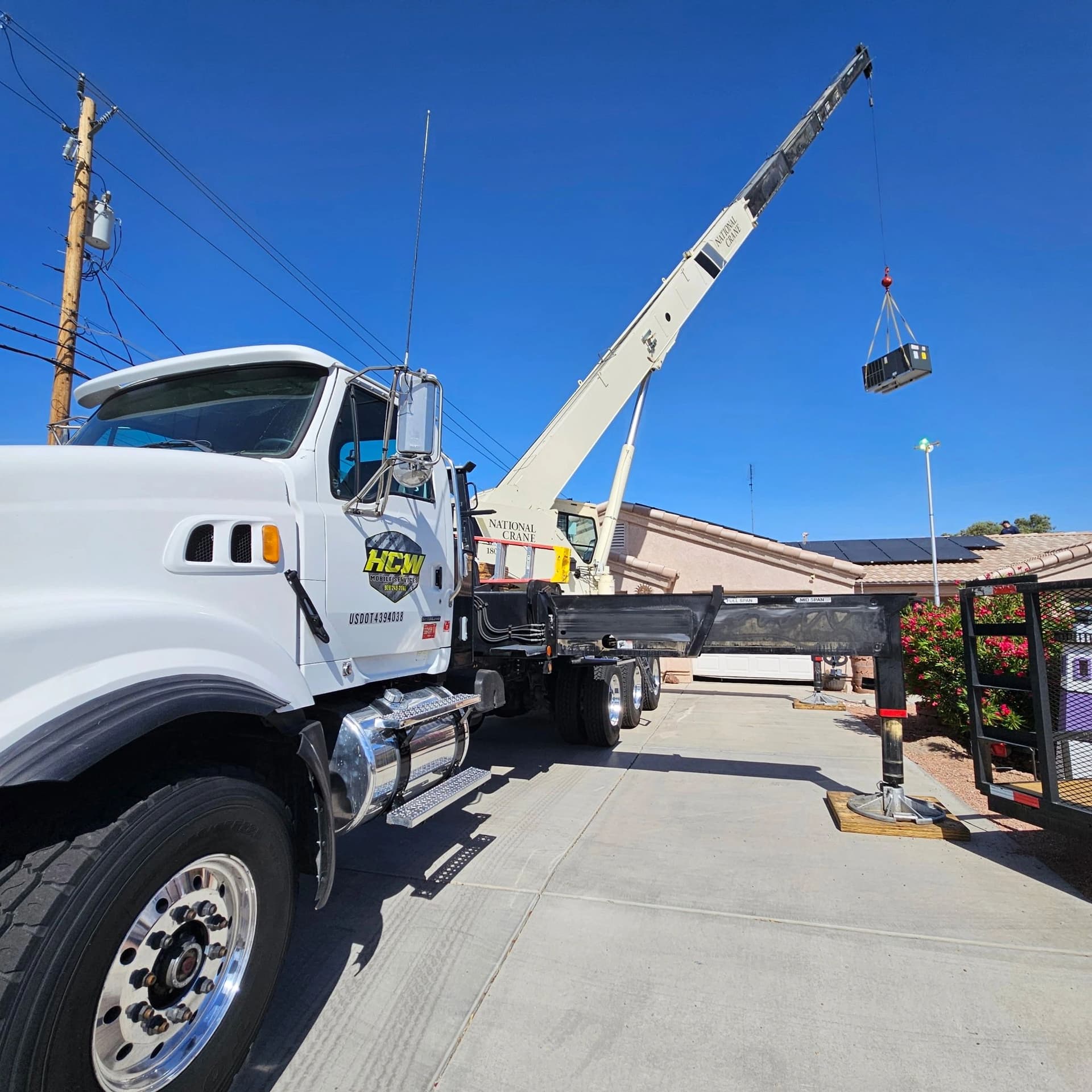
Rooftop unit lifted over a driveway 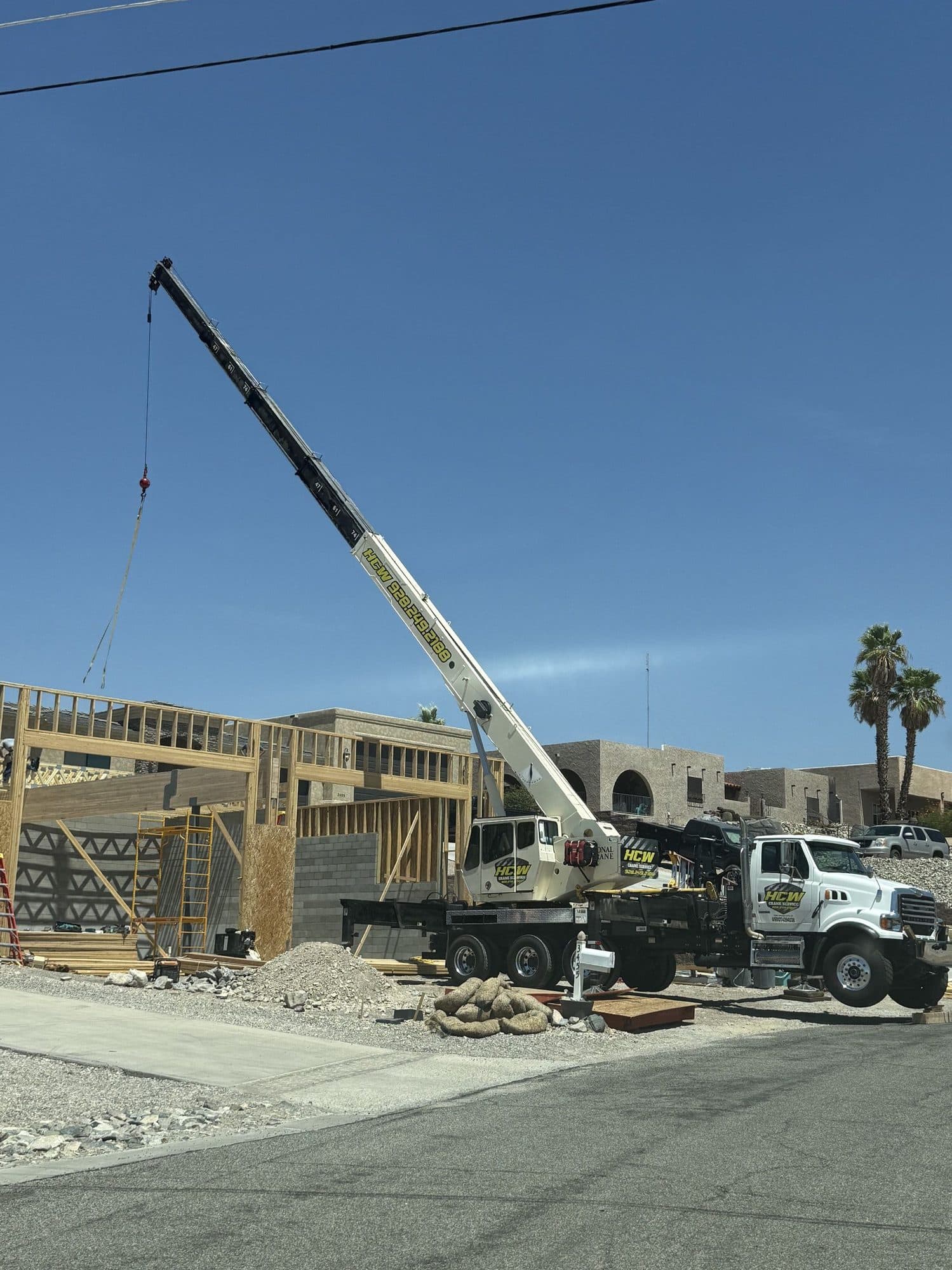
Boom truck working a framing site 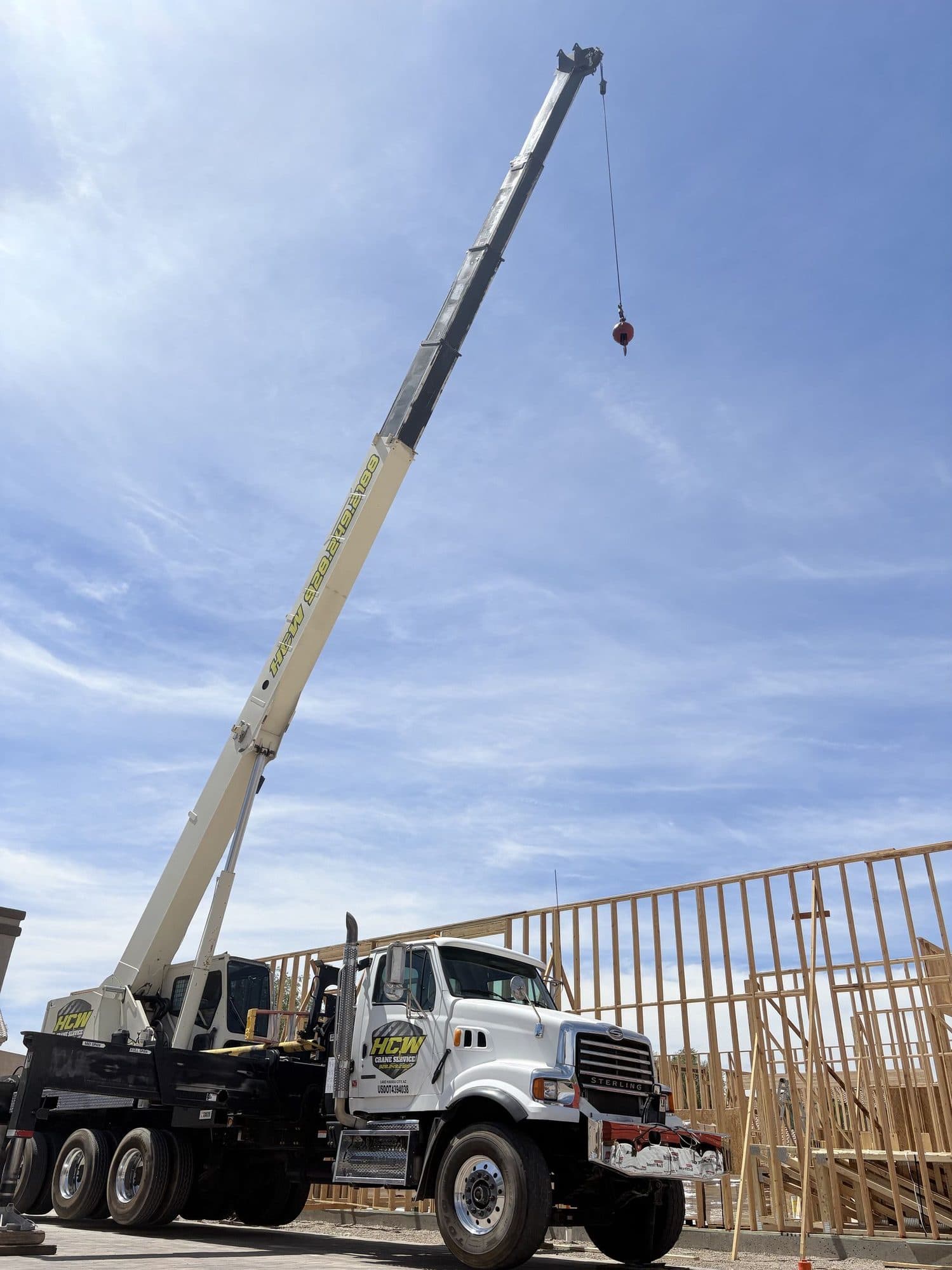
Boom raised beside new framing
Answers
Frequently Asked Questions
Can I rent the crane without an operator?
No. Every crane goes out with an operator. That is how we work. It also means you are not taking on the responsibility of running a machine you do not use every day, and you do not need to supply rigging.
How far can your crane reach?
Maximum reach is 142 feet with the 40-ton machine. Reach and capacity are linked, though. The further the boom goes out, the less it can hold. Give us the weight and the distance and we will tell you what is possible.
Do you work at night or on weekends?
Yes. The phone is answered 24 hours. Night and weekend work is common for emergency mechanical failures, jobs on busy commercial lots, and lifts that have to happen while a building is closed.
What if I do not know what the load weighs?
Tell us the make and model, or send a photo of the data plate. We can usually find a published weight. If nothing turns up, we plan on the heavy side and bring the larger crane rather than risk a trip that ends with the load still on the ground.
Will the crane damage my driveway or yard?
Outriggers put a lot of pressure on a small area, so we use mats to spread it out. Tell us up front if the setup area is pavers, stamped concrete, or a slab edge, and we will bring more cribbing and plan the position around it.
How much space do you need to set up?
It depends on the machine and the pick. The 22-ton works in noticeably tighter spots than the 40-ton. On a narrow street we may need a couple of cars moved and one lane clear. We will tell you exactly what we need before the day.
What areas do you cover?
Lake Havasu City and the surrounding Arizona communities. We are based on London Bridge Rd, so most local calls are a short run. Call with the address and we will confirm.
All Mobile Crane Service Services
- Owner-Operated Crane ServiceThe owner takes the call, walks the site, and runs the crane. One person accountable for the lift from the first phone call to the final walkthrough.
- Crane With OperatorEvery crane goes out with an operator and the rigging to do the job. Here is exactly who does what on site, and what your crew is responsible for.
- 22-Ton Crane ServiceOur 22-ton boom truck is the tight-street machine. Smaller setup footprint, quicker to place, and the right call for most single-story residential lifts.
- 40-Ton Crane ServiceOur 40-ton boom truck reaches up to 142 feet and holds weight far out from the truck. The machine for two-story picks and deep commercial roofs.
- Hydraulic Crane ServiceBoth of our boom trucks are hydraulic. Smooth metered control, fast setup, and no assembly. Here is what that means for your lift and for desert heat.
- Telescopic Crane ServiceTelescopic boom trucks extend the boom in sections, so capacity changes with every foot you pull out. Here is how we plan a pick around that.
- Boom Crane ServiceBoth HCW cranes are boom trucks. They drive to your site, set up on outriggers, make the pick, and leave. No trailers, no assembly, no crew required.
- Heavy Lift Crane ServiceHeavy picks leave no room for a guessed weight. We verify the load, check the chart at the real radius, and keep the lift slow and deliberate.
- Precision Crane PlacementSome loads have to land within an inch. Anchor bolts, curb openings, post seats, and finished stone. Here is how we set a load that has to be exact.
- Controlled Load PlacementA load that swings is a load nobody controls. Tag lines, smooth boom movement, and a hard stop when the monsoon wind starts to build.
- HVAC and Mechanical LiftsRooftop units, air handlers, condensers, and mechanical equipment set for HVAC contractors and homeowners.
- Truss and Structural PlacementRoof trusses, beams, columns, steel, precast, and modular sections set to your framing crew's pace.
- Spa and Residential Specialty LiftsSpas, hot tubs, and awkward residential loads flown over block walls into finished backyards.
Ready to schedule your lift?
Tell us the load, the site and the timing. We will confirm capacity, access and a window.