HVAC and Mechanical Lifts
Mechanical Equipment Lifts in Lake Havasu City
2 min readUpdated July 2026
Mechanical equipment lifts cover pumps, generators, boilers, water heaters, compressors, transformers, and skid-mounted assemblies. These loads usually have the mass concentrated on one side and rated lifting lugs provided by the manufacturer. Rigging to those points and getting a true hang is most of the work.
The Weight Is Never in the Middle
A generator has the alternator on one end and the engine on the other. A pump skid has the motor on one side. A packaged boiler has a heat exchanger that outweighs everything around it. Rig any of those with evenly spaced slings and the load tips the moment it clears the ground.
The manufacturer usually solves this for you with lifting lugs positioned around the actual center of gravity. Those are the points to use, and where a lift drawing exists it is worth having on site. It answers the hang question before anyone guesses at it.
Where no lugs exist, we rig to the skid or base frame and adjust sling lengths until the load hangs true at a test lift. That takes a few minutes on the ground and saves a lot of trouble in the air.
Tanks and vessels are their own case. A tank that is empty behaves nothing like one with residual product in it, and liquid that moves during the lift shifts the balance while the load is in the air. If a vessel is not confirmed empty, we plan it as though it is not.
Where It Lands and What It Lands On
Mechanical equipment tends to go into confined finished spaces. A generator pad behind a block wall. A pump in an equipment yard between a fence and a building. A water heater into a mechanical room across a patio.
That means a precise set in a tight footprint, often onto anchor bolts or an isolation pad with a specific orientation for conduit, piping, or exhaust. Orientation is worth confirming twice, because turning a heavy skid on a finished pad afterward is not simple.
Vibration isolators, spring mounts, and rails have to be in position before the equipment lands on them. If they are not there yet, we set the equipment on cribbing nearby rather than hold it in the air while somebody goes looking.
Access under the equipment is worth thinking about before it lands. Once a heavy skid is on its pad, getting rigging back underneath it means jacking or cribbing. If the same unit may need to come back out one day, leaving a way to rig it is worth five minutes now.
How the job runs
Our Process
Step 1: Get the Lift Data
Weight, lifting lug locations, center of gravity, and any manufacturer lift drawing. On generators and skids this information usually exists, so it is worth asking the supplier.
Step 2: Rig and Test the Hang
Slings to rated lugs or the base frame, lengths adjusted, then a test lift a few inches up to confirm the load hangs level before it travels.
Step 3: Clear the Landing Point
Isolators, rails, anchor bolts, and pads in place and swept. Orientation confirmed against the conduit, piping, or exhaust side.
Step 4: Set and Confirm
Slow controlled descent with tag lines, seated onto the pad or bolts, and held in the rigging until the installing crew confirms placement.
Scope
What Is Included
- Crane and operator for pumps, generators, skids, and tanks
- Rigging to rated lifting lugs or base frame
- Sling length adjustment for off-center weight
- Test lift and hang check before any travel
- Tag line control for tight equipment yards
- Load held in rigging until the installer confirms the set
Real HCW jobs
From the Job Site
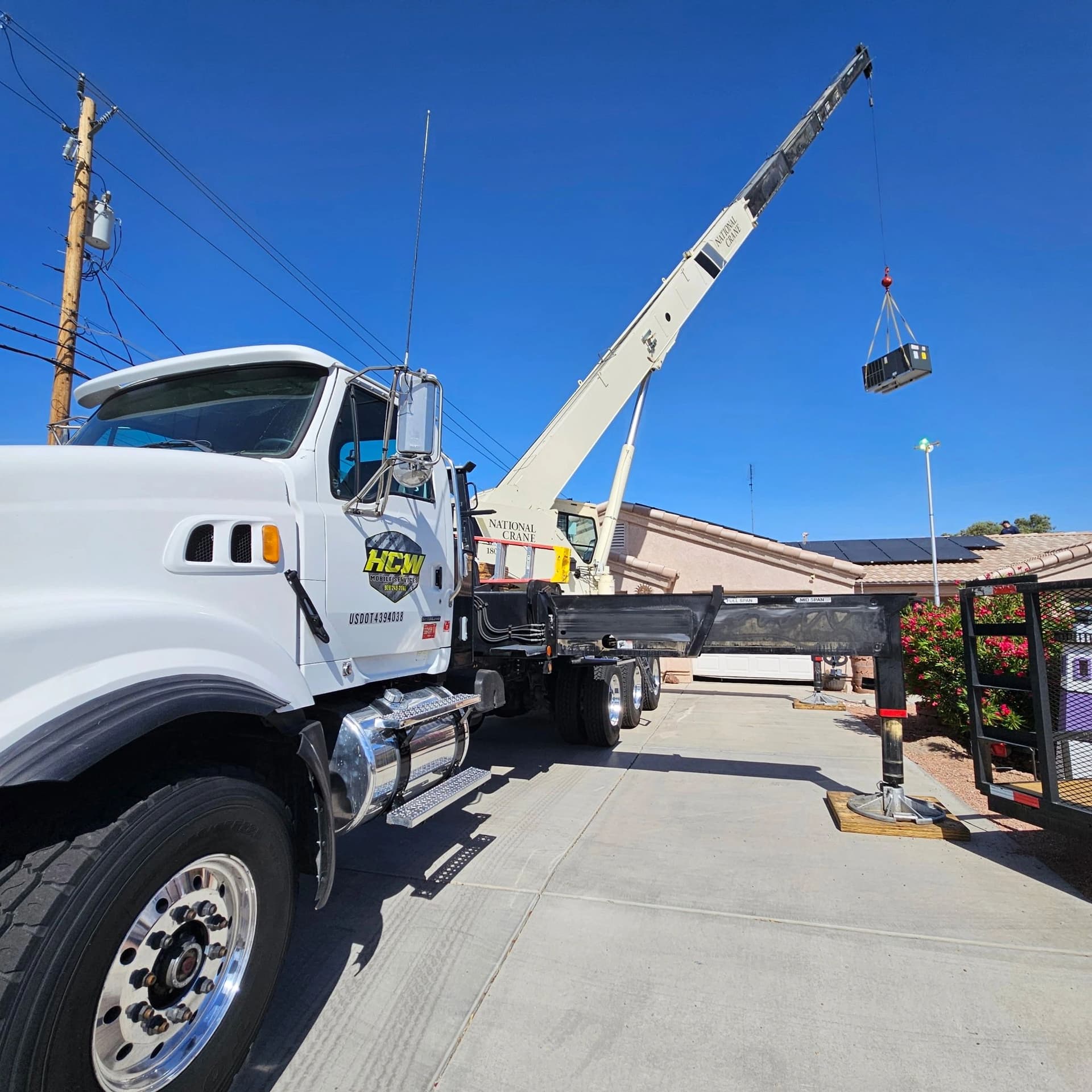
Rooftop unit lifted over a driveway 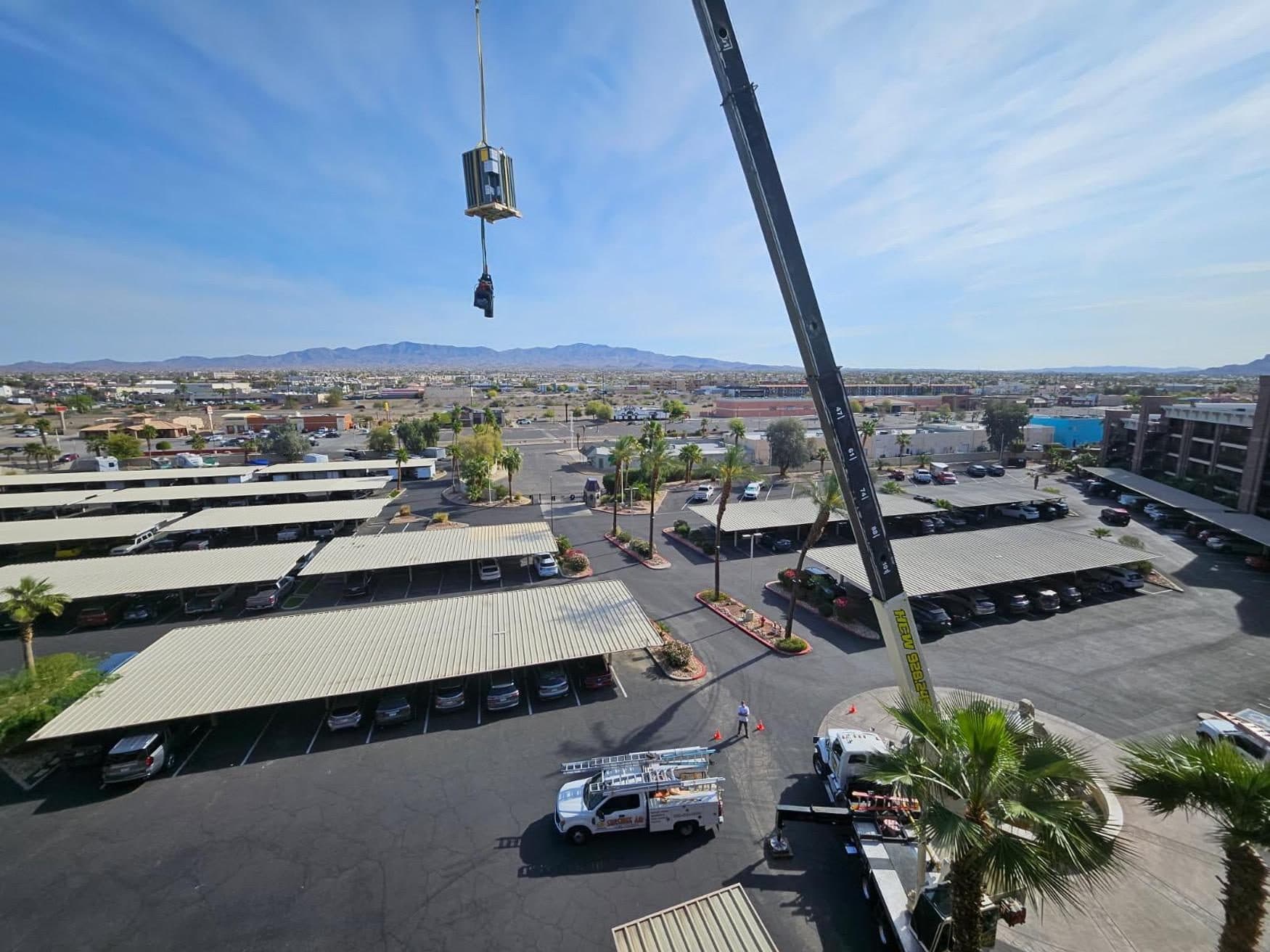
Rooftop HVAC unit in the air 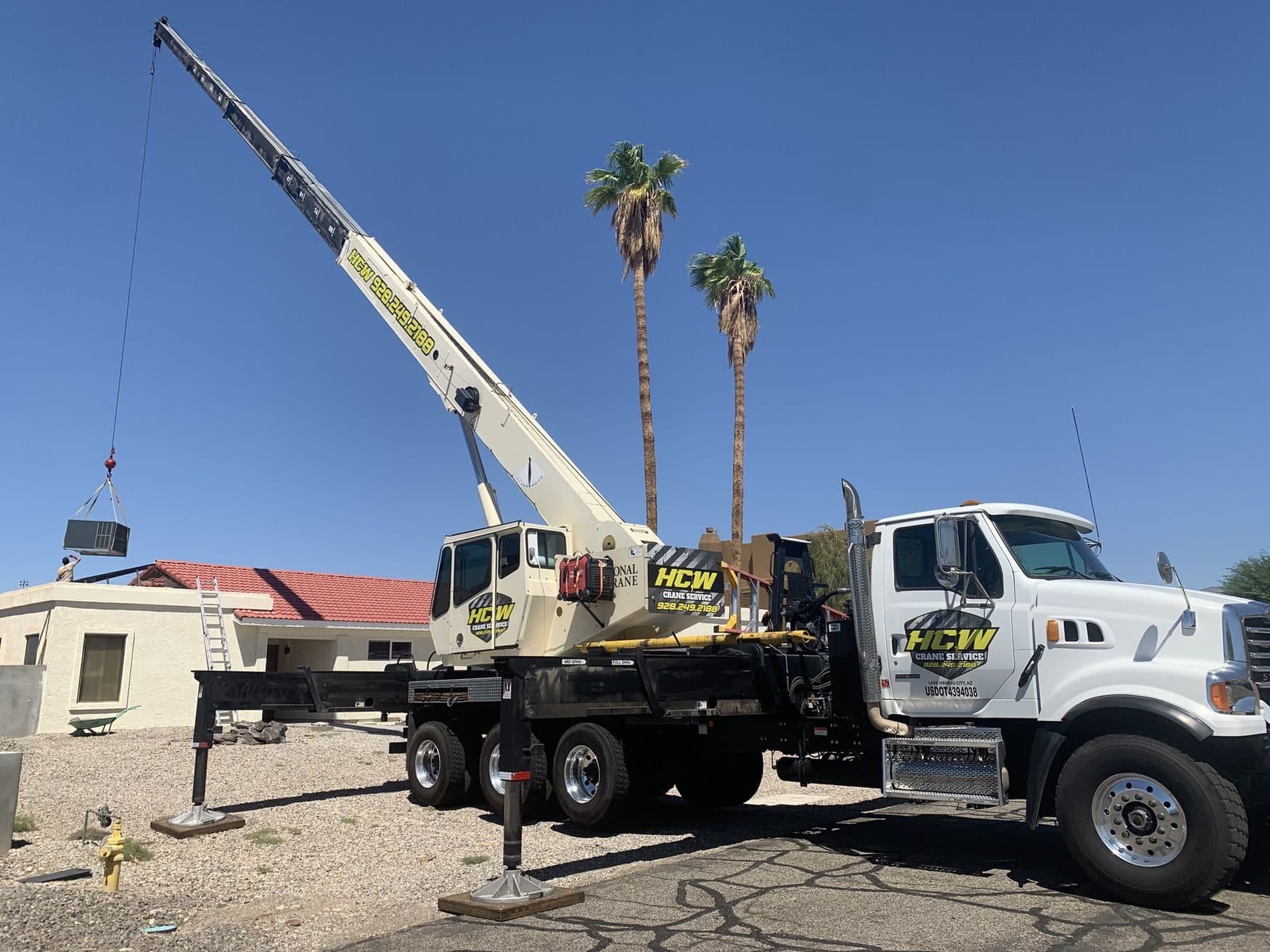
HVAC unit swung over a tile roof 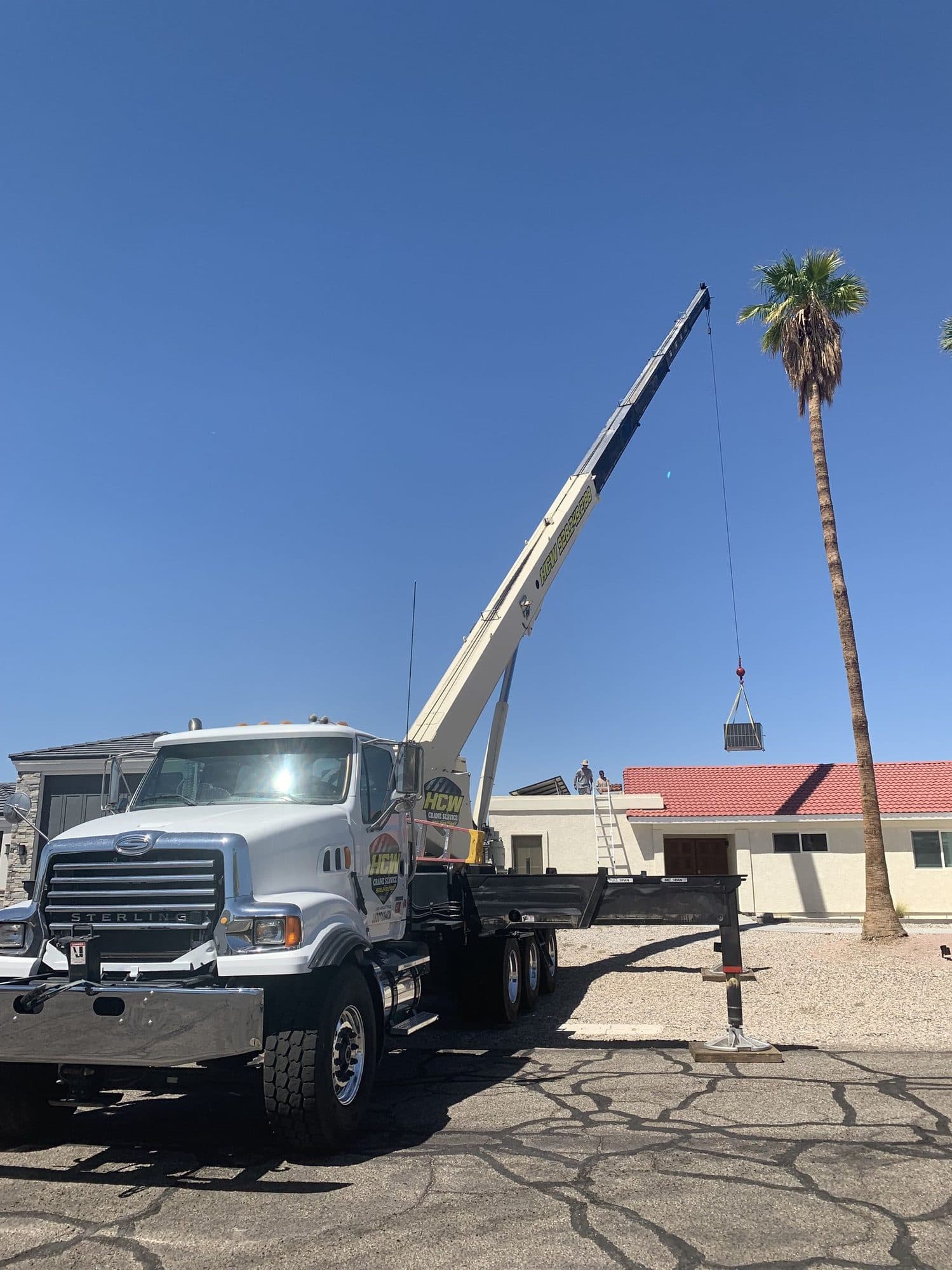
Rooftop unit headed for a tile roof
Answers
Frequently Asked Questions
Do you need the manufacturer lift drawing?
Not always, but it helps a lot on generators, boilers, and skid packages. It tells us the lug locations and the real center of gravity, which is the thing most likely to be misjudged.
What if the equipment has no lifting points?
We rig to the skid or base frame and adjust sling lengths until it hangs true at the test lift. What we do not do is sling across the equipment itself and hope.
Can you set a generator on its pad and bolts?
Yes. Have the anchor bolts, isolators, or rails in place beforehand and confirm which side the conduit and exhaust need to face. The set itself is slow and guided.
Can you get equipment into a walled equipment yard?
That is common work. We lift over the wall or fence rather than dismantling anything, and use tag lines for a controlled descent in a tight footprint.
Related Services
- Rooftop Equipment LiftsExhaust fans, kitchen hoods, evaporative coolers, ductwork, and mechanical equipment lifted onto commercial and residential roofs.
- Air Handler PlacementAir handlers rarely land on an open roof. They go through an opening or into a mechanical room, which makes the last twenty feet the hard part.
- Precision Crane PlacementSome loads have to land within an inch. Anchor bolts, curb openings, post seats, and finished stone. Here is how we set a load that has to be exact.
- Package Unit PlacementSetting rooftop package units square on the curb, with the gasket seated and the duct openings lined up. Crane and operator for HVAC contractors.
- Air Handler PlacementAir handlers rarely land on an open roof. They go through an opening or into a mechanical room, which makes the last twenty feet the hard part.
- Condenser Unit PlacementCondensers are light and fragile. The coil fins bend if you look at them wrong. We set them over walls into side yards without touching the coil.
- Rooftop Equipment LiftsExhaust fans, kitchen hoods, evaporative coolers, ductwork, and mechanical equipment lifted onto commercial and residential roofs.
- HVAC Unit Removal and ReplacementA change-out is two picks and an open roof in between. Sequencing, curb inspection, and a weather check are what keep it to one visit.
Ready to schedule your lift?
Tell us the load, the site and the timing. We will confirm capacity, access and a window.