
Spa and Residential Specialty Lifts
Spa Placement in Lake Havasu City
3 min readUpdated July 2026
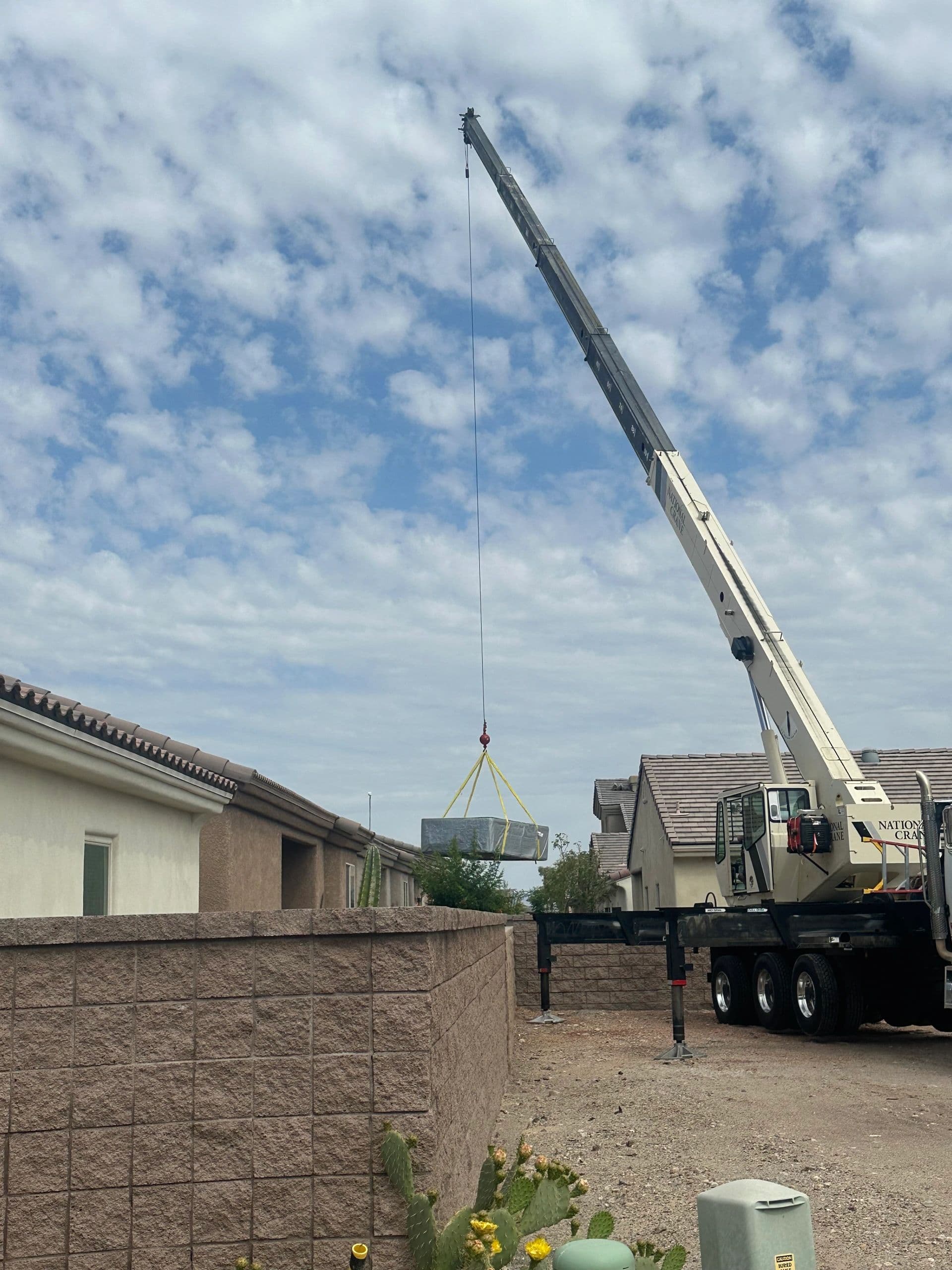
Spa placement means lifting a spa over a wall or structure and setting it square on a prepared pad. The weight sits in the shell rather than the cabinet, so slings run under the base frame. The pad must be level and cured, and the equipment bay has to face the electrical and access side.
Where the Weight Actually Is
A spa looks like a box. It is really a molded shell sitting in a light frame with a decorative cabinet skinned around the outside. Almost all of the mass is in the shell and the equipment pack, and the cabinet panels carry nothing at all.
That determines everything about the rigging. Slings run underneath, across the base frame, so the load goes through structure. A sling around the cabinet crushes the corners, cracks the skirt, and in a bad case lets the shell settle in the frame.
Shells also flex. Pick a spa badly and you can feel it work in the slings. That flex is what cracks a plumbing fitting or a jet body underneath where nobody sees it until it is full of water and leaking.
The Pad Decides How the Spa Lives
A spa full of water is far heavier than an empty one, and a full spa on an uneven base twists. That twist shows up as a shell that no longer sits right in its frame, doors that will not close on the cabinet, and eventually leaks.
So the base has to be level, flat, continuous, and cured. Fresh concrete needs its time. A gravel base needs to be compacted and screeded, not just raked out. Pavers need to be set on a proper bed rather than dropped onto sand.
We will tell you if the pad looks wrong before we set on it. Setting a spa on a base that is not ready is a problem we would be handing you, and correcting it later means draining, lifting, and setting again.
Slope matters as much as flatness. A base that drains away from the house is good practice everywhere else and wrong under a spa, because a shell sitting on a slope loads unevenly once it is full. If the pad has fall on it, that is worth sorting before the spa arrives rather than after.
Orientation Is a One-Time Decision
The equipment bay has to end up on the side where the electrical is, and where somebody can actually get a panel off to service it. A spa set with its equipment door against a block wall is serviceable only by moving the spa.
Steps, the cover lifter, the lounge seat, and the view all factor in too. Once it is down on a finished pad in a walled yard, rotating it is another crane visit, so we confirm the orientation with the homeowner while it is still in the air and stopped above the pad.
Have the electrician's stub location and the disconnect position in mind before the day. That single detail causes more repositioning than anything else on this work.
Wrap, Cover, and Wind
New spas arrive shrink wrapped, and that wrap is a sail. On a breezy morning a wrapped spa will try to rotate the whole way over the wall. Two tag lines go on, and if the wrap is loose and flapping we deal with it before the lift.
The cover comes off and stays off during the pick. A hard cover on top is loose weight and an enormous sail area, and it is not secured to anything. It goes into the yard separately.
Acrylic shells scratch, and a scratch on the inside of a shell is permanent and visible forever. Padding at every sling contact point costs a few minutes and is the difference between a clean install and a warranty conversation.
Weather matters on the day too. A shell that has been sitting in direct sun on a delivery truck all morning is hot enough to be unpleasant to handle and slightly softer than it should be. That is one more reason we push spa work toward the early part of a summer day.
How the job runs
Our Process
Step 1: Confirm Pad and Access
Pad type, level, and cure status, plus wall height and where the crane can set up. We would rather find a soft pad on the phone than in your backyard.
Step 2: Prep the Spa
Cover off, loose wrap dealt with, steps and accessories set aside. Slings run under the base frame with padding at every contact point.
Step 3: Test Lift and Hang Check
Up a few inches and stopped. We check that it hangs level and that no sling has slid toward a cabinet corner before it goes anywhere.
Step 4: Over the Wall
Two tag lines control rotation on the way over. A spotter in the yard has eyes on the pad and the wall the whole way down.
Step 5: Orientation Confirmed, Then Set
Stopped above the pad, orientation confirmed with the homeowner, then lowered in inches until it is fully seated. Rigging comes off last.
Scope
What Is Included
- Crane and operator matched to the yard and wall height
- Slings run under the base frame, never around the cabinet
- Padding at every sling contact point to protect the shell and skirt
- Two tag lines for rotation control over the wall
- Test lift and hang check before travel
- Spotter in the yard for the descent onto the pad
- Orientation confirmed with you before the spa is set
Answers
Frequently Asked Questions
Does my pad need to be finished before you come?
Yes, and cured. Setting a heavy shell on a base that is not ready leads to a spa that sits wrong once it is full of water, and correcting that means draining it and lifting it again.
Can you lift a spa that is already full?
No. Drain it first. Water more than doubles the weight and it sloshes, which makes the load unpredictable in the air. Drain it and let it sit long enough to stop dripping.
Will the slings damage the cabinet?
Not when they run underneath the base frame, which is how we do it. Damage comes from slings around the cabinet panels, which carry no load and crush at the corners.
Which way should the spa face?
Equipment bay toward the electrical and somewhere you can service it. Think that through before the day, because rotating a spa on a finished pad in a walled yard means booking another lift.
How high a wall can you clear?
Standard Havasu block walls are routine. Two-story homes and deep backyards are where we bring the 40-ton, which reaches up to 142 feet. Send a photo from the street and we can tell you.
Can you move my existing spa to a new spot?
Yes. Drain it, disconnect the electrical, and we can lift it out and reset it. If it is going over the wall and out, tell us where the truck or trailer will be.
Related Services
- Hot Tub Crane LiftDelivery day logistics for a hot tub lift. Where the truck parks, how long the street is blocked, and getting the old tub out on the same visit.
- Over-Structure PlacementFlying a load over a house, a garage, or a block wall. Ridge clearance, a blind descent on the far side, and a spotter running the last stage.
- Spa and Residential Specialty LiftsSpas, hot tubs, and awkward residential loads flown over block walls into finished backyards.
- Hot Tub Crane LiftDelivery day logistics for a hot tub lift. Where the truck parks, how long the street is blocked, and getting the old tub out on the same visit.
- Tight Access LiftsNarrow streets, no side yard, overhead lines, and neighbors on both sides. How we work a lift where there is barely room to set up.
- Over-Structure PlacementFlying a load over a house, a garage, or a block wall. Ridge clearance, a blind descent on the far side, and a spotter running the last stage.
- Residential Specialty LiftsSafes, boulders, fountains, statuary, sheds, playsets, and pool equipment. The one-off household loads that will not fit through a gate.
Ready to schedule your lift?
Tell us the load, the site and the timing. We will confirm capacity, access and a window.