
Resources
Placing Hot Tubs and Swim Spas Over Walls and Structures
In Short
Most yards here are walled with no gate wide enough for a spa. The crane goes over. A spreader bar keeps the shell from being squeezed.
4 min readUpdated July 2026
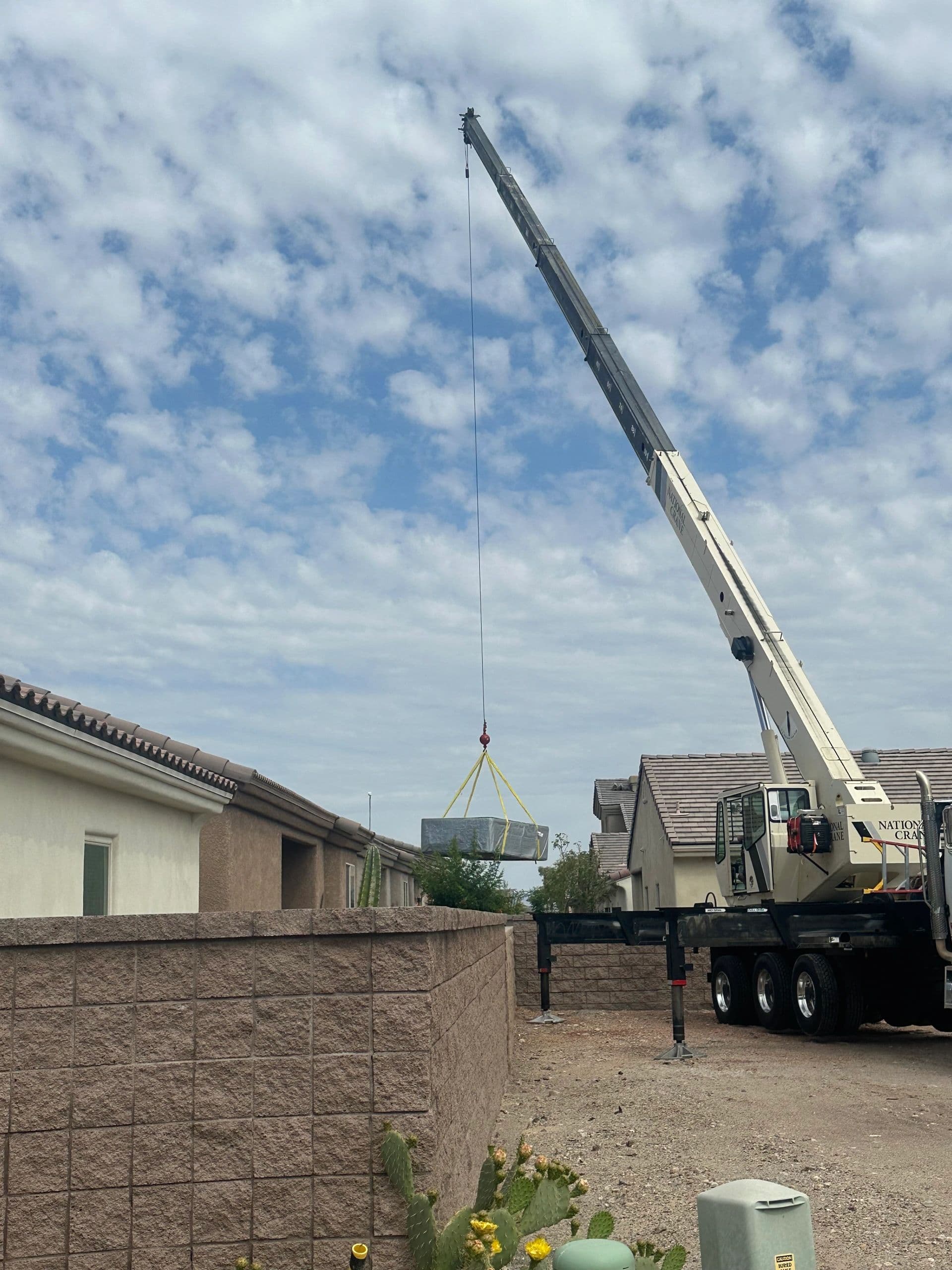
Spa placement by crane means lifting a hot tub or swim spa over a block wall, a house or a garage into a backyard with no ground access. The shell is rigged with a spreader bar so the sling legs pull upward rather than inward, and the unit is landed slowly onto a prepared, level pad.
The Wall Is the Whole Reason
Nearly every yard in this town is enclosed by a block wall, and almost none of those walls have a gate wide enough for a hot tub. That single fact is why spa deliveries here so often end with a phone call to a crane operator rather than four people and a set of dollies.
The alternatives are worse than they look. Taking down a section of block wall means a mason, a delivery window that has to line up with the wall being open, and a rebuild. Dragging a spa through a side yard on rollers works until the side yard turns out to be narrower than the spa is deep, or has an air conditioner in it, which is common.
Going over is usually the shortest route between the delivery truck and the pad. The question is not whether it can be done. It is where the truck can sit and how far back the pad is from there.
What a Spa Actually Weighs and Where the Weight Is
An empty hot tub is lighter than people expect and a full one is far heavier. Spas are always lifted empty, and if you are having one removed it needs to be drained completely first, including the plumbing lines that hold water after the shell looks empty.
The weight is not evenly spread. The heater, pump and control pack sit together on one side, so an empty spa hangs down on the equipment corner unless it is rigged for that. On a swim spa the imbalance is more pronounced because the unit is longer.
Cabinet and shell are also different things. The decorative cabinet is not structural and will not carry the unit's weight. Rigging goes to the frame or the base, and anything that puts load into the cabinet skirt tends to end with a damaged skirt.
Rigging the Shell Without Crushing It
A hot tub is a big shallow box, and slings run under it will want to pull inward toward the hook as they rise. Without something to stop that, the sling legs squeeze the sides of the unit, and an acrylic shell in a wooden frame does not respond well to being compressed.
A spreader bar sits above the load and holds the sling legs apart, so the pull on each corner is close to straight up instead of angled in. That is the whole point of it, and on spa work it is not optional equipment.
Padding goes wherever a strap crosses an edge or a finished surface. Corner protection matters because a strap under tension across a hard corner concentrates force exactly where the shell is least able to take it. Most spa damage during a lift is not dramatic, it is a stress mark or a cracked skirt that nobody notices until later.
The Pad, the Landing and the Last Six Inches
The pad has to be ready, level and cured before the spa arrives. A spa set on a pad that is not level does not just look wrong, it puts the frame into a twist and can affect how the unit sits and drains. If the pad was poured recently, say when, because concrete that has not fully cured is not ready to take a point load and is not ready to take outriggers either.
Landing is the fussiest part of the lift. The unit comes down slowly, often with somebody guiding by hand from a safe position or by signal, and the last few inches are about getting the base fully in contact rather than resting on one edge. Where the operator cannot see the pad from the seat, which is normal on a walled yard, a signal person runs the landing.
Access panels and equipment doors should end up somewhere you can actually reach. Orientation is easy to fix in the air and awkward to fix on the ground, so decide before the lift which way the equipment side is facing.
Removals, Swaps and Working With the Dealer
Taking an old spa out is a different job from putting a new one in, mainly because an old unit has been sitting on a pad for years and is often heavier than its listed weight thanks to soaked insulation and trapped water. It also may not have any usable rigging points left.
Swaps are best done as one visit: old unit out, new unit in, one setup. That requires the new spa to be on site and the old one drained and disconnected before the truck arrives, which is worth confirming rather than assuming.
Coordination with the spa dealer's delivery truck is the other thing worth nailing down. The most common cause of a wasted hour is a crane set up and waiting on a delivery that is running late. Agreeing an arrival order the day before fixes it. Disposal of an old unit is normally the customer's arrangement unless it has been discussed in advance.
How the job runs
Our Process
Step 1: Confirm the unit and the route
Get the make, model, dry weight and dimensions, and establish where the truck can park relative to the pad. Photos over the wall from the street help.
Step 2: Prepare pad and access
Pad level, cured and clear. Old unit drained and disconnected if this is a swap. Vehicles moved and the flight path over the wall clear of obstructions.
Step 3: Rig with a spreader bar
Slings to the frame or base, spreader bar above to keep the legs from pulling inward, padding at every edge, and a tag line to control rotation.
Step 4: Lift over and land slow
The unit clears the wall or roof, travels under tag line control, and is landed onto the pad on signals from someone who can see it.
Step 5: Check the set and derig
Confirm the base is fully in contact, the unit is level and the equipment access faces the right way before rigging comes off.
Scope
What Is Included
- Lift over block walls, garages or single story rooftops into an enclosed yard
- Spreader bar rigging so the shell is not compressed by sling angle
- Edge and corner padding on all contact points
- Tag line control through the swing
- Signal person for the landing where the pad is out of the operator's sight
- Removal of an existing spa and placement of the new one on one visit
Answers
Frequently Asked Questions
Can you get a hot tub into a backyard with no gate?
Yes, and that is the most common spa job here. The unit goes over the block wall, or over the house where the wall route does not work. What decides the job is where the truck can park and how far back the pad sits from there.
Does the spa need to be empty?
Completely empty, including the plumbing lines that hold water after the shell looks drained. A full spa is far too heavy to lift and the water shifting inside would make the load unmanageable even if it were not.
Will the lift damage the shell or the cabinet?
Not when it is rigged properly. A spreader bar keeps the sling legs from squeezing the sides, and padding goes wherever a strap crosses an edge. The damage that does happen on spa lifts almost always comes from slings pulling inward without a spreader.
Does my pad need to be finished before you come?
Yes, level and fully cured. Tell us the pour date if it is new, because fresh concrete will not take a point load and will not take outriggers either. Setting a spa on an unlevel pad puts the frame into a twist.
Can you take my old hot tub out and set the new one the same day?
Yes, and that is the efficient way to do it. The old unit must be drained and disconnected, and the new one has to be on site, before the truck arrives. Disposal of the old unit is normally your arrangement unless it was agreed in advance.
Can you place a swim spa?
Yes. Swim spas are longer and the weight distribution is more uneven than a standard hot tub, so rigging and spreader bar setup matter more. Send the model and dry weight and the geometry gets checked against where the truck can sit.
More Guides
- Spa and Hot Tub Placement BundleSpa lifted over the block wall into a walled backyard, or the old tub out and the new one in on the same call. Lake Havasu City, Arizona.
- Over-Structure PlacementHow a crane lifts a load over a house, garage or block wall and lands it on the far side when there is no ground route into the yard.
- Rigging FundamentalsHow slings, shackles and spreader bars attach a load to the hook. Sling angle, center of gravity, gear inspection, and who supplies the rigging.
- Tight Access LiftsSetting up in the street, partial outrigger extension, working over the corner, and staging loads closer when there is barely room for the truck.
- Site Preparation ChecklistWhat to clear, move, unlock and check before a crane arrives. A prepared site keeps the visit short and stops problems being found at the worst moment.
- How Mobile Crane Service WorksA mobile crane brings the machine and the operator to your site. Here is what happens from the first phone call through setup, the pick and pack up.
- Capacity and Reach ExplainedA 40-ton crane will not lift 40 tons at full boom. Here is what capacity ratings, load radius and 142 feet of reach actually mean for your job.
- Site Preparation ChecklistWhat to clear, move, unlock and check before a crane arrives. A prepared site keeps the visit short and stops problems being found at the worst moment.
- What to Expect on Lift DayA walkthrough of lift day from arrival to departure, including how long each stage takes, what you can do, and why setup takes longer than the pick.
- HVAC Unit Crane Placement GuideHow rooftop package units and condensers get craned on and off, how the work is sequenced with your HVAC contractor, and what a curb mismatch means.
- Truss Lifting Process and SafetyHow roof trusses get set with a boom truck: staging bundles, spreader bars, bracing, wind limits and keeping the crane in one position along the wall line.
Ready to schedule your lift?
Tell us the load, the site and the timing. We will confirm capacity, access and a window.