Service
Heavy Lifting and Equipment Placement in Lake Havasu City
6 min readUpdated July 2026
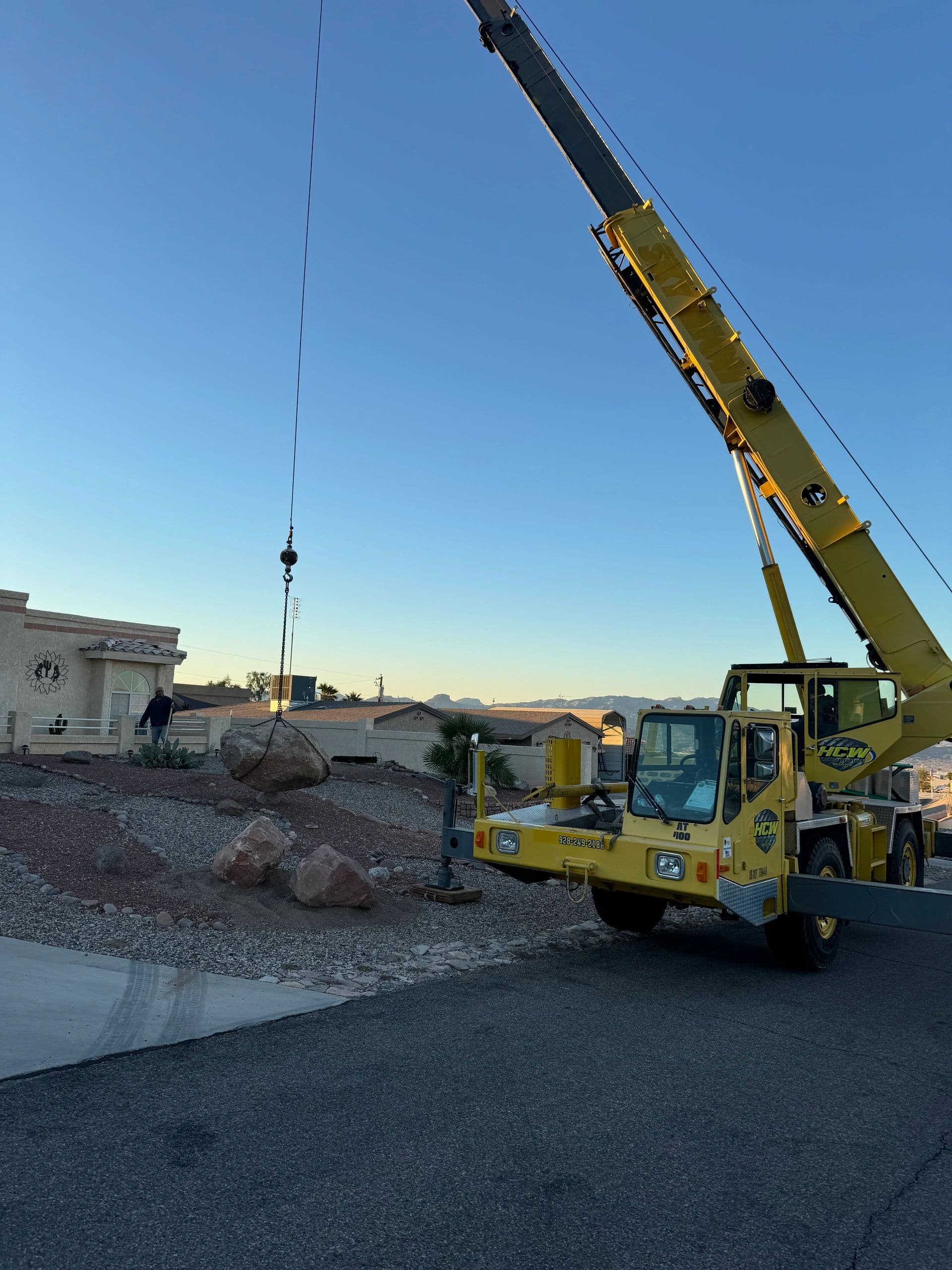
Heavy lifting and equipment placement means using a mobile crane to set machinery, generators, transformers, tanks, and other heavy items in their final position. HCW Crane Service runs a 22-ton and a 40-ton boom truck in Lake Havasu City, Arizona. The owner runs every lift, from the first call to the hook coming off.
Knowing the Real Weight Before Anything Moves
A lift starts with one number, and that number has to come from a real source. The nameplate on the machine, the bill of lading from the shipper, or the tag stapled to the crate. Those three are worth trusting. Somebody remembering what a similar unit weighed on a job years ago is not a source, and we will not plan a pick around it.
Load charts have no cushion built into them for optimism. Say the true weight is eighty four hundred pounds and the figure we were handed was six thousand. Every choice that came off that figure is now wrong: the boom angle, the working radius, the outrigger spread, the sling size. Finding that out with the load already off the deck is the worst possible time to find it out.
Weight is not just the machine, either. Slings, shackles, a spreader bar, a lifting beam, and the hook block all hang below the boom point, and all of it comes off the chart. On a long boom at a wide radius, that rigging weight stops being a rounding error and starts being the difference between a lift that works and one that does not.
- Nameplate or data plate on the unit itself
- Bill of lading or shipping manifest from the hauler
- Crate tag or manufacturer packing list
- Overall dimensions, so we know where a sling can go
Where the Crane Can Physically Set Up
A boom truck does not lift from wherever it happens to park. It lifts from where the outriggers can go all the way out and sit on ground that will hold them. Half extended outriggers cut what the chart allows, sometimes badly, and the direction of the lift matters too. Over the rear is not the same as over the side.
Ground around here fools people. Caliche gives you a hard crust that feels like concrete under a boot, and under that crust can be anything from solid rock to loose fill somebody trenched and backfilled two years ago. Pads or cribbing go under the floats, and we look at what is beneath them instead of trusting how the surface looks.
Then there is everything else in the way. Block walls around nearly every backyard, side yards you cannot get a truck into, steep driveways off the channel, and older roads where the overhead service drop hangs right through the working area. Those constraints usually settle the setup spot before weight ever enters the conversation.
Boat and RV storage yards deserve their own mention. The rows are narrow, the ground is often graded fill that was never compacted for anything heavier than a trailer, and there is usually somebody's boat parked exactly where the outriggers want to go. On lakefront lots the problem flips: plenty of view, very little flat ground, and a drop off behind the setup point. We would rather find that out with a tape measure than with a boom in the air.
Weight Limited or Radius Limited
Two different problems both end with the crane saying no, and they get solved in opposite directions. A weight limited lift is one where the load is heavy enough that the chart runs out even with the boom pulled in close. A radius limited lift is one where the load is light but has to travel out far, over a wall or across a yard, and capacity falls off fast as the boom reaches.
Most residential and light commercial work around Lake Havasu City turns out to be radius limited. A twelve hundred pound unit sitting forty feet past the truck is a bigger ask than a five thousand pound unit sitting twenty feet away. That surprises people, and it is the most common reason a job that sounded easy on the phone needs a different plan once somebody stands in the yard.
Maximum reach on these trucks is one hundred forty two feet. Reach and capacity are not the same thing, though. Getting the boom out there is one question, and what it can hold once it is out there is another one entirely. When the numbers do not work, the fix is almost always moving the setup point closer rather than reaching harder.
When the Landing Point Is Not Ready
A load in the air is not a place to store anything. If the pad has not cured, the anchor bolts are not set, the curbs are not built, or a forklift is still parked in the spot, the pick stops right there. We can hold it, or we can set it down on cribbing off to the side and come back to it, but neither one is free time.
Tolerance is the part that catches people off guard. A bolt pattern does not care how strong the crane is. If the holes have to line up within a sixteenth of an inch, that last bit of motion comes from the winch, a tag line, a pry bar, and patience. Boom motion is coarse by nature and it always will be.
So we ask ahead of time what the landing actually looks like. Is it a pad, a curb, a frame, a set of rails, a roof? Is it level, and who checked it? Are the shims staged? Is there somebody on site who owns the final position and can say yes, that is right, set it down? Answers to those questions are what keep a pick to one attempt.
An Operator Comes With the Crane
This is not equipment rental. There is no version of this where the crane gets dropped off and somebody on your crew climbs in and runs it. The operator comes with the truck, every time, on every job. Nobody at your shop has to learn load charts, and nobody has to sign for a machine they have never touched.
Two trucks, and they get picked for different reasons. The 22-ton handles most of what comes up: a rooftop unit, a shop machine, a small genset, a boulder in a front yard. It sets up in less room and it fits places the bigger truck will not. When the load is heavier, or when it has to go out past a wall and still hold capacity at that radius, the 40-ton is the right call.
Choosing between them is usually a five minute phone conversation. Weight, how far out it has to travel, and what the truck can park on. That is generally enough to know which one is coming. When it is close, somebody looks at the site first rather than guessing and showing up short.
Lift Points Get Checked Before the Day
Half the reasons a placement job stalls have nothing to do with the crane. The machine has no lifting eyes. The eyes it does have are painted over, bent, or clearly an afterthought somebody added in a hurry. The base frame is cracked where a forklift caught it. The mounting feet do not match the holes in the pad.
Those are all things a photo shows ahead of time. We ask for pictures of the lift points, the base, and the landing spot, so a missing eye or a damaged frame gets found on the phone instead of in the driveway. Often the answer is a different rigging method: slings around a solid base rail, a bar through a designed opening, or a spreader bar that keeps the pull where the frame can take it.
When a load has nothing sound to rig from, we say so before the day and the owner gets it sorted by whoever built or services the equipment. Showing up and making do with a strap wrapped somewhere hopeful is not how a lift gets done. Finding the problem early is what keeps a one day job a one day job.
How the job runs
Our Process
Step 1: The Call
You describe the load and the site. What it is, roughly what it weighs, where it has to end up, and what the truck can park on. The phone gets answered at any hour. How fast we get there depends on where the truck already is when you call.
Step 2: Weight and Dimensions Confirmed
We ask for the nameplate, the shipping paperwork, or the crate tag, plus overall dimensions. That number picks the truck and the rigging. If nothing on paper exists, we work from the manufacturer's published data for that model instead of an estimate off the top of anyone's head.
Step 3: Site Look and Setup Plan
Somebody walks the setup spot, the swing path, and the landing point. Outrigger positions get chosen, ground under the floats gets probed, and overhead service drops and block walls get measured against the boom path. This is the stage where a lift gets re planned if it needs to be.
Step 4: Rigging and Ground Prep
Pads or cribbing go under the outrigger floats. Slings, shackles, and a spreader bar get sized for the weight and the sling angle, then looked over for cuts, wear, and bent hardware. Tag lines get tied on before the load leaves the deck, not after it starts to turn.
Step 5: The Test Lift
The load comes up a few inches and stops. We watch how it hangs and whether the center of gravity sits where we expected. If it wants to roll, tip, or spin, it goes back down and the rigging changes. Only after it hangs right does the boom start moving anywhere.
Step 6: Landing and Release
The load comes down slow onto the pad, frame, or roof, guided by tag lines and the person who owns the final position. Shims go in, level gets checked, anchors go through the pattern. The hook does not come off until the equipment is stable and standing on its own.
Scope
What Is Included
- 22-ton or 40-ton boom truck with an operator
- Load chart checked against a verified equipment weight
- Slings, shackles, and spreader bars sized to the pick
- Outrigger pads and cribbing for crusted or soft ground
- Swing path and overhead clearance walked before setup
- Two tag lines and load control on awkward shapes
- Leveling, shimming, and anchor pattern alignment at landing
- Lift points and base checked from photos before the day
- Calls answered any hour, seven days a week
Answers
Frequently Asked Questions
How do I find out what my equipment weighs?
Check three places in this order: the nameplate or data plate bolted to the unit, the bill of lading from whoever hauled it, and the tag on the crate. If all three are gone, look up the model number on the manufacturer's site and use their published shipping weight. Send us a photo of the plate and we will read it.
Can you drop the crane off and let my crew run it?
No. An operator comes with the crane on every job, and that is not negotiable. This is operated crane service, not bare equipment rental. It also means nobody on your side has to interpret a load chart, set outriggers, or take responsibility for a machine they have not been trained on.
How far can you reach?
Maximum reach is one hundred forty two feet. Reach and capacity are separate questions, though. Capacity drops as the boom goes out, so what matters for your job is how much weight has to be held at that specific distance, not the headline reach number. Tell us the weight and the distance and we can answer it properly.
Do you need to see the site before the day of the lift?
For a straightforward pick with good access, a few photos and some measurements are usually enough. For anything tight, anything over a block wall, anything near an overhead service drop, or anything where the ground looks questionable, somebody comes out first. It is far cheaper to move the plan than to move the truck twice.
What happens if it gets windy on the day?
Wind postpones more lifts here than weight ever does, especially during monsoon season when a calm morning turns into a hard blow by mid afternoon. Light loads with a lot of surface area are the first to become unsafe. If the wind is pushing the load around more than the tag lines can hold, the pick waits.
The pad is not poured yet. Can you still set the equipment?
We can offload it and set it on cribbing near the final spot, then come back to place it once the concrete is ready. That is two trips instead of one, so it is worth checking cure times against your delivery date. If the pad is only a day or two out, waiting is usually the better move.
My machine has no lifting eyes. Is that a problem?
It is a common one. Send photos of the frame and base. Often a solid base rail, a bar opening, or a frame member can carry slings, padded where they touch. If nothing on the machine is sound to rig from, we tell you before the day so the manufacturer or your service tech can add proper lift points.
Which truck will you send?
The 22-ton covers most work and gets into tighter spots. The 40-ton comes when the load is heavy, when it has to go out past a wall or a house, or when capacity at that radius is the deciding factor. Weight plus distance plus where the truck can park tells us which one before we leave.
All Heavy Lifting and Equipment Placement Services
- Machinery PlacementMobile crane machinery placement in Lake Havasu City, Arizona. Lathes, presses, and shop equipment rigged to frame lift points and set on the pad.
- Generator PlacementGenerator placement in Lake Havasu City, Arizona. We level the pad, spread the sling angle, and land the genset clean over the conduit stub ups.
- Transformer PlacementPad mount and oil filled transformer placement in Lake Havasu City, Arizona. Rigged to the base lugs, hung plumb, and landed over the vault window.
- Tank and Vessel LiftsCrane lifts for poly and steel tanks in Lake Havasu City, Arizona. Empty tanks act like sails, so wind, tag lines, and cradle slings govern the pick.
- Industrial Equipment PositioningIndustrial equipment positioning in Lake Havasu City, Arizona. Short picks to tight tolerance inside a working plant, done inside the shutdown window.
- Commercial Equipment LiftsRooftop commercial equipment lifts in Lake Havasu City, Arizona. HVAC units, cooler sections, and hood fans set over an open store without closing it.
- Capacity MatchingCrane capacity matching in Lake Havasu City. We read the load chart at your real radius and pick the 22 ton or 40 ton boom truck that fits the site.
- Reach and Radius PlanningReach and radius planning in Lake Havasu City. Where the boom truck can stand sets the radius, and radius decides what the crane can lift over your house.
- Site AssessmentCrane site assessment in Lake Havasu City. Gates, driveway slope, turnaround room, overhead lines and the landing point checked before the day of the lift.
- Machinery Moving and SettingCrane machinery moving and setting in Lake Havasu City, Arizona. Shop machines picked out of one building, hauled, and set level in the next one.
Ready to schedule your lift?
Tell us the load, the site and the timing. We will confirm capacity, access and a window.