Mobile Crane Service
Boom Crane Service in Lake Havasu City
2 min readUpdated July 2026
A boom crane, or boom truck, carries a telescoping crane on a road-legal truck chassis. Both HCW cranes are boom trucks. They drive to the job, set outriggers, make the pick, and drive away. That mobility is what makes short local calls and multiple stops in one day practical.
Owner Devan Decastro is NCCCO certified: Telescopic Boom Crane, Swing Cab (TLL). CCO ID 444146986.Verify on NCCCO(opens verifycco.org in a new tab)
The Machine Arrives Ready to Work
A boom truck is self-contained. The crane, the boom, the winch, the outriggers, and the deck space for rigging all ride on one chassis. Nothing is transported separately and nothing gets bolted together in your driveway.
That changes what a small job looks like. A single lift that would be uneconomical if it needed a lowboy, an escort, and an assembly crew is a routine call for a boom truck. It is the reason a homeowner can get a crane for one spa and a contractor can get one for four trusses.
It also means a job that turns out to need a second visit is not a disaster. The truck comes back the next morning without any staging overhead.
The chassis is a working truck in its own right, which matters more than it sounds. It carries mats, cribbing, and rigging without a separate vehicle, so a job that turns into two tasks does not turn into two trips.
Deck Space, Rigging, and Working From the Truck
The deck carries the rigging, so slings, shackles, spreader bars, tag lines, and mats are all on board and get selected on site once the operator can see the load. That flexibility matters when the load in front of you is not quite what was described on the phone.
The truck itself is also part of the setup decision. Where it parks sets the radius for every pick that day. On a job with several loads landing in different spots, one good parking position can cover all of them, and a poor one means picking up and re-setting.
On commercial sites we look for a spot that keeps a drive lane open and keeps the swing path away from doors, patios, and parking anybody is still using. On residential streets the same thinking applies with different priorities. We want a position that reaches the work, keeps at least one lane usable if the street allows it, and does not sit directly under a service drop. Those three rarely line up perfectly, so there is usually a trade to make.
Where the truck ends up also decides how much of your property we touch. A pick made entirely from the street means nothing heavy crosses the driveway or the yard at all, which on a finished lot is often worth spending extra boom on.
How the job runs
Our Process
Step 1: Drive-In and Position
The truck arrives under its own power and gets positioned for the best radius on every pick planned that day, not just the first one.
Step 2: Outriggers Onto Mats
Pads come down onto cribbing sized for the surface. Asphalt in summer heat, paver driveways, and fresh fill all get extra material under them.
Step 3: Rig From the Deck
Slings and hardware get chosen once we can see the load in front of us. Everything needed is already on the truck.
Step 4: Strike and Move On
Boom stowed, outriggers up, deck loaded, and gone. A second job across town the same day is normal with a boom truck.
Scope
What Is Included
- Road-legal boom truck that drives to your site
- 22-ton or 40-ton machine, operator included
- Full rigging inventory carried on the deck
- Outrigger mats and cribbing on board
- No trailer, escort, or assembly crew required
- Multiple picks from one setup position where geometry allows
Real HCW jobs
From the Job Site
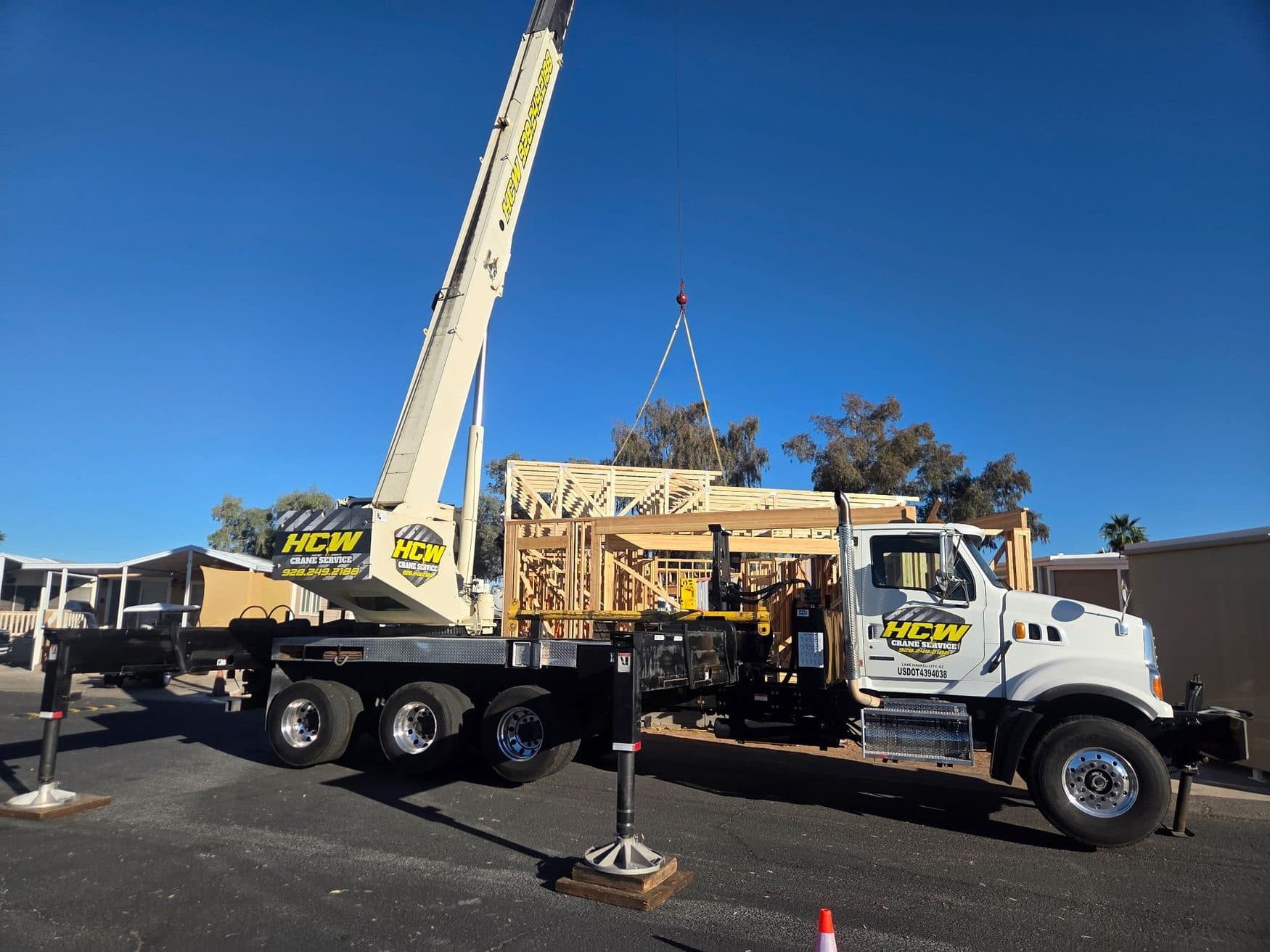
Full rig set up for a truss lift 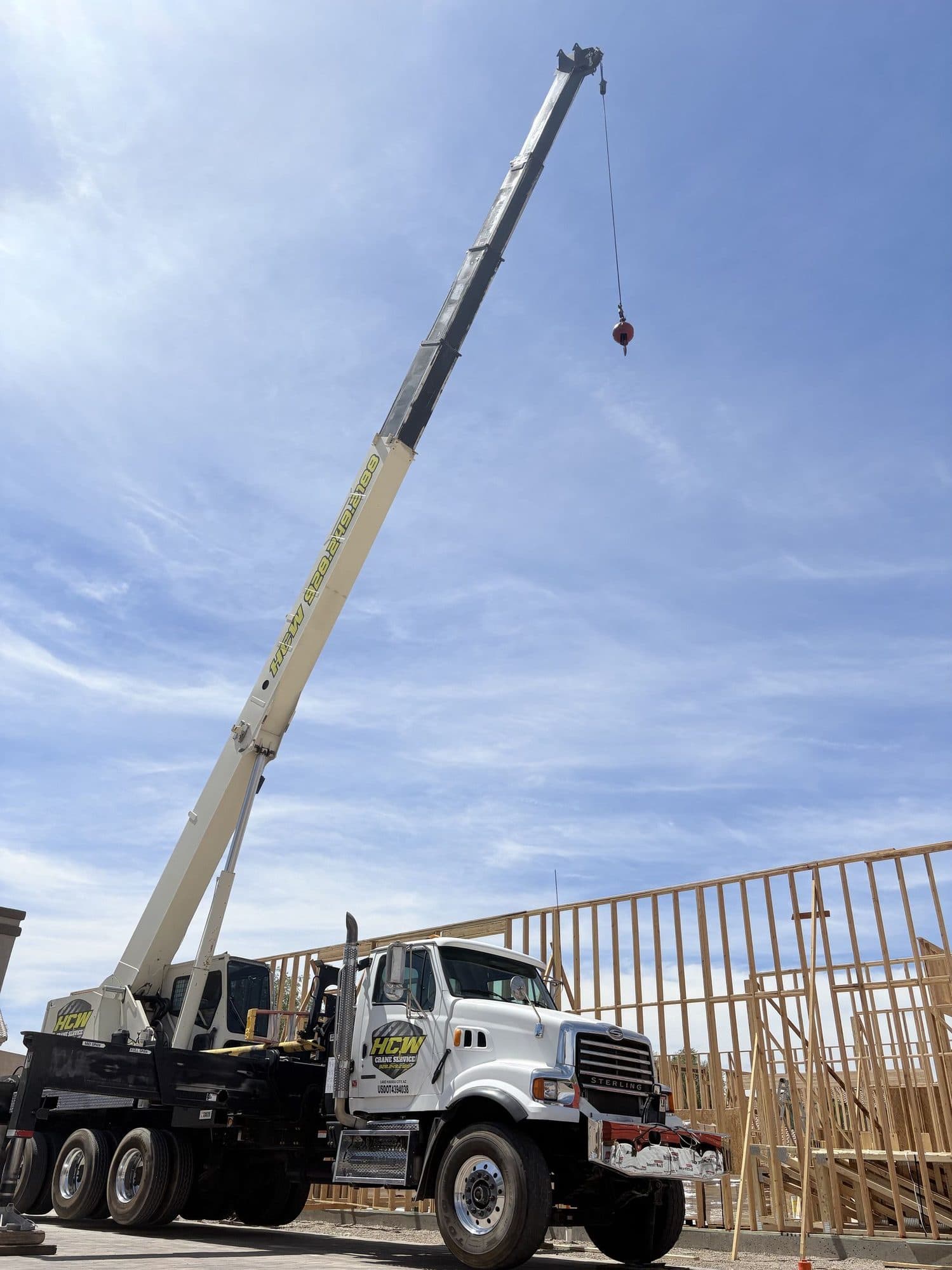
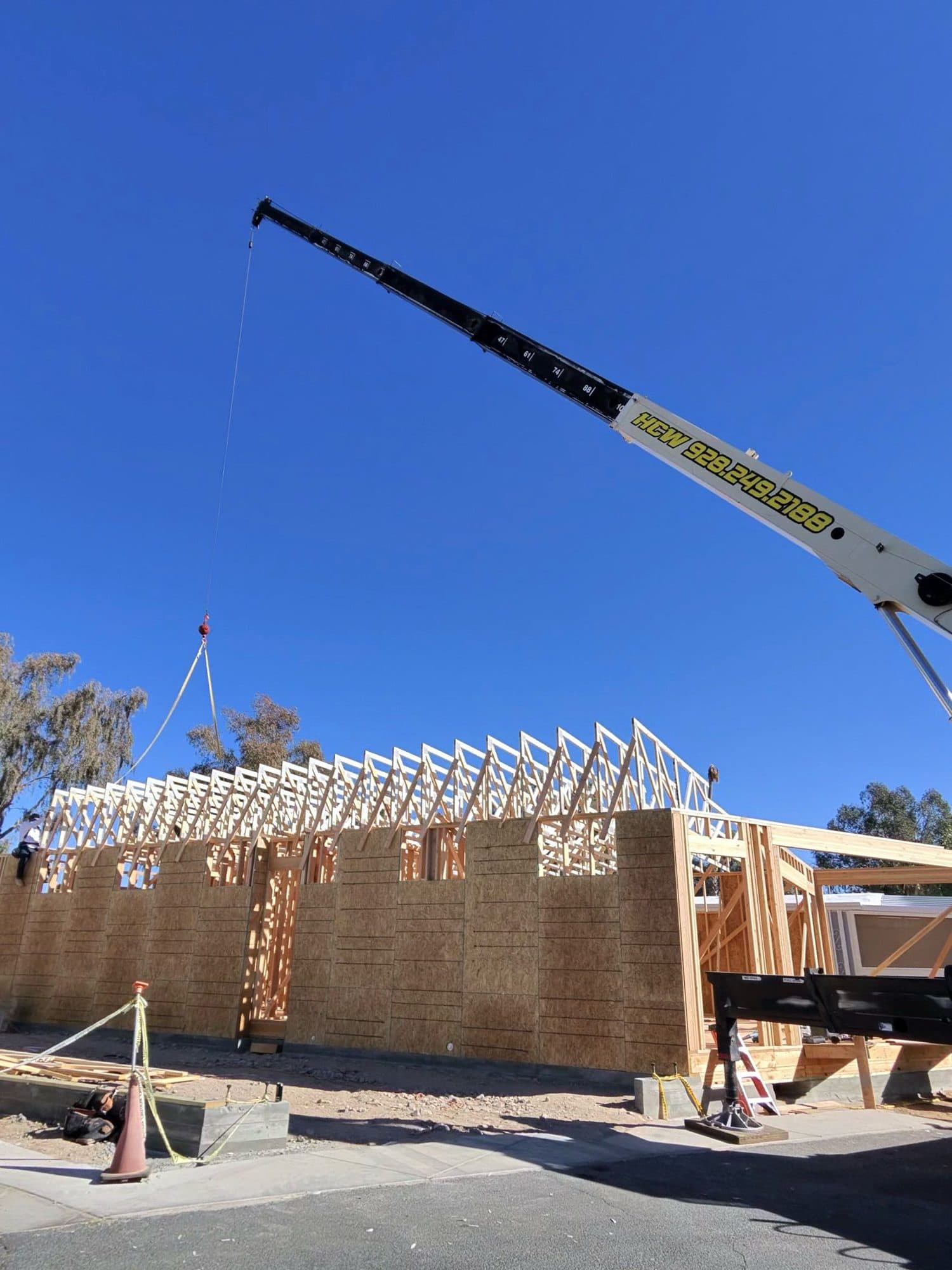
Boom raised beside new framing 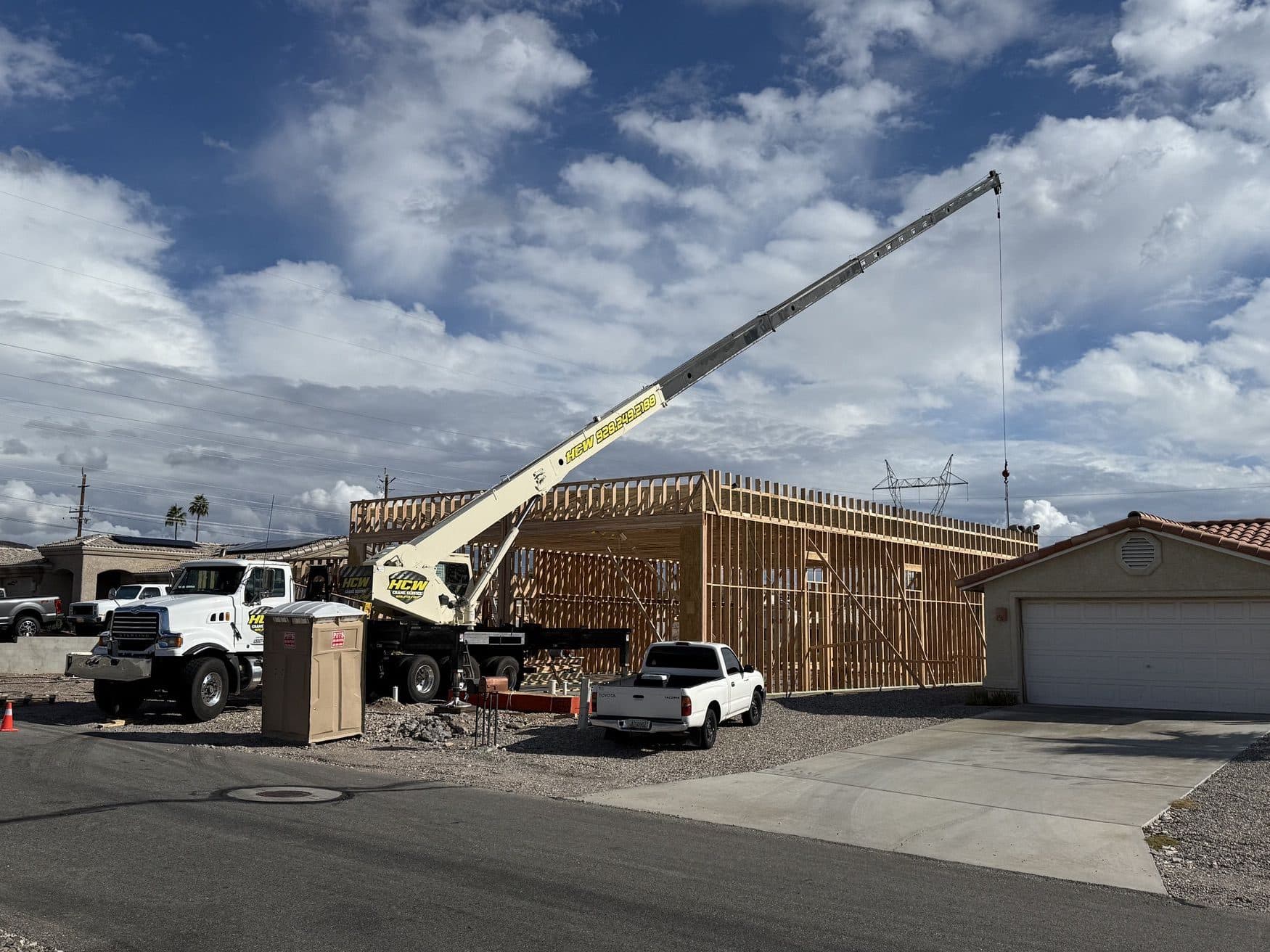
Boom set up beside new wall framing 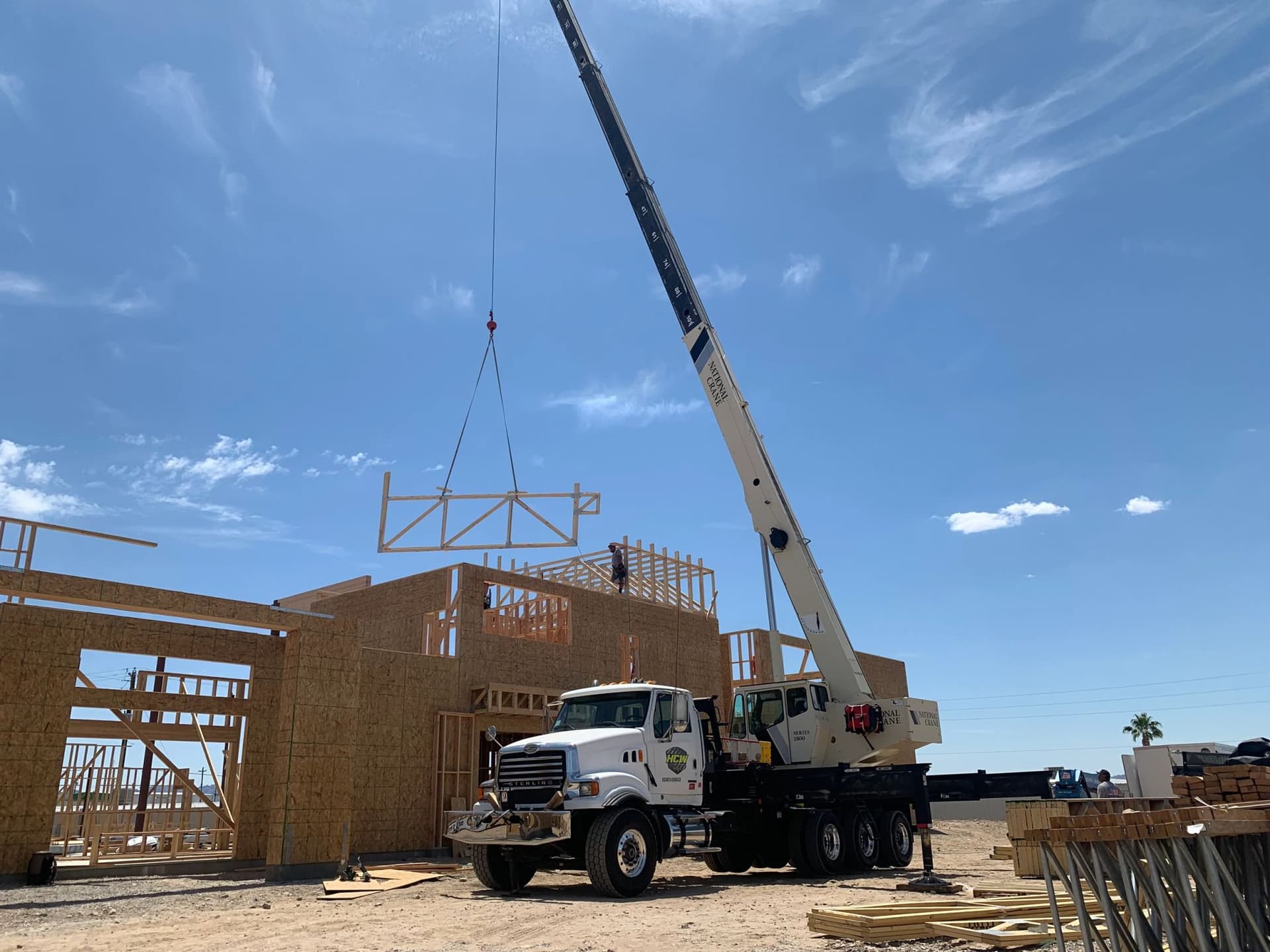
Roof truss set on a two-story frame
Answers
Frequently Asked Questions
Is a boom truck the same as a mobile crane?
A boom truck is one kind of mobile crane. It mounts a telescoping crane on a truck chassis, which makes it road legal and quick to deploy. Both of our machines are boom trucks.
Do you need a flatbed to bring the crane in?
No. It drives itself. That is the main reason short local calls are practical, and why we can be on site quickly on an emergency.
Can the truck work from the street instead of my property?
Often yes, as long as the radius still works. Working from the street keeps a driveway or a finished yard untouched, at the cost of more boom.
Can you make several picks from one setup?
Yes, when the landing points sit inside the same working radius. Planning that up front saves the time it takes to strike, reposition, and re-level.
Related Services
- Telescopic Crane ServiceTelescopic boom trucks extend the boom in sections, so capacity changes with every foot you pull out. Here is how we plan a pick around that.
- Mobile Crane Service22-ton and 40-ton boom trucks with an operator on every call, reaching up to 142 feet.
- Hydraulic Crane ServiceBoth of our boom trucks are hydraulic. Smooth metered control, fast setup, and no assembly. Here is what that means for your lift and for desert heat.
- Owner-Operated Crane ServiceThe owner takes the call, walks the site, and runs the crane. One person accountable for the lift from the first phone call to the final walkthrough.
- Crane With OperatorEvery crane goes out with an operator and the rigging to do the job. Here is exactly who does what on site, and what your crew is responsible for.
- 22-Ton Crane ServiceOur 22-ton boom truck is the tight-street machine. Smaller setup footprint, quicker to place, and the right call for most single-story residential lifts.
- 40-Ton Crane ServiceOur 40-ton boom truck reaches up to 142 feet and holds weight far out from the truck. The machine for two-story picks and deep commercial roofs.
- Hydraulic Crane ServiceBoth of our boom trucks are hydraulic. Smooth metered control, fast setup, and no assembly. Here is what that means for your lift and for desert heat.
Ready to schedule your lift?
Tell us the load, the site and the timing. We will confirm capacity, access and a window.