
Resources
Setting Roof Trusses With a Mobile Crane
In Short
Trusses go up in the order the framers set them. Long spans need a spreader bar, every truss needs bracing, and wind ends a truss day early.
3 min readUpdated July 2026
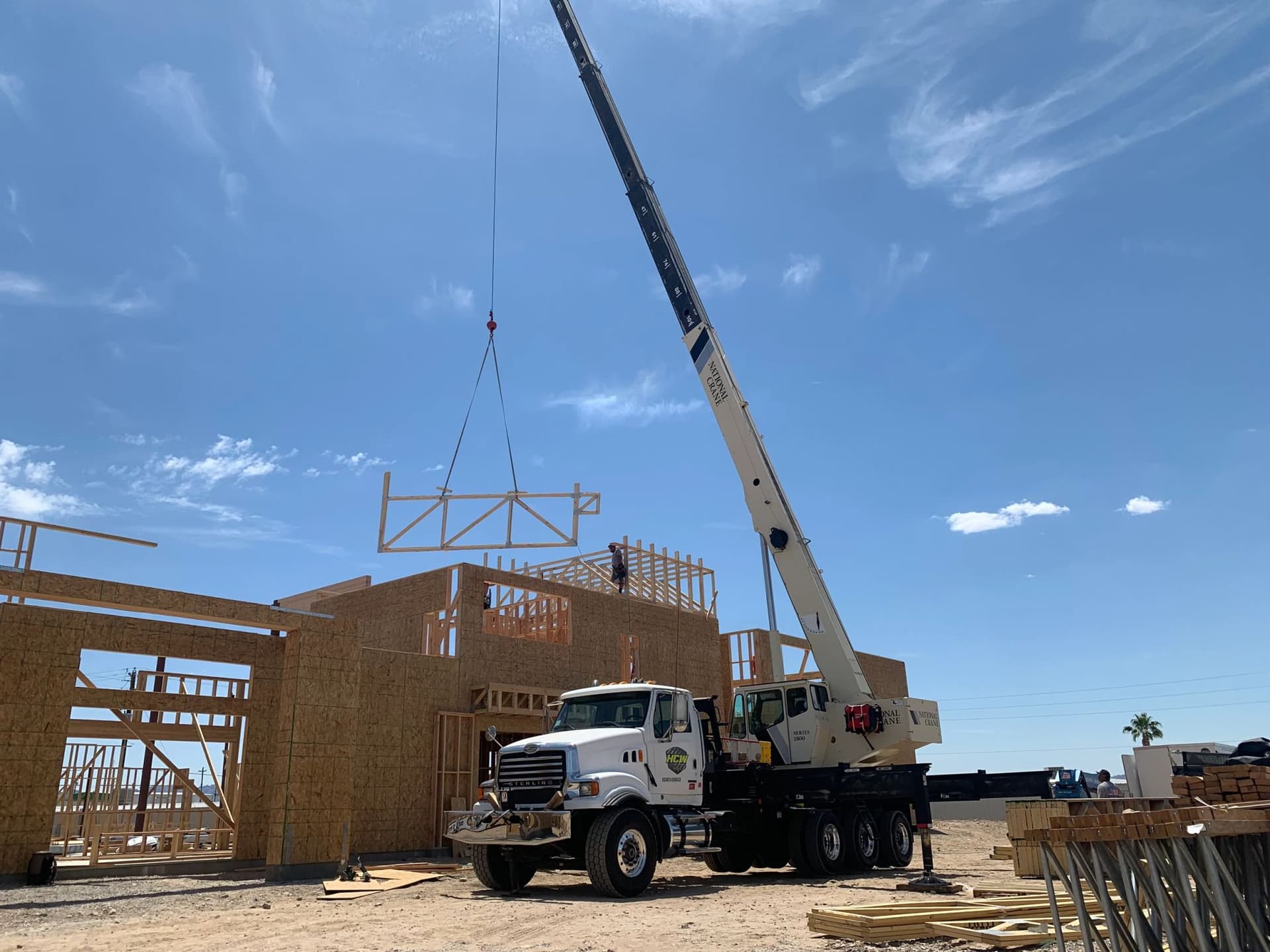
Setting roof trusses with a mobile crane means staging bundles within reach, lifting trusses in the order the framing crew will install them, using a spreader bar on long spans to stop the truss flexing, and holding each one until temporary bracing is fixed. Wind is the limiting factor on any truss day.
A Truss Day Is a Rhythm, Not a Series of Lifts
Setting trusses is different from most crane work because it is repetitive and paced by another crew. The crane is not doing one difficult pick, it is doing a lot of similar picks in a sequence that the framers control.
That changes what good looks like. The measure of a well run truss day is not how fast any single truss goes up, it is whether the crane and the framing crew ever have to wait for each other. When it is working, the hook is coming back for the next truss at about the time the crew is ready to receive it.
It also means the setup position is a much bigger decision than usual. A position that serves ten trusses without moving is worth far more than a position that is perfect for the first one.
Staging, Order and the Wall Line
Trusses arrive in bundles, and where those bundles get dropped decides how the day goes. They need to be inside the crane's working radius, on ground that will stay usable, and oriented so the crane can pick from the top of the stack without dragging trusses across each other.
The install order comes from the framing crew and the truss layout, usually gable end first and then working along. The crane follows that order. Picking trusses out of sequence because they are easier to reach creates a mess on the roof that costs more time than it saved.
The wall line is what determines how often the truck moves. A long, straight run can often be served from one or two positions, and radius stays roughly consistent as the crane works down it. Complex roofs with wings and returns need more repositioning, and each move is setup time repeated.
Rigging a Truss Without Damaging It
A truss is strong in the plane it was designed for and surprisingly weak out of it. Picked from a single point in the middle, a long truss will flex, and flexing pops plates and cracks members. The damage is not always obvious afterward, which is the dangerous part.
The answer is spreading the pick points. A spreader bar holds the sling legs apart so the truss is supported at multiple points along its length and lifted close to vertical rather than being squeezed inward. The longer the span, the more this matters.
Trusses also want to lie down. Keeping one upright through a lift is a matter of rigging geometry and tag line control, not muscle. Nobody should be steadying a truss by hand at height, and a tag line from the ground does the job better and from a safer place.
Bracing Is Part of the Lift, Not After It
A truss that has been landed but not braced is not finished, and the crane does not release it until it is. Temporary bracing to the previous truss and back to a fixed point is what keeps the whole run from folding over, and the first few trusses in a run need the most attention because there is nothing behind them yet.
The crane holding position while bracing goes on is normal and expected. It looks like the crane is idle. It is actually doing the most important part of that particular pick.
Permanent bracing and the rest of the framing is the framing contractor's work. What the crane crew cares about is that nothing gets released into a condition where it depends on luck.
Wind, Season and Scheduling a Truss Set
A truss is a large flat object with very little weight for its area, which makes it the most wind sensitive thing a crane in this town regularly handles. A breeze that would be irrelevant on a compact load is a genuine problem on a truss.
This is the main reason truss dates move. During the late summer storm season, afternoon wind can arrive fast enough that a job which was fine at nine in the morning is over by two. Starting early is not a preference on truss work, it is how the day gets finished.
Winter is the building season here, and truss work concentrates in the cooler months when framing crews can work full days. That is the easier half of the year for this work, with longer usable weather windows and fewer heat related stoppages, though a winter front can still bring wind that ends a set.
How the job runs
Our Process
Step 1: Confirm layout and bundle drop points
Agree with the framing crew where bundles land so they sit inside the working radius and can be picked in install order.
Step 2: Choose positions along the wall line
Pick truck positions that serve as much of the run as possible, keeping radius consistent and minimizing the number of moves during the day.
Step 3: Rig for the span
Fit a spreader bar and multiple pick points on long trusses so the member is supported along its length rather than flexed from a single point.
Step 4: Set in sequence and hold
Trusses go up in the framers' order, land on the wall plates, and the crane holds each one until temporary bracing is fixed.
Step 5: Release, then move on
The truss is released only once braced, the hook returns for the next one, and the truck repositions when the run outgrows the current radius.
Scope
What Is Included
- Crane and operator for the scheduled truss set day
- Positioning planned around the wall line to reduce truck moves
- Spreader bar and multi-point rigging for long spans
- Holding position while temporary bracing is installed
- Tag line control so trusses do not turn or lie over in the air
- Coordination with the framing crew on install sequence
- Wind assessment through the day, with a stop call if it gets marginal
Answers
Frequently Asked Questions
Can you set trusses for a residential framing crew?
Yes, and it is routine work. The crane follows the crew's install sequence and holds each truss until it is braced. Book the crane for the day the crew is actually ready to set, not the day the trusses are delivered.
Do you lift trusses one at a time or in bundles?
Bundles get moved into position, then trusses are set individually. Setting individually is what allows each one to be landed accurately and braced before release. Where a bundle needs relocating on site, that is a separate lift.
Why do long trusses need a spreader bar?
Because a long truss picked from one point flexes out of plane, which can pop connector plates and crack members. A spreader bar holds the sling legs apart so the truss is supported at several points and lifted with the legs closer to vertical.
How windy is too windy for setting trusses?
There is no single number, because it depends on truss size and how exposed the site is. A truss has a lot of surface area and very little weight, so it becomes unmanageable at wind speeds that would not affect a compact load. The operator makes the call on the day and will stop the set if the margin disappears.
Who handles the bracing?
The framing contractor installs temporary and permanent bracing. The crane's part is holding the truss steady and in position until that temporary bracing is fixed, and not releasing before it is.
Can you load the roof sheathing on the same visit as a truss set?
Often, yes. Once the trusses are set and braced, bundles of sheathing can go up and be spread over bearing walls where the framer wants them. Doing it while the truck is already set up avoids a second mobilization later.
More Guides
- Truss Setting PackageA booked truss day for your framing crew: bundles staged, trusses lifted in set order, and the crane holding while your temporary bracing goes on.
- Rigging FundamentalsHow slings, shackles and spreader bars attach a load to the hook. Sling angle, center of gravity, gear inspection, and who supplies the rigging.
- Precast Panel PlacementSetting precast panels, vault lids, steps and box culverts: using cast-in inserts, rotating flat to vertical, bracing and joint tolerance.
- Lift Planning BasicsWhat a lift plan contains, why even a small residential pick gets one, and what a written plan looks like when a project file needs documentation.
- Planning a Roof Load-UpHow to plan a roof load-up by crane: where stacks land, how the load is spread over bearing walls, when it happens around tear-off, and what to send ahead.
- How Mobile Crane Service WorksA mobile crane brings the machine and the operator to your site. Here is what happens from the first phone call through setup, the pick and pack up.
- Capacity and Reach ExplainedA 40-ton crane will not lift 40 tons at full boom. Here is what capacity ratings, load radius and 142 feet of reach actually mean for your job.
- Site Preparation ChecklistWhat to clear, move, unlock and check before a crane arrives. A prepared site keeps the visit short and stops problems being found at the worst moment.
- What to Expect on Lift DayA walkthrough of lift day from arrival to departure, including how long each stage takes, what you can do, and why setup takes longer than the pick.
- HVAC Unit Crane Placement GuideHow rooftop package units and condensers get craned on and off, how the work is sequenced with your HVAC contractor, and what a curb mismatch means.
- Spa Placement Safety and MethodsHow hot tubs and swim spas get lifted over block walls and rooftops into backyards, including shell protection, spreader bars and pad preparation.
Ready to schedule your lift?
Tell us the load, the site and the timing. We will confirm capacity, access and a window.