
Lift Planning and Site Support
Crane Capacity Matching in Lake Havasu City
3 min readUpdated July 2026
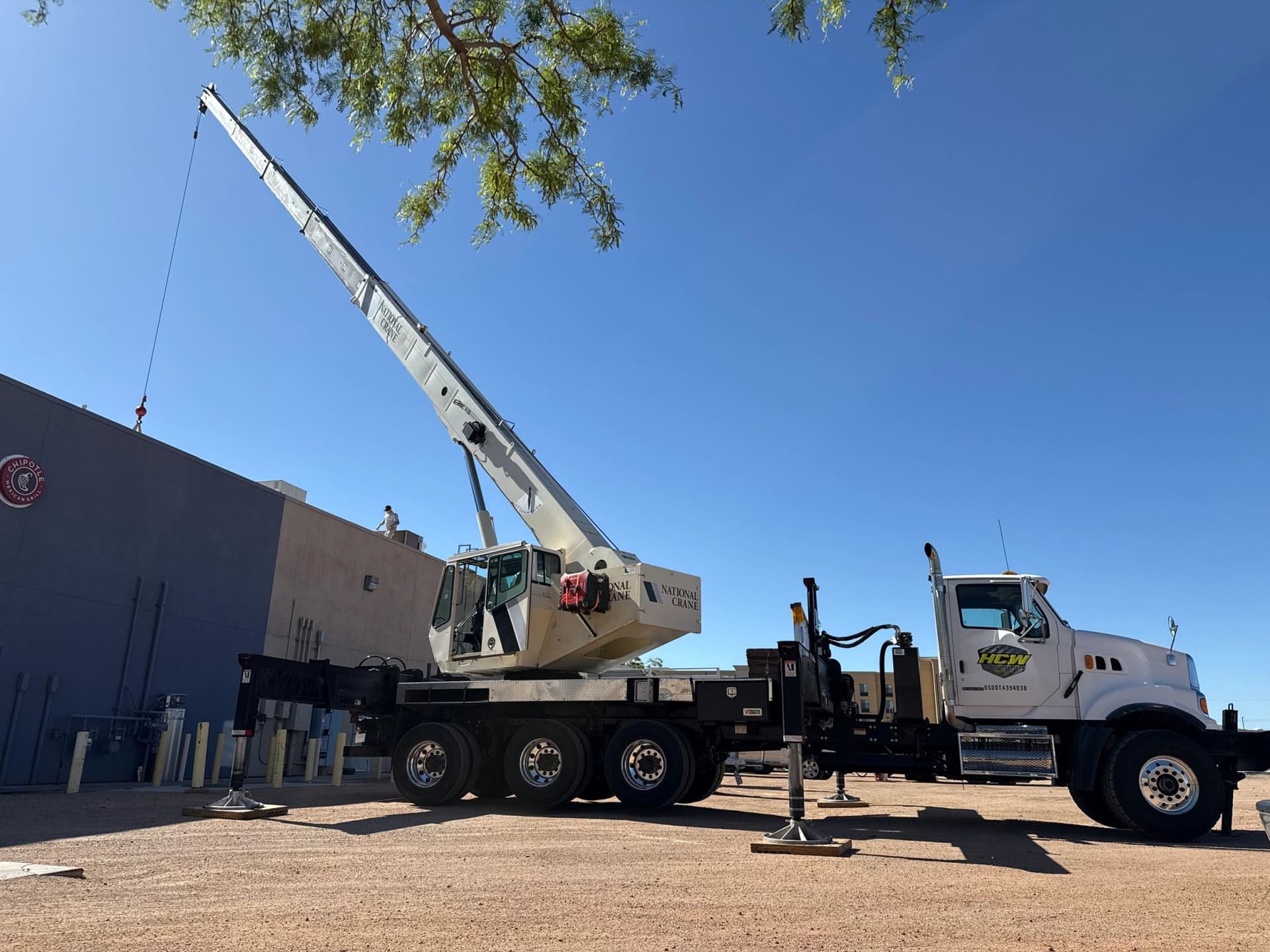
Capacity matching is checking a load against the crane's load chart at the radius the site actually requires. A 22 ton or 40 ton rating describes the crane at its shortest reach only. HCW Crane Service confirms the real weight, subtracts the block, hook and rigging, and picks the truck that fits the site.
What the tonnage rating actually means
A 22 ton crane is not a crane that picks 22 tons. It is a crane that picks 22 tons with the boom short and the load tucked in tight against the machine, which is very close to nowhere anyone needs a load to be. The same is true of the 40 ton truck. The number on the door is a headline, not a promise.
What governs the job is the load chart. The chart is a grid: boom length down one side, radius across the top, and a capacity in every box where the two meet. Move the load out and the number in the box drops, and it drops faster than most people expect. Doubling the radius does not halve the capacity, it usually takes far more than half.
That falloff is not the manufacturer being cautious. It is a lever. The load sitting out on the end of the boom is trying to tip the machine over its outrigger, and the further out it sits, the harder it pries against a counterweight that never moves. The chart is just that arithmetic printed in a table.
Gross chart capacity is not what you get at the hook
The number in the chart box is gross. Everything hanging off the boom before your load even exists comes off the top of it. The hook block is the first bite, and on a heavier block that is not a small figure. Then the wire rope hanging out at long boom, then whatever rigging you plan to use.
Slings weigh something. A spreader beam weighs a lot more, and on wide pick points a spreader is often the only way to get an acceptable sling angle. If a jib is rigged, it comes off too, whether or not you use it, because it is out there on the boom head adding its own moment.
Subtract all of that from the chart figure and what remains is net capacity at the hook. That is the number your load has to fit inside. It is common for the deductions to eat a meaningful slice of a chart box at long radius, which is exactly when people assume they have more room than they do.
Getting a real weight instead of a guess
Every guessed weight is low. Nobody ever eyeballs a unit and comes in over. Rooftop equipment gets guessed at because it is up there and nobody wants to climb, and a tank gets guessed at because somebody forgot about the residual in the bottom. So we go looking for a number that somebody wrote down.
The nameplate on the unit is the first place to look, and on packaged equipment it is usually right there on the data tag. Shipping paperwork gives a weight, and if it came on a truck somebody weighed it. A manufacturer cut sheet gives dry weight, and you add whatever is in it. For shop built steel, the shop drawing and a weight per foot get you close.
When no number exists, the pick gets planned against a conservative estimate with the reasoning stated out loud, and the crane gets sized so the estimate being wrong is survivable. That is not the same as guessing. It is deciding, in advance, how much room to leave for being surprised.
Choosing between the 22 ton and the 40 ton
Bigger is not automatically better, which surprises people. The 40 ton truck is a bigger machine in every direction. It is longer, it is heavier, and it wants a wider outrigger spread to earn its chart. All of that has to fit on the property before any of its extra capacity counts for anything.
Plenty of lots in town cannot give it that. A driveway between two block walls, a gate off a narrow lane, a lakefront lot with no frontage to spare. On those the 22 ton truck set up close beats the 40 ton parked back at the roadway, because radius is worth more than raw rating. The smaller machine standing in the right spot wins.
When the numbers come back short on both trucks at the radius the site forces, the answer is that this one is not our pick, and you get told that on the phone rather than on the day. It is not a good look for anybody to arrive, set up, run the chart and then pack back up.
How the job runs
Our Process
Step 1: Establish the real weight
We chase down a written weight from the nameplate, the shipping ticket or the manufacturer cut sheet, and we ask what is inside it. Residual fluid, a full battery bank or a shipping skid all add up. If no number exists anywhere, we say so and plan around a conservative figure.
Step 2: Fix the working radius
The weight means nothing until we know how far out it has to go. Where the truck can physically stand, measured to the center of rotation, and where the load has to land set the radius. Both ends of the pick get measured, since picking and setting are often at different distances.
Step 3: Read the chart and deduct
Boom length and radius give a gross capacity off the chart. Off that comes the hook block, the hanging line, the slings, the shackles and any spreader beam being used to open up the sling angle. What remains is the number the load has to fit under, with margin left deliberately.
Step 4: Truck choice for site
Capacity is only half the choice. The 40 ton truck needs a wider outrigger footprint and more length to place itself, and a driveway or a gate can rule it out. Where access is tight, the 22 ton set close often gives more usable capacity than the larger machine held back.
Step 5: Confirm or decline
If the numbers work with room left, the setup spot and rigging get locked in. If they do not, we say the pick is not ours and explain which number killed it. Sometimes removing an obstruction to gain ten feet of radius changes the answer, and we will tell you when it would.
Scope
What Is Included
- Written load weight traced to a nameplate or ticket
- Load chart read at the actual working radius
- Deductions taken for block, line, rigging and spreader
- Truck selection matched to both capacity and access
- Net capacity at the hook stated in plain numbers
- Clear decline when the chart will not support the pick
Answers
Frequently Asked Questions
Why can a 40 ton crane not pick a 10 ton load in my back yard?
Because the 40 ton figure applies with the load tucked in tight against the machine. Your back yard puts it sixty or seventy feet away over a house, and at that radius the chart may give a small fraction of the headline number. Capacity is always weight at a distance, never weight on its own.
How do I find out what my unit weighs?
Look for the data tag on the unit itself, usually near the electrical connections or on the base rail. If it has not been installed yet, the shipping paperwork will list a weight, and the manufacturer cut sheet gives a dry weight you add contents to. Send us a photo of the tag and we will read it from there.
Does the rigging really change the answer that much?
It can. The hook block alone is a real number, and a spreader beam heavy enough to open the sling angle on a wide unit adds more. At long boom the hanging wire rope counts too. On a short close pick the deductions barely matter. Out at the end of the chart they can decide the job.
Which crane will you bring to my job?
Whichever one the site and the chart point to. If access is tight, the 22 ton truck standing close to the work usually gives better usable capacity than the 40 ton held back at the property line. If the load is heavy or has to travel a long way out, the bigger truck comes, assuming it fits.
What if my weight estimate turns out to be wrong on the day?
That is why margin gets left in the plan rather than working right up to the chart line. A modest surprise is absorbed. A large one means the pick gets recalculated on the spot, and if it no longer works the load stays on the ground. Nothing gets lifted on optimism about a number.
Can you pick something with an unknown weight if it looks small?
Small and heavy live together more often than people think. A compact transformer or a machine base can outweigh something three times its size. If nothing written exists, we work from dimensions and material to build a defensible estimate, then size the crane so being wrong does not become an incident.
Related Services
- Reach and Radius PlanningReach and radius planning in Lake Havasu City. Where the boom truck can stand sets the radius, and radius decides what the crane can lift over your house.
- Lift Planning and Site SupportWeight, radius, ground and overhead worked out before the truck rolls, by the operator who runs the crane.
- Machinery PlacementMobile crane machinery placement in Lake Havasu City, Arizona. Lathes, presses, and shop equipment rigged to frame lift points and set on the pad.
- Reach and Radius PlanningReach and radius planning in Lake Havasu City. Where the boom truck can stand sets the radius, and radius decides what the crane can lift over your house.
- Site AssessmentCrane site assessment in Lake Havasu City. Gates, driveway slope, turnaround room, overhead lines and the landing point checked before the day of the lift.
- Ground Condition EvaluationGround condition evaluation in Lake Havasu City. Outrigger bearing pressure, caliche crust, backfill, buried vaults and pads sized before the crane sets up.
- Power Line Clearance PlanningPower line clearance planning in Lake Havasu City. Minimum approach distance, full swing path clearance and utility coordination settled before a crane sets up.
- Pre-Lift Safety BriefingPre lift safety briefing in Lake Havasu City. Roles, signals, exclusion zone, stop authority and the abort plan agreed out loud before the outriggers go down.
Ready to schedule your lift?
Tell us the load, the site and the timing. We will confirm capacity, access and a window.