Why Choose HCW
How Property Damage Actually Gets Prevented
2 min readUpdated July 2026
Most crane damage on a residential or commercial property is caused by outrigger loading on the wrong surface, or by something in the swing path nobody looked at. HCW Crane Service cribs every outrigger, walks the whole load path rather than the two ends, and moves fragile items before the boom comes up.
Everything That Bears Weight Gets Something Under It
A boom truck puts a large share of its weight and the load through four outrigger feet. The contact patch is small and the pressure is high, which is why an outrigger set straight onto a residential driveway can leave a mark that will not buff out.
Steel or timber pads spread that load across a much bigger area, and cribbing builds it up further where the ground is uneven or the surface needs protecting. That is standard, not an extra, and it happens on concrete as readily as on dirt.
On pavers, stamped concrete and decorative surfaces the answer is often simpler. Do not set up there. Reaching from the street costs some capacity and it removes the question entirely, which is usually the better trade on a finished property.
The Swing Path, Not Just the Two End Points
People picture a lift as a starting point and a destination. The damage happens in between. A load travels an arc, and everything under that arc is exposed for the whole time the load is above it.
So the walk covers the path, at height and on the ground. What the load passes over. What the boom passes over, which is a different line. What is directly underneath at every point, because a dropped shackle falls straight down and does not care about the plan.
Rotation is the other half of it. A load that is free to spin will spin, and a spinning load has a much bigger footprint than a still one. Tag lines held by hand are how that gets controlled, and they go on before the load leaves the ground rather than after it starts turning.
The Things That Actually Get Hit
Damage in this trade is rarely dramatic. It is small, avoidable, and almost always something nobody thought to look at. The list barely changes from job to job.
Every one of those is visible on a walk and invisible from the cab once the boom is up. That is the entire reason the walk happens with someone who knows the property.
- Block wall caps, which crack and are hard to match
- Gate posts and gate hardware on the way through
- Downspouts, gutters and roof edge tiles
- Irrigation heads and drip line under an outrigger
- Security cameras and satellite dishes on a corner
- Line sets, hose bibs and meters in a tight side yard
- Parked vehicles nobody moved because they seemed far enough away
Moving It Before, Not Working Around It
The cheapest form of protection is removal. A patio table moved ten feet cannot be hit. A car moved to the next street cannot be hit. A camera unclipped from a wall for an hour cannot be hit.
So part of the walk is agreeing what gets moved rather than worked around. It takes a few minutes at the start and it removes a whole category of risk from the rest of the day.
Where something genuinely cannot move, like a shade structure or a mature planting, it changes the plan instead. A different setup position, a different approach angle, or a higher path. Working carefully around an obstacle is always worse than not having the obstacle in the path.
How the job runs
Our Process
Step 1: Walk the Whole Path
Not just where the load starts and stops. What it passes over, what the boom passes over, and what sits directly underneath at every point along the arc.
Step 2: Protect Every Bearing Point
Pads under all four outriggers, cribbing where the ground is uneven, and a decision to work from the street where a surface is too good to risk.
Step 3: Clear and Move
Vehicles, furniture, removable fittings and anything fragile gets moved out of the path rather than worked around. Agreed with you before setup.
Step 4: Control Rotation the Whole Way
Tag lines on before the load leaves the ground, held by hand for the whole travel, and a slow controlled set at the end.
Scope
What Is Included
- Pads and cribbing under every outrigger, on any surface
- Full swing path assessment rather than endpoint checks
- Tag line control from lift-off to set-down
- Agreed removal of fragile or moveable items before setup
- Setup from the street to protect finished driveways
- Condition photographs before the truck is deployed
From the cab
The View From the Operator's Seat
These were taken from inside the crane cab on real HCW jobs.
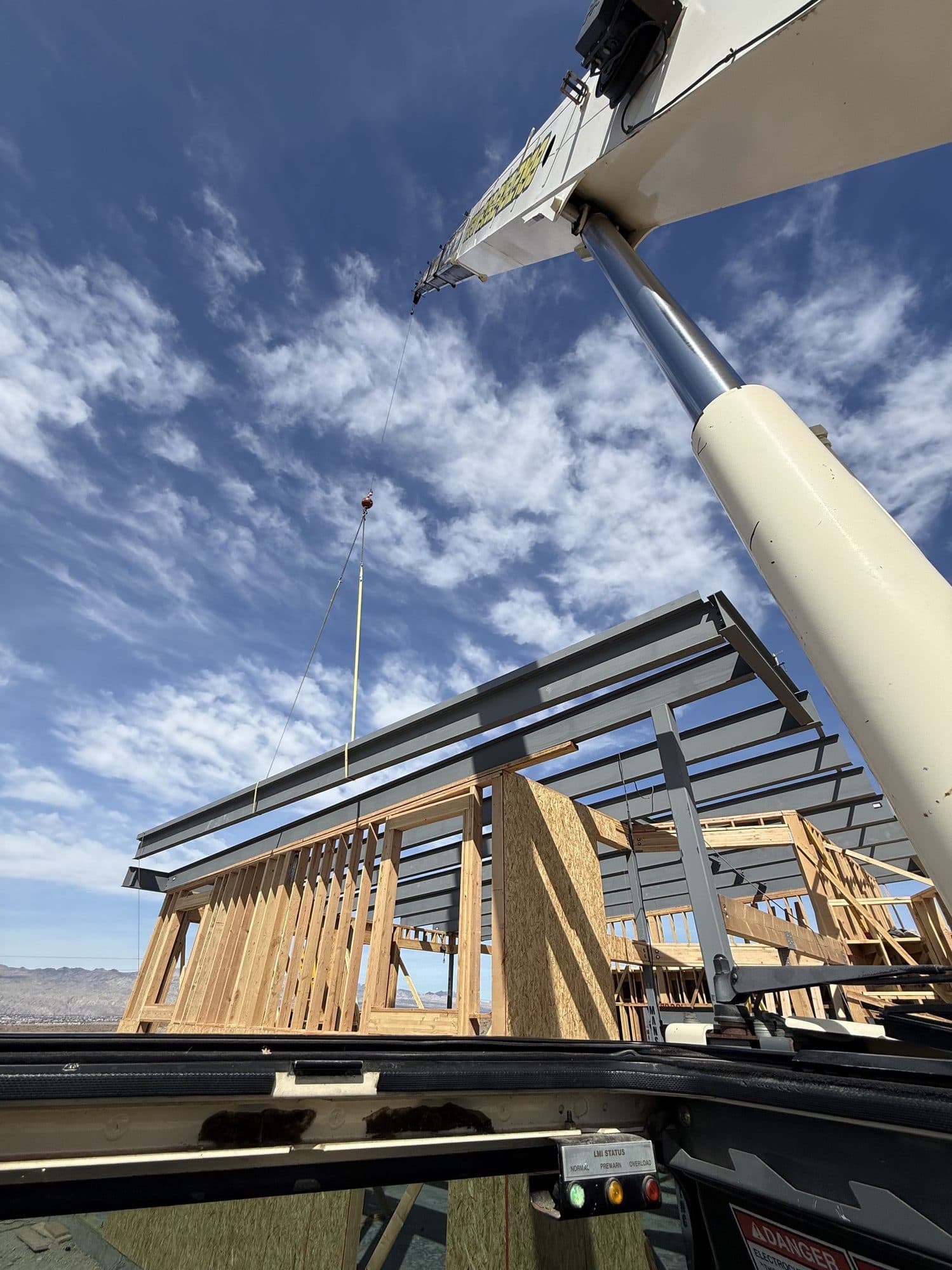
Operator view of a beam landing 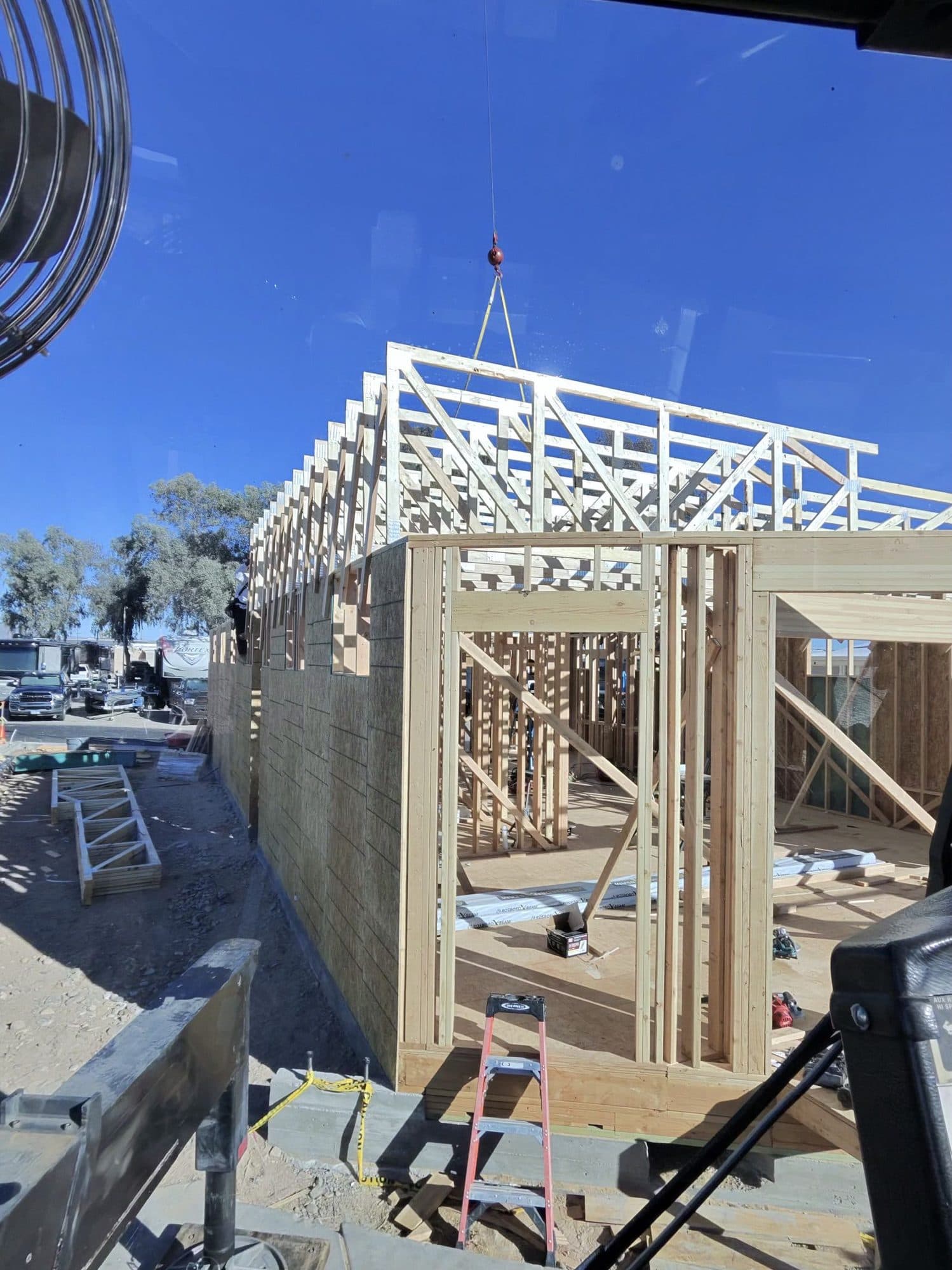
Trusses landing on a house frame 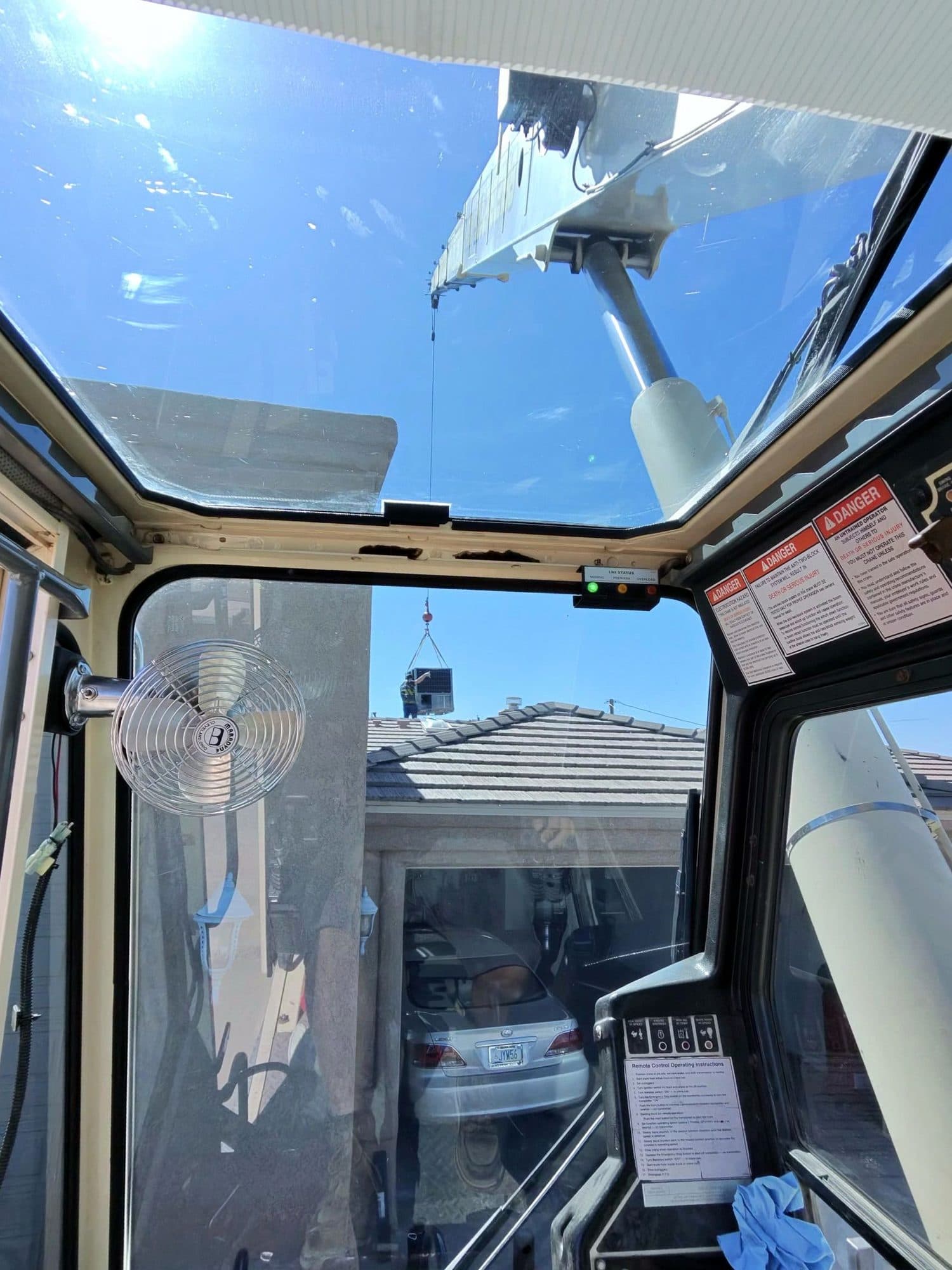
Rooftop unit lifted over a tile roof
Answers
Frequently Asked Questions
Will outriggers crack my driveway?
Not with pads and cribbing under them, which is standard here. The risk comes from setting feet directly on the surface. Where a driveway is decorative or looks marginal we set up on the street instead and reach in.
What is the most common damage on a residential lift?
Block wall caps and gate hardware, by some distance. They sit exactly where a load passes and they are easy to overlook because they are part of the scenery. They get identified on the walk for that reason.
Do I need to move my cars?
Usually yes, and further than you would expect. The exclusion zone covers the swing radius, not just the spot underneath the load. It is easier to sort out the night before than to be knocking on a neighbour's door at seven in the morning.
What stops the load from spinning?
Tag lines, held by hand, fitted before the load leaves the ground. A suspended load will rotate on its own given any chance, and a spinning load sweeps a much wider area than the plan allowed for.
Do you take photos of existing damage?
Yes, before anything is deployed. It protects you and it protects us. A photograph of a cracked wall cap taken before setup settles a question that would otherwise come down to two people remembering differently.
More Reasons
- Safety First ProcessThe walk, the ground check, the load chart, the exclusion zone and the briefing. What actually happens before a load leaves the ground on a Havasu job.
- Clean Professional PlacementA load set on the marks, checked for level before anything is unhooked, and every pad, sling, block and piece of packaging taken off the site with us.
- Peace of Mind ResultsWhat we take responsibility for, what stays yours, and what finished actually looks like. A plain division of labour instead of a vague reassurance.
- Documented ProcessCondition photos before setup, the setup itself, and the finished placement. A record of what happened on your property that does not rely on memory.
- Safety First ProcessThe walk, the ground check, the load chart, the exclusion zone and the briefing. What actually happens before a load leaves the ground on a Havasu job.
- On Time and Clear CommunicationArrival windows instead of day ranges, a confirmation call the day before, and one phone number that reaches the person driving the truck to your job.
- Experienced OperatorsOver 20 years of operating experience shows up in small decisions, not in headlines. Reading ground, catching a bad pick early, and knowing when to say no.
- Owner Supervised QualityThe person who quotes your job is the person who runs the crane on it. No handoff, no relayed instructions, and one name attached to the outcome.
- Local Reliable ResponseBased on London Bridge Road, not dispatched from another county. What a night call actually sounds like and what can honestly be done before daylight.
- Peace of Mind ResultsWhat we take responsibility for, what stays yours, and what finished actually looks like. A plain division of labour instead of a vague reassurance.
Ready to schedule your lift?
Tell us the load, the site and the timing. We will confirm capacity, access and a window.