Mobile Crane Service
Precision Crane Placement in Lake Havasu City
2 min readUpdated July 2026
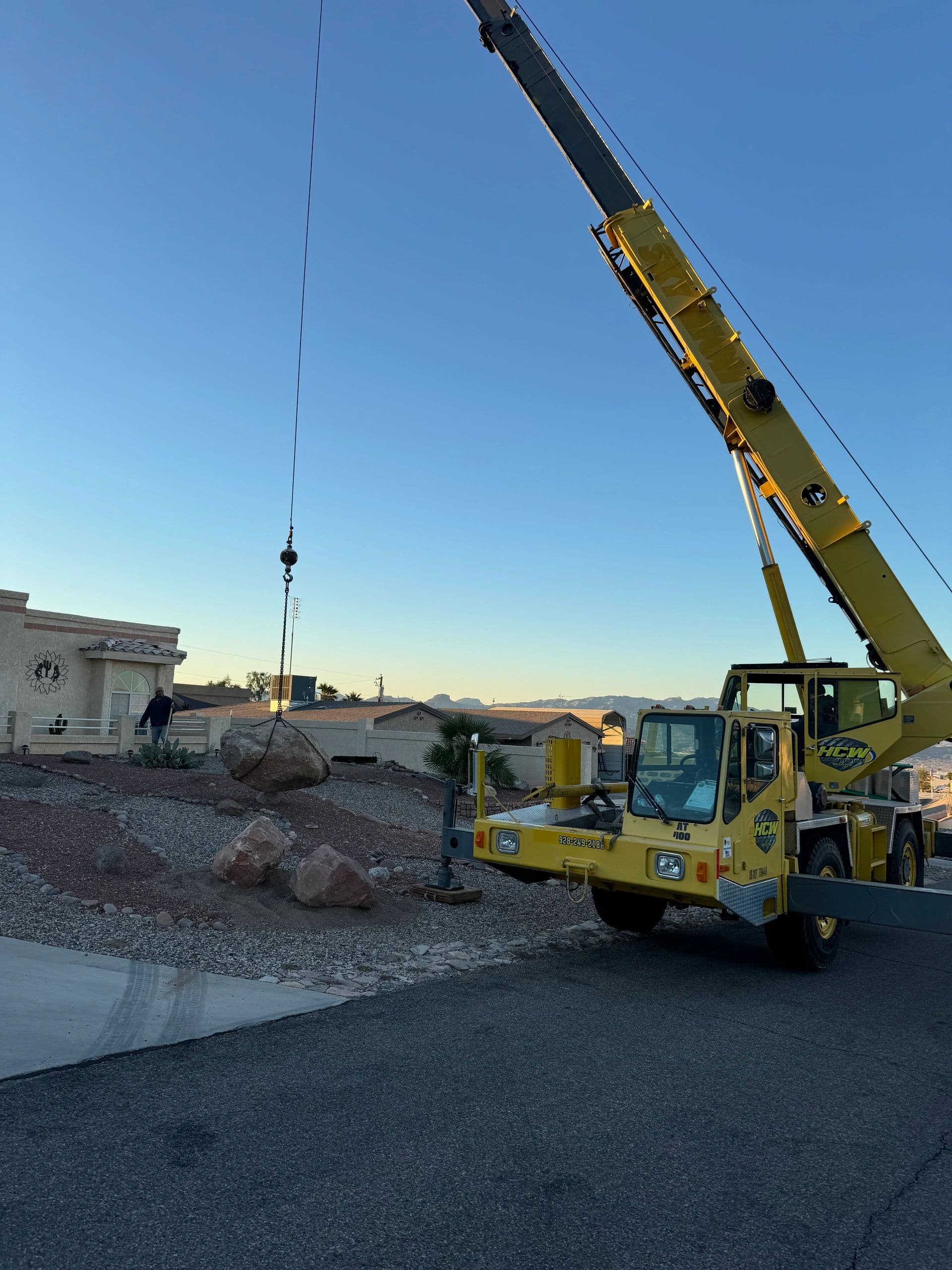
Precision crane placement is setting a load into an exact position, such as onto anchor bolts, an open roof curb, a post seat, or a prepared stone base. It relies on slow metered boom and hoist control, tag lines, and a spotter at the landing point who can see the target the operator cannot.
Owner Devan Decastro is NCCCO certified: Telescopic Boom Crane, Swing Cab (TLL). CCO ID 444146986.Verify on NCCCO(opens verifycco.org in a new tab)
The Last Six Inches Are the Job
Getting a load into the air and across a property is routine. Landing it on four anchor bolts, or seating a beam into a saddle, or setting a boulder so the good face points at the front door, is where the time goes.
That final approach is done in small deliberate movements with the load barely off its target. The operator is working the boom and hoist in inches while the spotter calls the position. Rushing here is how a bolt gets bent or a stone edge gets chipped.
Getting the load to hang correctly beforehand matters just as much. A load that hangs cocked will fight every correction. We adjust the rigging on the ground until it hangs the way it needs to sit, because you cannot fix a bad hang in the air.
Orientation, Rotation, and the Blind Spot
Most precision sets need a specific orientation as well as a position. A package unit has to face the right way for its duct openings. A generator has to line up with its conduit stub. A boulder has a face and three sides nobody should ever see.
Rotation is controlled with tag lines, set before the load leaves the ground, and a load that is close to its final rotation on the ground is far easier than one that has to be spun in the air.
The operator usually cannot see the target at the moment of contact, because the load itself is in the way. That is why one spotter with a clear view runs the last stage, either on radio or on agreed hand signals, and why nobody else is calling out at the same time.
Protecting What Is Already Finished
Precision sets often happen on ground that is already done. Travertine patios, pavers, new concrete, cured pads, planted landscaping. The load has to arrive without the site paying for it.
We use soft slings on finished surfaces, plywood or mats where the crane and the crew work, and we plan the flight path so a load never travels directly over the one thing on site that cannot be replaced.
It is also worth agreeing what happens if the target is not right. Sometimes a base is out of level or a bolt pattern is off, and the honest answer is to set the load aside on cribbing and let you fix it. Forcing a precision set onto a target that is wrong just moves the problem.
How the job runs
Our Process
Step 1: Prepare the Target
Bolts, curb, pad, or base gets checked and swept before the load moves. It is much easier to find a misplaced anchor bolt now than with a load hanging over it.
Step 2: Rig for a True Hang
Sling lengths adjusted on the ground until the load hangs level and near its final orientation. Tag lines attached before the pick.
Step 3: Bring It Close and Stop
The load travels to a position above and slightly clear of the target, then stops. Everybody confirms position and orientation before it comes down.
Step 4: Set in Inches
One spotter calls it in. The operator meters the boom and hoist in small movements until the load is seated, and it stays in the rigging until the receiving crew confirms it.
Scope
What Is Included
- Slow metered boom and hoist control for close-tolerance sets
- Rigging adjusted on the ground for a level hang and correct orientation
- Tag lines for rotation control the whole way in
- One spotter on radio or hand signals at the landing point
- Soft slings and surface protection on finished stone and pavers
- Load held in the rigging until the set is confirmed
Real HCW jobs
From the Job Site
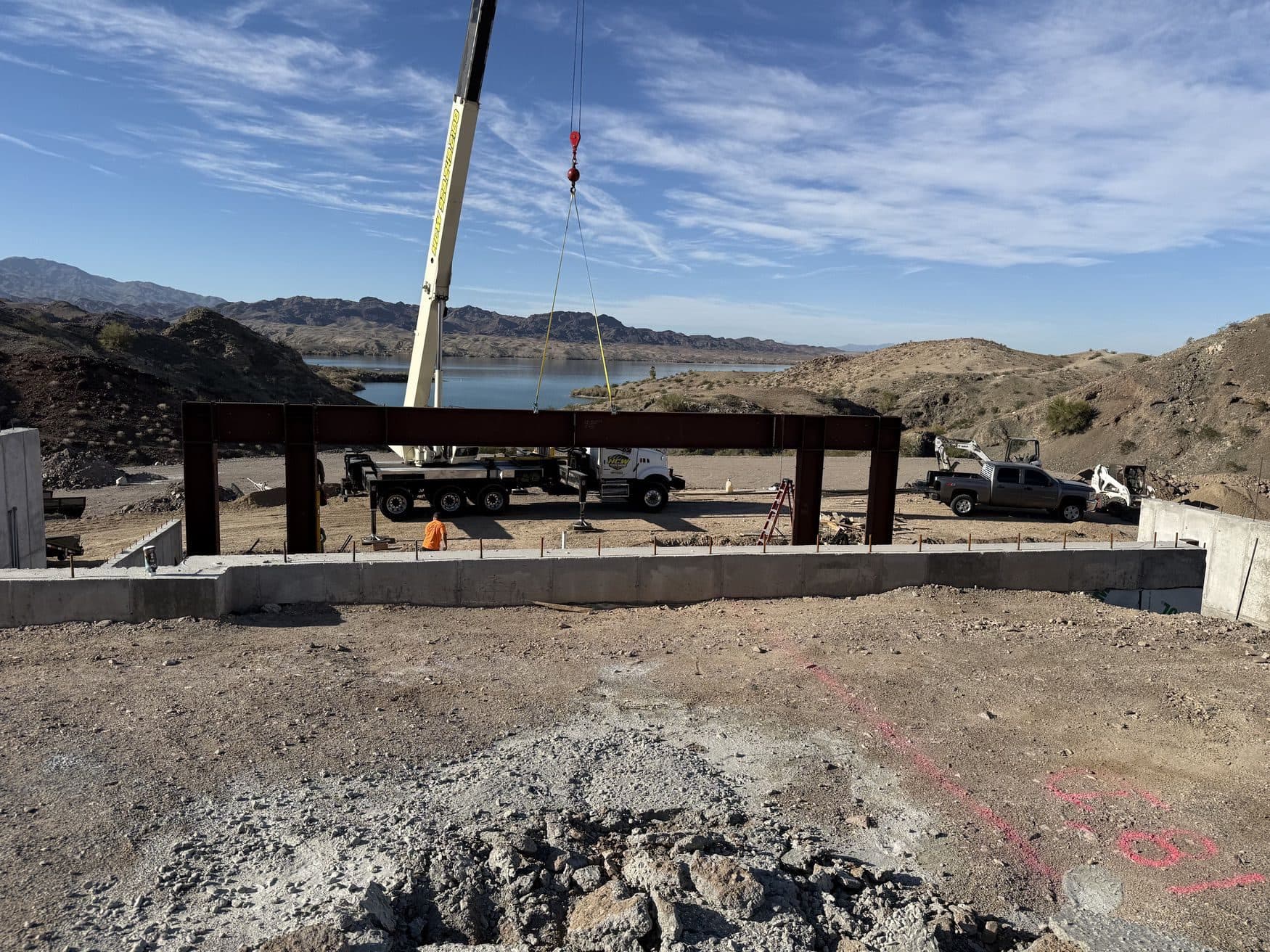
Steel portal frame above the lake 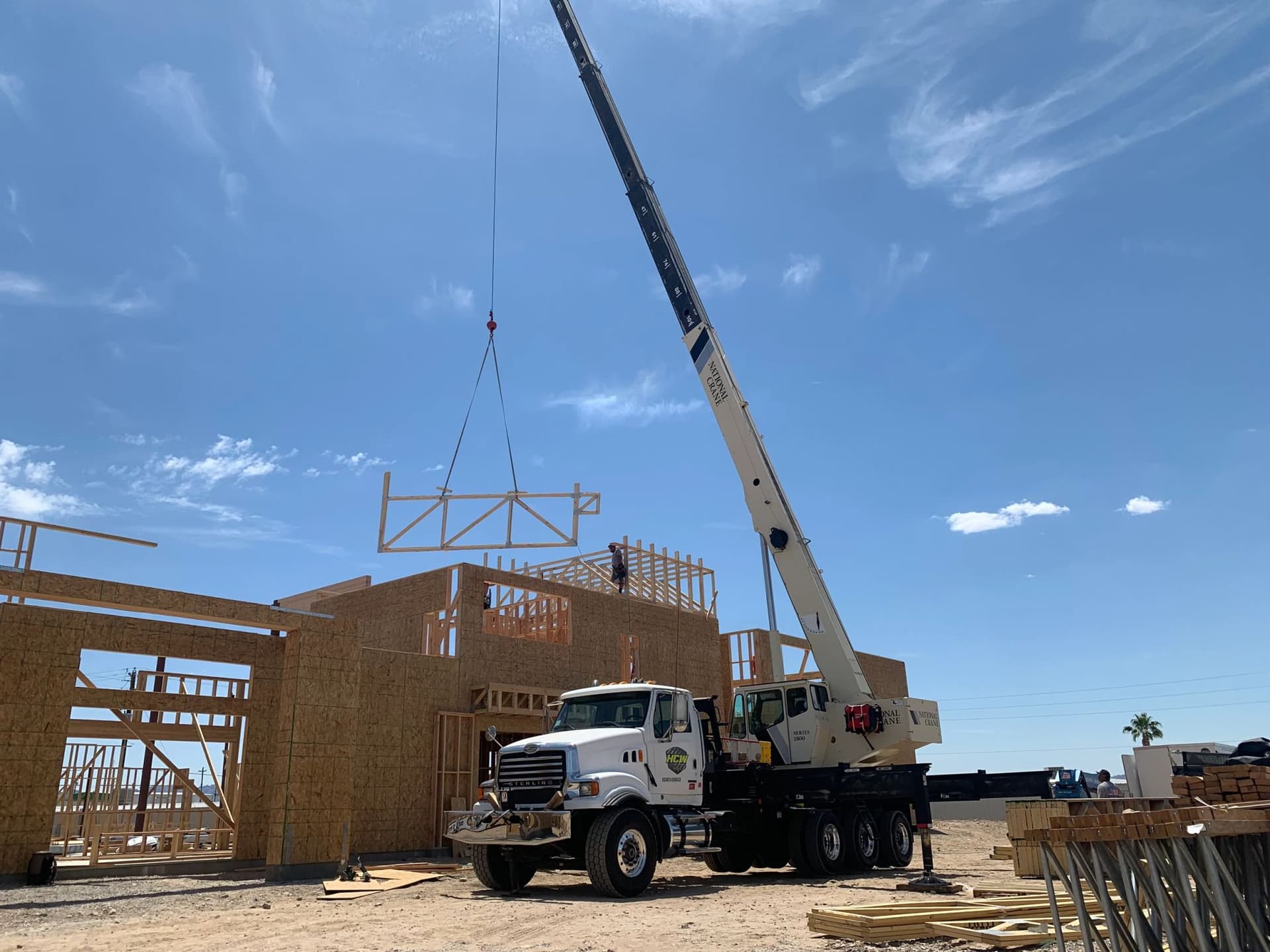
Roof truss set on a two-story frame 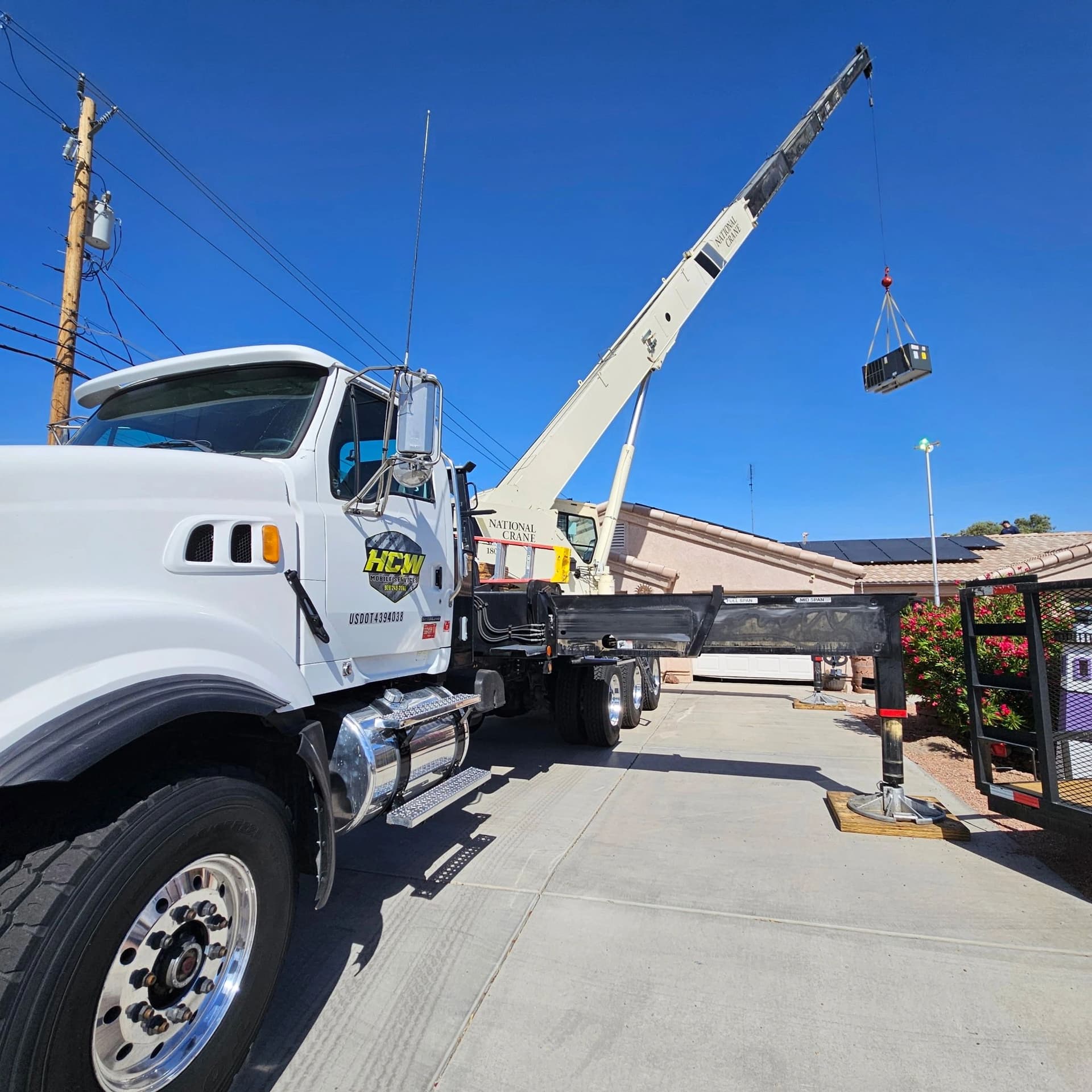
Rooftop unit lifted over a driveway 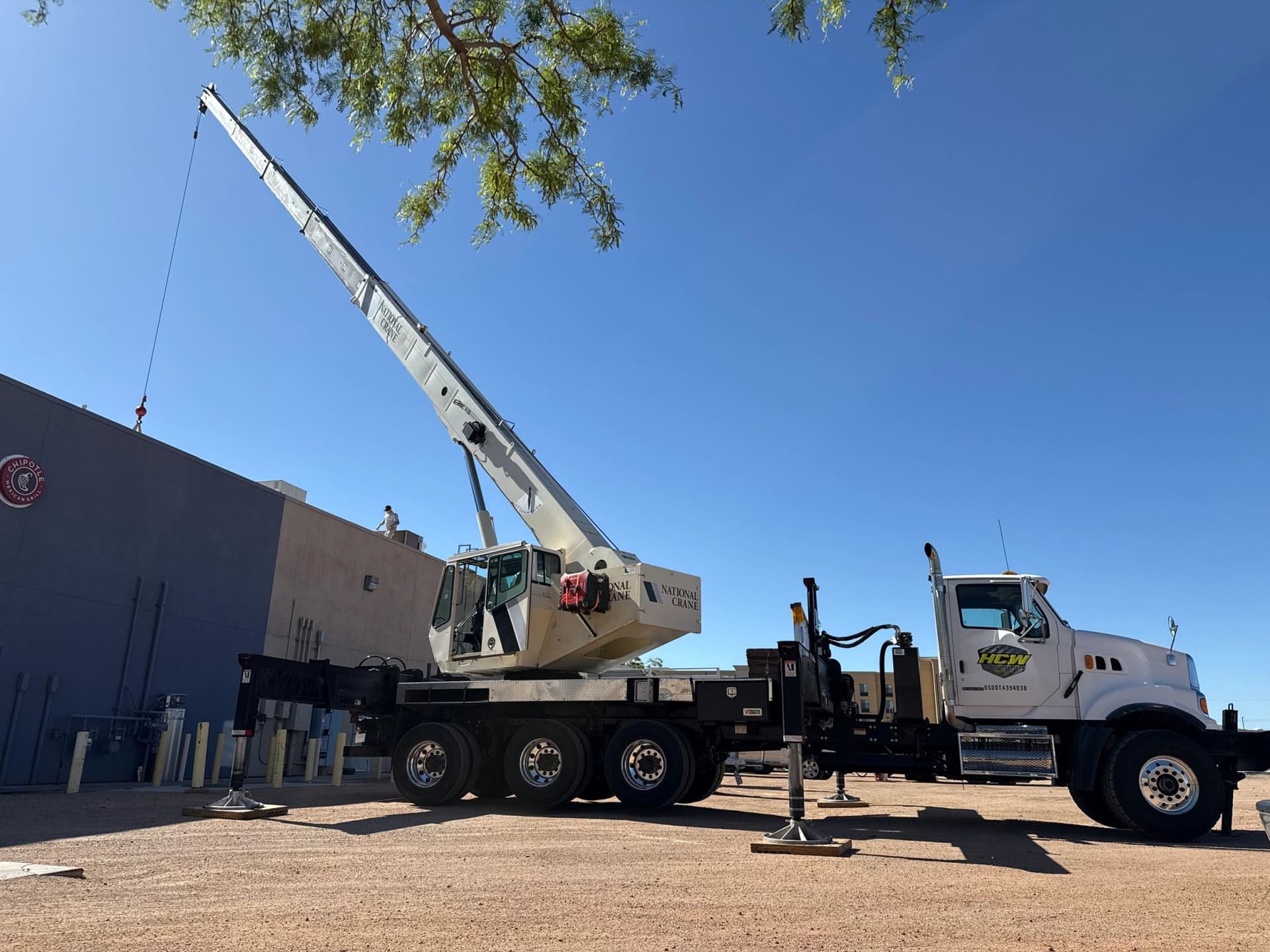
Outriggers set beside a commercial roof
Answers
Frequently Asked Questions
How accurate can a crane set actually be?
Close enough for anchor bolts and curb openings routinely. Accuracy comes from a good hang, tag line control, and a spotter, not from the crane itself. A load that hangs badly is the usual reason a set will not go in.
What if the anchor bolts do not line up?
We set the load clear, get it back on the ground or on cribbing, and let you sort the bolts. Trying to force a load onto misplaced anchors damages the load, the anchors, or both.
Can you rotate the load in the air?
Yes, with tag lines and patience. It is far easier if the load starts close to its final orientation on the ground, so we set it up that way whenever the pick point allows.
Will you damage my patio or pavers?
We plan the setup and the flight path around finished surfaces, put mats under the outriggers, and use soft slings where a load can mark. Tell us on the phone what is finished and we will design the pick around it.
Do you set boulders and landscape features?
Yes. Boulders, fountains, statuary, and stone features are common precision sets. Face orientation and a level seat are usually more work than the weight is.
Related Services
- Controlled Load PlacementA load that swings is a load nobody controls. Tag lines, smooth boom movement, and a hard stop when the monsoon wind starts to build.
- Residential Specialty LiftsSafes, boulders, fountains, statuary, sheds, playsets, and pool equipment. The one-off household loads that will not fit through a gate.
- Mobile Crane Service22-ton and 40-ton boom trucks with an operator on every call, reaching up to 142 feet.
- Owner-Operated Crane ServiceThe owner takes the call, walks the site, and runs the crane. One person accountable for the lift from the first phone call to the final walkthrough.
- Crane With OperatorEvery crane goes out with an operator and the rigging to do the job. Here is exactly who does what on site, and what your crew is responsible for.
- 22-Ton Crane ServiceOur 22-ton boom truck is the tight-street machine. Smaller setup footprint, quicker to place, and the right call for most single-story residential lifts.
- 40-Ton Crane ServiceOur 40-ton boom truck reaches up to 142 feet and holds weight far out from the truck. The machine for two-story picks and deep commercial roofs.
- Hydraulic Crane ServiceBoth of our boom trucks are hydraulic. Smooth metered control, fast setup, and no assembly. Here is what that means for your lift and for desert heat.
Ready to schedule your lift?
Tell us the load, the site and the timing. We will confirm capacity, access and a window.