Mobile Crane Service
Controlled Load Placement in Lake Havasu City
2 min readUpdated July 2026
Controlled load placement is keeping a suspended load quiet through its entire travel, not just at the ends. It relies on tag lines, smooth acceleration and deceleration on the boom and swing, and stopping the lift when wind makes the load unpredictable. Wind is the main variable in Lake Havasu.
Owner Devan Decastro is NCCCO certified: Telescopic Boom Crane, Swing Cab (TLL). CCO ID 444146986.Verify on NCCCO(opens verifycco.org in a new tab)
Why Loads Swing, and What Stops Them
A load on a line is a pendulum. Every abrupt movement of the boom starts it swinging, and once it is swinging the load is going somewhere on its own schedule. The fix is not correcting the swing after the fact, it is not starting one.
That means easing into every movement and easing out of it. Boom, swing, and hoist all get accelerated and stopped gradually. It looks unhurried and it is the fastest way to get a load where it belongs, because you never have to wait for a swing to die out.
Tag lines are the other half. A line to the ground gives a person outside the drop zone leverage over rotation and drift without anyone touching the load. On anything long, flat, or tall, we run two.
Wind, Sail Area, and the Monsoon
Weight is not what wind grabs. Surface area is. A spa shell, a precast panel, a banded stack of trusses, or a large sheet metal cabinet all present a face that catches air, and a light load with a big face is far harder to control than a heavy compact one.
Havasu monsoon season brings gusts that build quickly and arrive from a direction that changes through the afternoon. A pick that is comfortable at seven in the morning can be a bad idea by two. We plan wind-sensitive loads early in the day during that season.
If the wind builds mid-lift, the load goes down. Not held, not hurried through. Set it somewhere safe, wait, and pick it back up. That is a short delay against a load that starts swinging over a finished roof.
Blind Picks and the Drop Zone
Plenty of loads travel where the operator cannot see them the whole way, over a ridge line, behind a parapet, or down into a walled yard. Those runs are controlled by a spotter on radio who has eyes on the load and the landing point the whole time.
The drop zone gets cleared and stays clear. On residential jobs that takes active management, because homeowners, neighbors, and dogs all drift toward a crane. We set a boundary before the first pick and we hold it.
How the job runs
Our Process
Step 1: Read the Load and the Day
Sail area, shape, and the wind forecast set the plan. High-surface loads get scheduled for the calmest part of the day during monsoon season.
Step 2: Tag Lines Before the Pick
One or two tag lines attached on the ground, handled from outside the drop zone. Nobody guides a load with their hands on it.
Step 3: Smooth Through the Whole Travel
Gradual starts and stops on boom, swing, and hoist. The goal is a load that never begins to swing rather than one that gets corrected.
Step 4: Spotter on the Landing Point
On blind picks a spotter with radio owns the last stage. The drop zone stays clear until the load is down and out of the rigging.
Scope
What Is Included
- Tag lines sized and placed for the load, one or two as needed
- Smooth metered boom, swing, and hoist through the full travel
- Wind assessment before the lift and monitoring during it
- A defined drop zone kept clear on residential and commercial sites
- Radio spotter on blind picks over roofs and walls
- A stop and set down if conditions change mid-lift
Real HCW jobs
From the Job Site
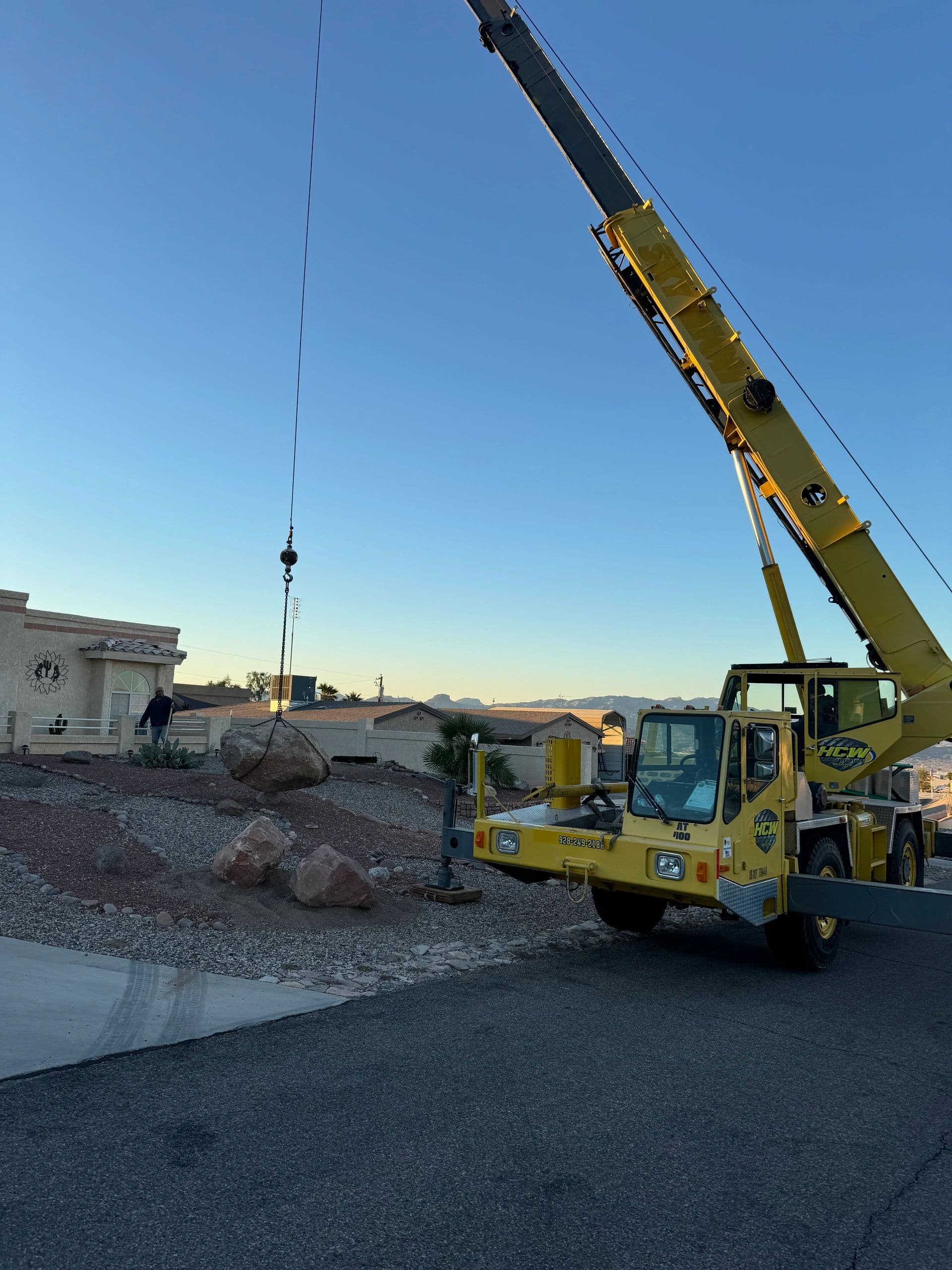
Landscape boulder set at dusk 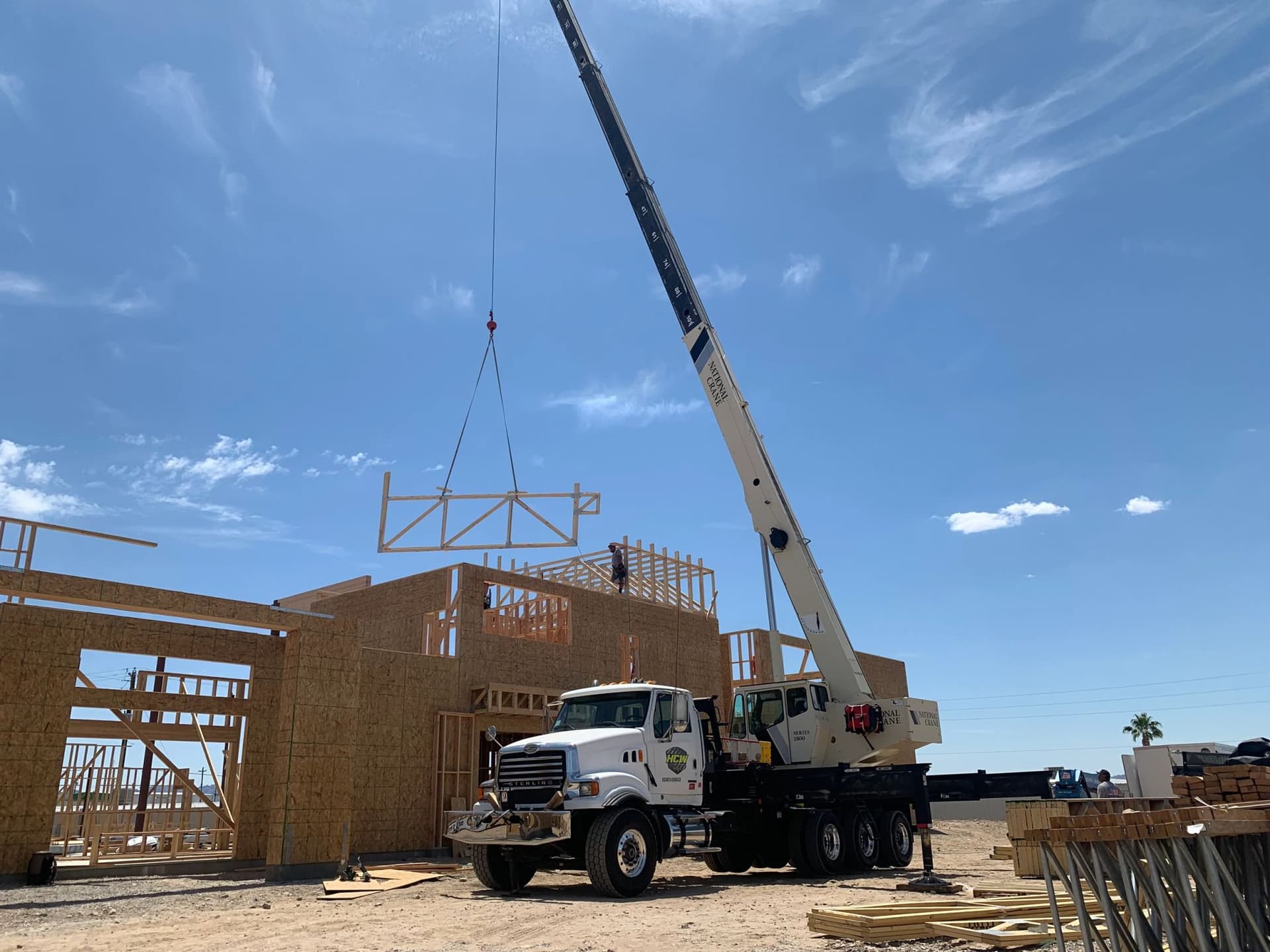
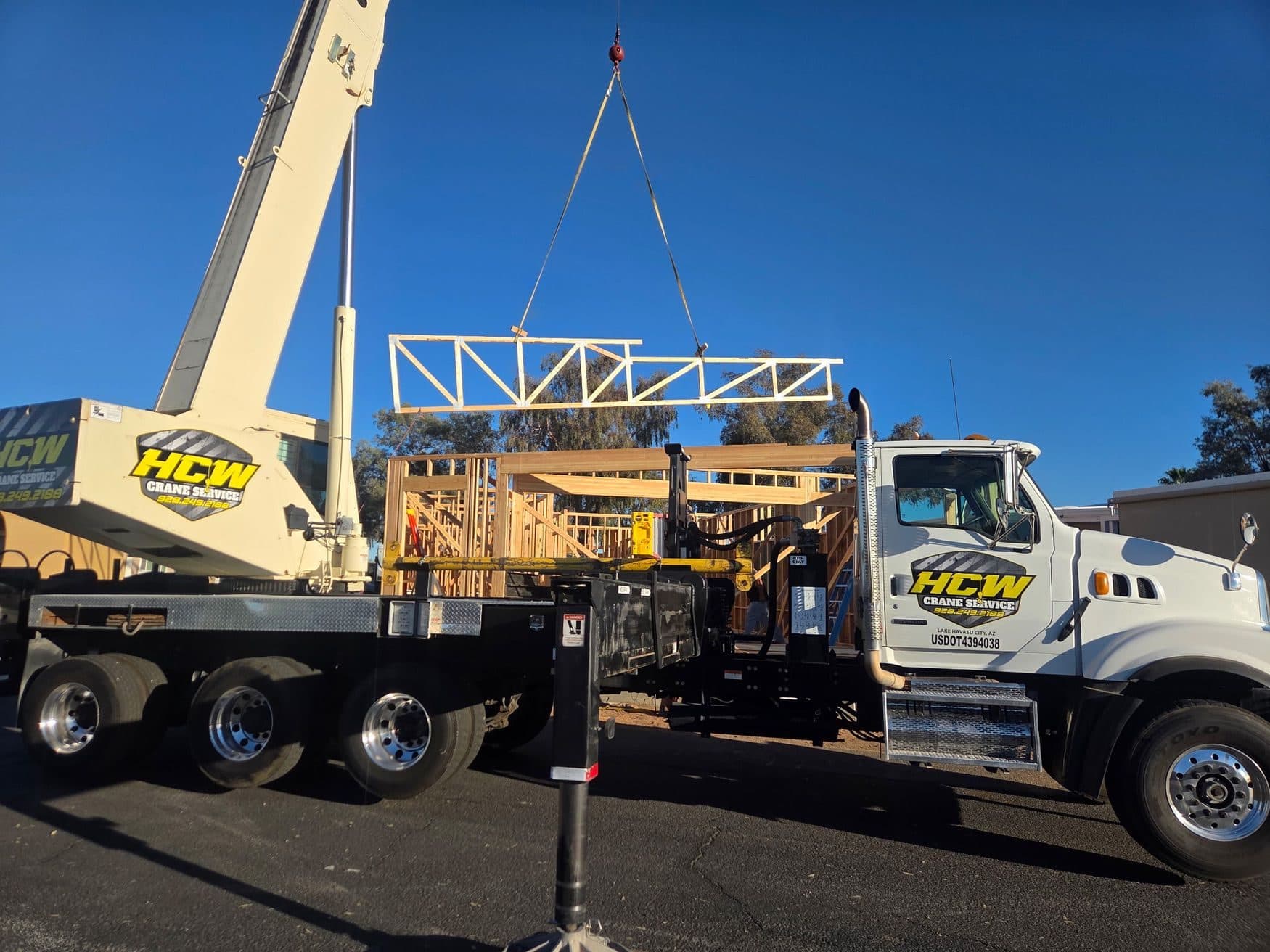
Roof truss set on a two-story frame 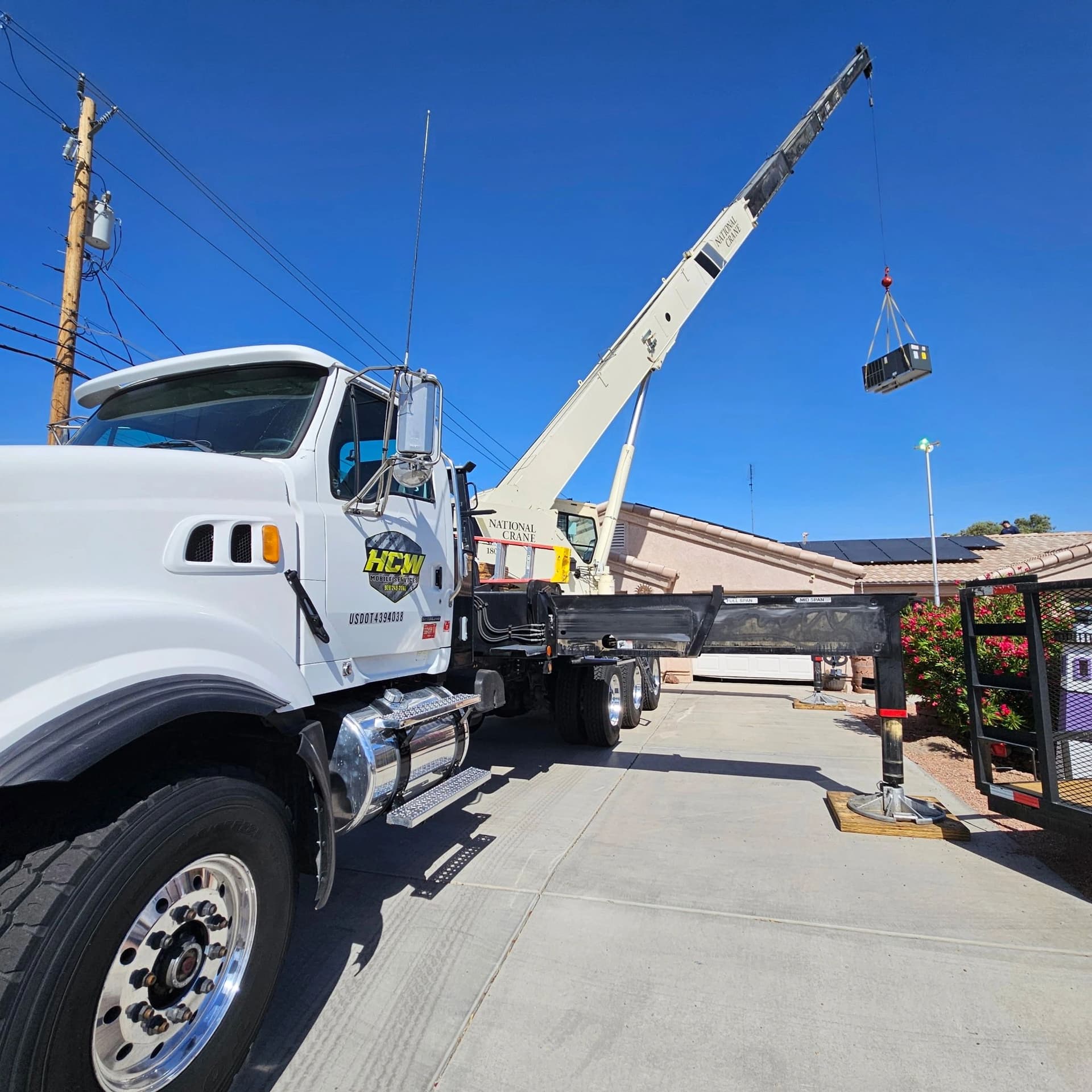
Rooftop unit lifted over a driveway 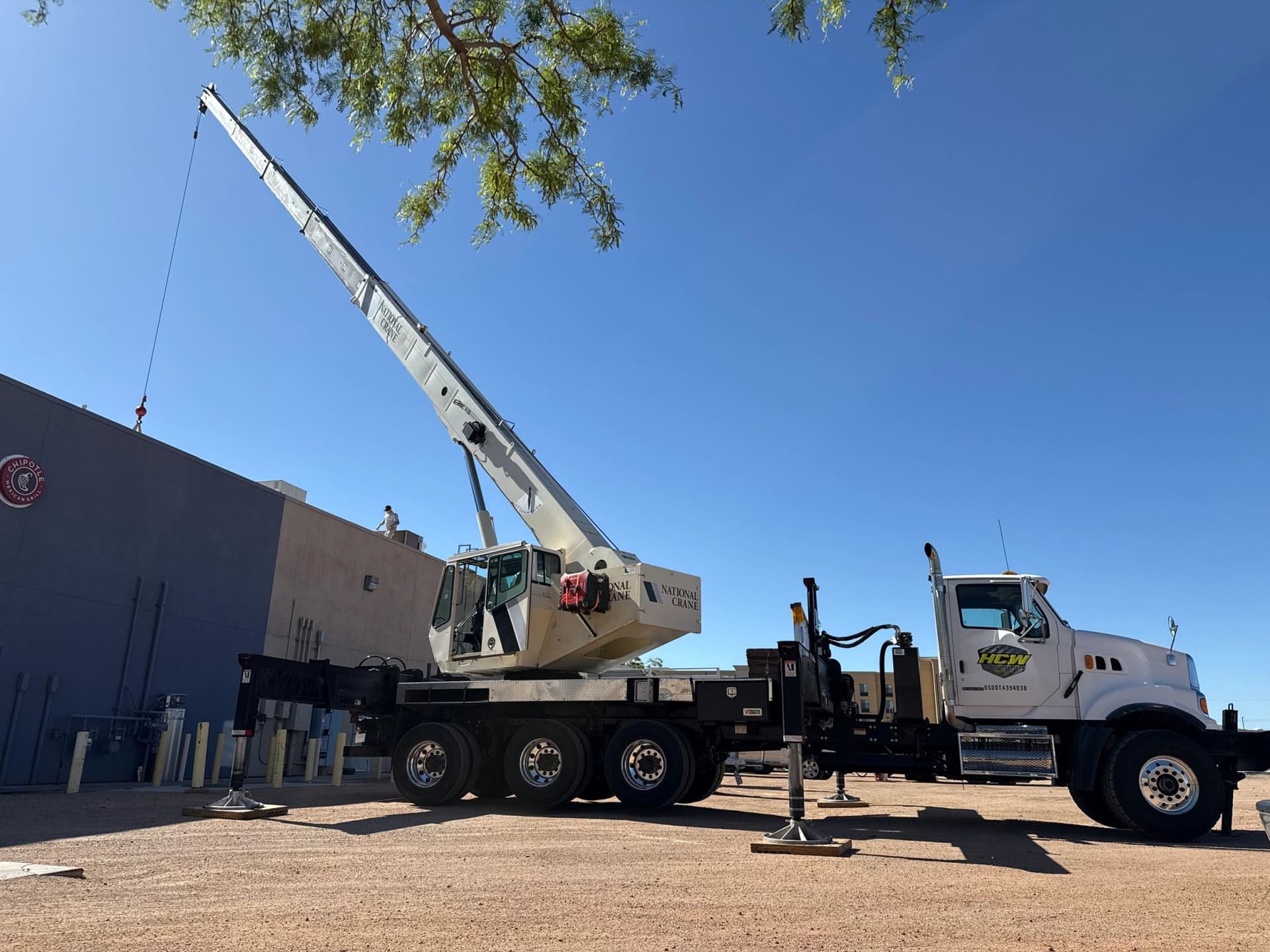
Outriggers set beside a commercial roof
Answers
Frequently Asked Questions
At what wind speed do you stop lifting?
It depends on the load as much as the number. A compact steel load and a flat spa shell behave completely differently in the same gust. The operator makes the call on the day, and setting a load down and waiting is always the available option.
Can somebody hold the load steady by hand?
No. Hands stay off suspended loads and people stay out of the drop zone. Tag lines give better control from a safe distance, which is exactly why we use them.
How do you control a load you cannot see?
A spotter with a radio who has continuous view of the load and the landing point. Signals get agreed before the pick, and only that one person talks to the operator.
Is monsoon season a problem for crane work?
It changes the schedule more than it cancels it. Wind-sensitive loads move to early morning, and we watch the forecast. Afternoon gusts that build fast are the specific thing we plan around.
Related Services
- Precision Crane PlacementSome loads have to land within an inch. Anchor bolts, curb openings, post seats, and finished stone. Here is how we set a load that has to be exact.
- Heavy Lift Crane ServiceHeavy picks leave no room for a guessed weight. We verify the load, check the chart at the real radius, and keep the lift slow and deliberate.
- Over-Structure PlacementFlying a load over a house, a garage, or a block wall. Ridge clearance, a blind descent on the far side, and a spotter running the last stage.
- Owner-Operated Crane ServiceThe owner takes the call, walks the site, and runs the crane. One person accountable for the lift from the first phone call to the final walkthrough.
- Crane With OperatorEvery crane goes out with an operator and the rigging to do the job. Here is exactly who does what on site, and what your crew is responsible for.
- 22-Ton Crane ServiceOur 22-ton boom truck is the tight-street machine. Smaller setup footprint, quicker to place, and the right call for most single-story residential lifts.
- 40-Ton Crane ServiceOur 40-ton boom truck reaches up to 142 feet and holds weight far out from the truck. The machine for two-story picks and deep commercial roofs.
- Hydraulic Crane ServiceBoth of our boom trucks are hydraulic. Smooth metered control, fast setup, and no assembly. Here is what that means for your lift and for desert heat.
Ready to schedule your lift?
Tell us the load, the site and the timing. We will confirm capacity, access and a window.