Project Examples
Truss and Structural Placement Examples
1 min readUpdated July 2026
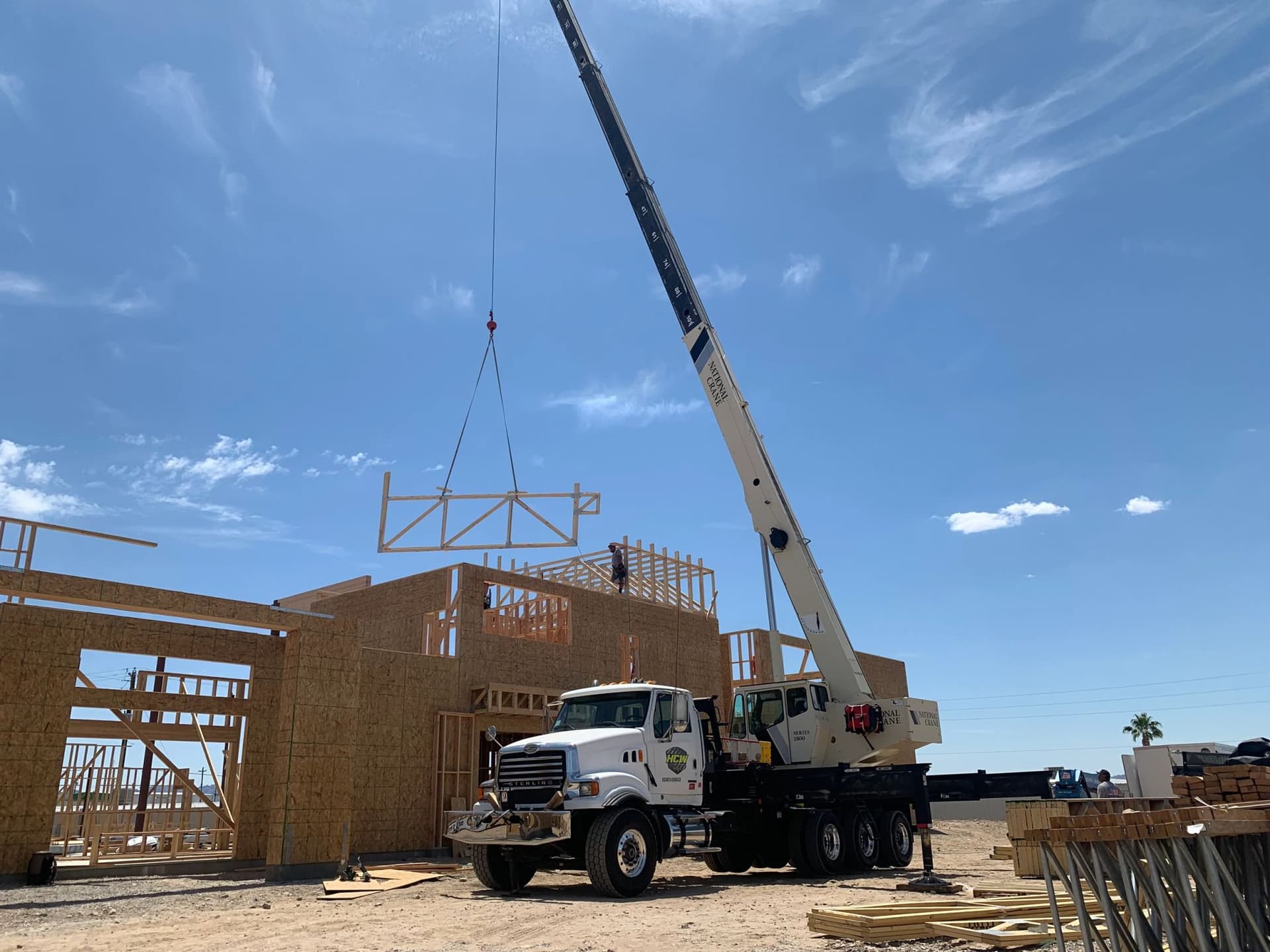
Truss work is different from a single equipment pick because the crane is part of a continuous operation. Trusses arrive banded, get lifted in the order the framing crew needs them, and each one is held until it is braced. The crane is on site for hours, not minutes.
The sequence is the job
Trusses go up in a set order, usually starting at a braced end and working across. Each one is landed on the top plate, held while the crew tacks and braces it, then released. Get the order wrong and the crew has to work around a truss that is in the way of the next one.
That means the crane is committed for the duration. A truss set is not a job we can squeeze between two other calls, and we schedule it as a block.
Why long-span trusses are awkward loads
A roof truss is strong in its own plane and floppy across it. Picked at a single point it will bow, and a long-span truss can be damaged just by lifting it badly. Spreader bars or a two-point pick keep it straight.
Wind matters more here than on almost any other load because the truss presents a large flat area. During monsoon season a gusty afternoon is a reason to stop, and it is better to plan for a morning start than to argue with the weather at two in the afternoon.
What the framing crew needs from us
Predictable timing and a setup position that lets the boom reach every bearing point without moving the truck mid-set. Repositioning a crane in the middle of a truss set costs everyone an hour.
We walk the pad before the first pick and pick a position that covers the whole span. If one position will not cover it, we plan the move into the sequence instead of discovering it halfway through.
Answers
Frequently Asked Questions
How many trusses can you set in a day?
It depends on the crew receiving them, not on the crane. A well-organized framing crew on a straightforward roof moves quickly. We match their pace.
Do you provide the rigging for trusses?
Yes. We bring slings and spreader arrangements suited to the span. Tell us the longest truss and we will bring what it needs.
What happens if it gets windy mid-set?
We stop. A large flat load in a gust is not controllable and no schedule is worth that. We resume when it settles, which in Havasu is often the following morning.
More Project Types
- Truss and Structural PlacementRoof trusses, beams, columns, steel, precast, and modular sections set to your framing crew's pace.
- Roof Truss LiftingTrusses arrive banded and go up floppy. Spread pick points, two tag lines, and a crew that braces as it goes. Crane and operator supplied.
- Beam and Column PlacementGlulam and steel beams onto post seats, columns plumbed on anchor bolts. The crane holds the member while your crew makes the connection.
- HVAC and Mechanical LiftsHow we set rooftop package units, air handlers and condensers in Lake Havasu City, including a documented commercial unit swap.
- Spa and Residential LiftsHow we place spas and hot tubs over block walls and structures in Lake Havasu City backyards without damaging the property.
- Industrial and Equipment PlacementHow we set generators, machinery, tanks and commercial equipment in Lake Havasu City and across Mohave County.
- Rigging and Construction Lift JobsHow we rig and set containers, machinery, roofing loads, solar racking, signs, poles, boats and boulders in Lake Havasu City and Mohave County.
- Tight Access ProjectsHow we work narrow lots, side yards and restricted setups in Lake Havasu City where a standard setup will not fit.
- Over Structure ProjectsHow we lift loads over houses, walls and patio covers in Lake Havasu City, and what has to be checked first.
Ready to schedule your lift?
Tell us the load, the site and the timing. We will confirm capacity, access and a window.