
Resources
Ground Conditions, Outriggers and Where a Crane Can Set Up
In Short
A crane sends most of its weight through four outrigger pads. Good ground is firm and undisturbed. Backfilled trenches are the local hazard.
4 min readUpdated July 2026
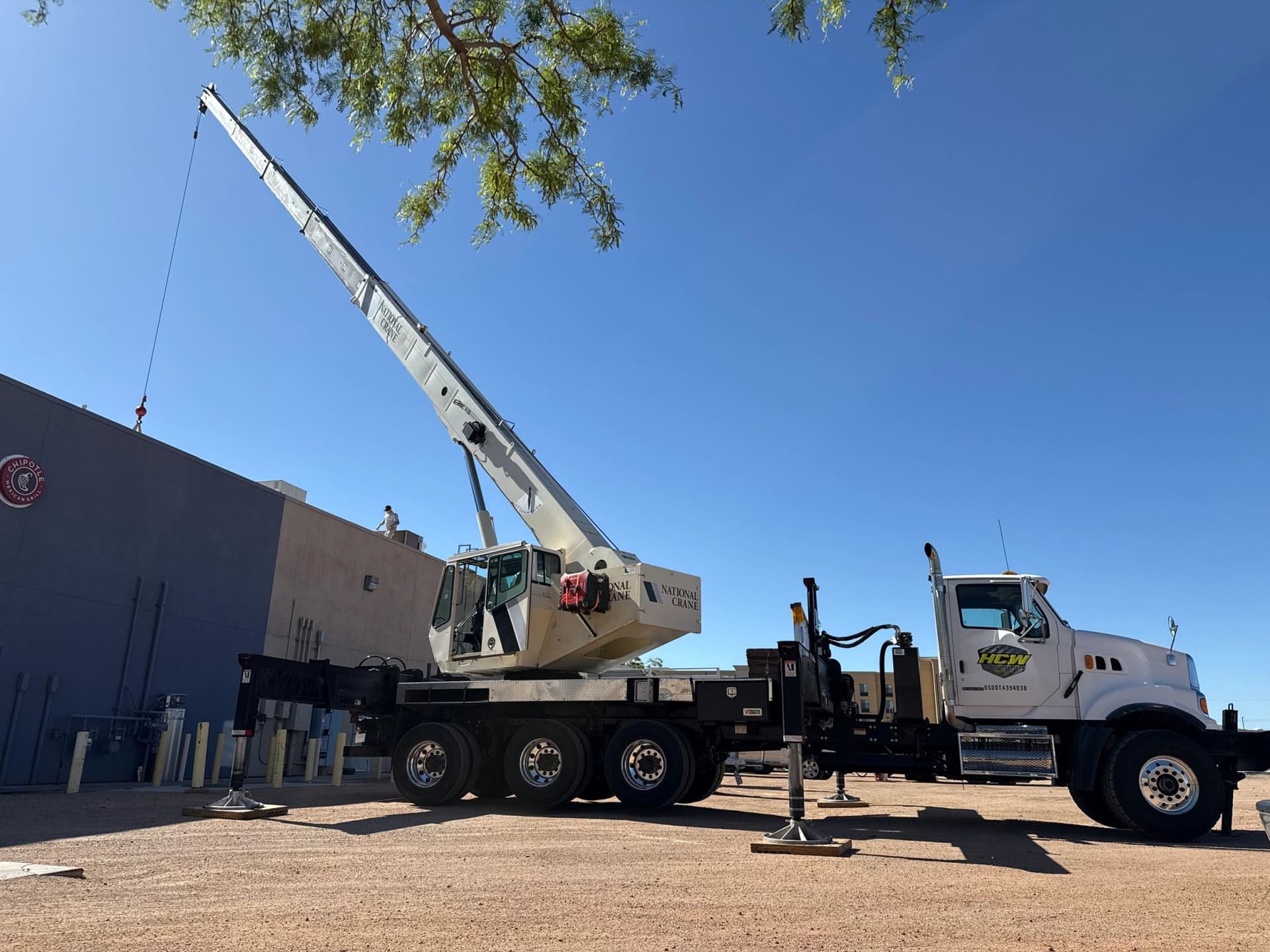
A mobile crane transfers most of its weight through four outrigger pads, each covering a small area. Setup requires firm, level, undisturbed ground. Cribbing and mats spread the load where the surface needs it. In this area the main risk is not hard caliche but backfilled utility trenches and soft fill that look identical from the surface.
Four Small Pads Carrying a Very Large Load
When a crane sets up, the truck comes off its tires entirely. From that moment everything, the machine, the counterweight and whatever is hanging on the hook, is carried by four outrigger pads, each covering a modest patch of ground.
That concentration is the whole issue. A vehicle spreads its weight across four tire contact patches while it is moving and the load shifts constantly. A crane on outriggers puts a much higher and much more focused pressure into four fixed points, and it does it while the load moves around, which means the pressure at each pad changes as the boom swings.
The pad carrying the most is whichever one is on the side the load is over. Swing the boom and that changes. A setup that is fine with the load in one direction can be marginal with the load in another, which is why the operator cares about ground under all four legs and not just the two he happens to be looking at.
Full Extension, and What It Costs to Go Short
Outriggers are designed to go all the way out. Fully extended, the crane has the widest possible base and the chart it is rated against assumes exactly that.
Sometimes there is not room. A narrow driveway, a wall on one side, a neighbor's vehicle. Partial extension is possible on many setups, but it is not free: a narrower base means the machine tips more easily, so the chart that applies is a different and more restrictive one. What the crane can lift drops, and it can drop a lot.
That is a decision made against the chart, not by eye. It is also a reason to clear more room than seems necessary before the truck arrives. Six feet of extra clearance on the load side occasionally makes the difference between a job that works and a job that does not.
Cribbing, Mats and Spreading the Load
Cribbing is the timber or engineered blocking that goes under an outrigger pad to spread its load over a wider area. Mats do the same thing over a larger footprint. The purpose is to take the pressure at the pad and hand it to the ground over more square footage than the pad alone provides.
They come out for soft ground, for surfaces that mark or crack easily, and for anything where the operator wants more margin than the bare pad gives. Decorative concrete, pavers, pool decking, asphalt in summer heat and any recently poured slab all get this treatment.
Asphalt deserves a mention on its own. In July, asphalt in this town is soft enough that an unspread pad will leave a permanent dent. That is not a structural failure, it is a cosmetic one the property owner has to live with, and spreading the load prevents it.
- Pavers and decorative or stamped concrete
- Any concrete poured recently, before it has fully cured
- Asphalt, particularly in summer heat
- Pool decks, patio surfaces and coping
- Loose gravel, landscaped areas and recently graded ground
Caliche, and What Is Not Caliche
Under a few inches of desert soil across most of this area is caliche, a hard cemented layer that is genuinely good bearing material. When a crane is sitting on undisturbed native ground here, the ground is usually not the problem. That is worth saying plainly, because people assume desert soil means poor support.
The problem is everything that is not undisturbed native ground, and from the surface it all looks the same. A backfilled utility trench crossing a driveway. Fill brought in to level a building pad. A wash that got graded flat years ago. Landscaping soil over what used to be a hole. All of it can be sitting there looking like solid ground and behaving nothing like it.
Septic tanks, leach fields, cisterns, drywells and shallow utility laterals are the other category. These are not soft ground, they are voids or vulnerable structures with a thin lid over them, and a crane pad on top of one is a genuinely serious situation.
This is why the questions about buried services get asked and asked again. If you know where a trench was cut, say so. If a section of the yard was regraded, say so. Nobody can see any of it from the seat of a truck.
How a Bad Set Shows Itself
Ground problems announce themselves during setup rather than during the lift, which is one reason setup is unhurried. As the truck comes up on its legs, the operator is watching for a pad that keeps going down when the others have stopped, for the machine refusing to sit level, and for the level drifting after it has been set.
During the pick, the sign is the machine settling as the boom comes over one side. A pad that sinks progressively while the load is out is telling you the ground under it is consolidating, and the response is to set the load down and reassess rather than to finish quickly.
Anyone on site can call a stop if they see the truck moving in a way that looks wrong. It is far better to have a false alarm and lose ten minutes than to be right and say nothing.
How the job runs
Our Process
Step 1: Identify the candidate positions
Before the day, work out from photos and description where the truck could sit, and what the radius would be from each of those positions.
Step 2: Ask what is underneath
Establish what is buried and what has been disturbed: trenches, septic, leach fields, cisterns, fill and recent grading or landscaping.
Step 3: Assess on arrival
The operator inspects each pad location on foot, checks for fresh work, soft spots and surface types that need protecting.
Step 4: Set on cribbing or mats as needed
Pads go down onto blocking or mats wherever the surface calls for it, outriggers extend as far as the site allows, and the machine is leveled.
Step 5: Monitor through the lift
The set is watched as the load moves and the pressure shifts between pads. Any progressive settling stops the lift for reassessment.
Scope
What Is Included
- Ground assessment at every proposed outrigger position
- Cribbing and mats sized to the surface being protected
- Full outrigger extension wherever the site allows it
- Chart verification when only partial extension is possible
- Leveling of the machine before any load is picked
- Monitoring for settlement while the load is out
- A stop and reassess if any pad starts to move
Answers
Frequently Asked Questions
Can a crane set up on dirt or gravel?
Usually yes, if the ground is firm, level and undisturbed. Native ground in this area is typically thin soil over caliche, which supports a crane well. The exceptions are backfilled trenches, imported fill and washes, which look the same from the surface.
Will the outriggers crack my concrete?
Not on sound, cured concrete with the load spread appropriately. Risk rises sharply on new pours, pavers, decorative finishes and any slab spanning something hollow. Tell us the pour date on anything recent, because that cannot be judged by eye.
Do the outriggers have to be all the way out?
Fully extended is preferred because that is the widest base and the most capacity. Partial extension is sometimes possible but a more restrictive chart applies, which can significantly reduce what the crane can lift from that position.
Can you set up over a septic tank or leach field?
No. Those are lids and voids rather than bearing ground, and a concentrated pad load on top of one is a serious risk. Mark them if you know where they are, and if the location is uncertain the truck will be positioned conservatively away from the suspected area.
What is cribbing and when do you use it?
Cribbing is blocking placed under the outrigger pads to spread the load across a wider area. It comes out for soft ground, for surfaces that mark or crack, and any time more margin is wanted than the bare pad provides. Mats do the same job over a larger footprint.
What happens if the ground turns out too soft on the day?
The truck moves to a better position if one exists, or cribbing and mats spread the load enough to make the position workable. If neither solves it, the job does not proceed from that spot, and the alternatives get discussed rather than the set being forced.
More Guides
- Site Preparation ChecklistWhat to clear, move, unlock and check before a crane arrives. A prepared site keeps the visit short and stops problems being found at the worst moment.
- Tight Access LiftsSetting up in the street, partial outrigger extension, working over the corner, and staging loads closer when there is barely room for the truck.
- Lift Planning BasicsWhat a lift plan contains, why even a small residential pick gets one, and what a written plan looks like when a project file needs documentation.
- Capacity and Reach ExplainedA 40-ton crane will not lift 40 tons at full boom. Here is what capacity ratings, load radius and 142 feet of reach actually mean for your job.
- Common Mistakes to AvoidEight mistakes that actually delay or stop crane jobs, from guessing the weight to booking before the pad has cured, and what to do instead.
- How Mobile Crane Service WorksA mobile crane brings the machine and the operator to your site. Here is what happens from the first phone call through setup, the pick and pack up.
- Capacity and Reach ExplainedA 40-ton crane will not lift 40 tons at full boom. Here is what capacity ratings, load radius and 142 feet of reach actually mean for your job.
- Site Preparation ChecklistWhat to clear, move, unlock and check before a crane arrives. A prepared site keeps the visit short and stops problems being found at the worst moment.
- What to Expect on Lift DayA walkthrough of lift day from arrival to departure, including how long each stage takes, what you can do, and why setup takes longer than the pick.
- HVAC Unit Crane Placement GuideHow rooftop package units and condensers get craned on and off, how the work is sequenced with your HVAC contractor, and what a curb mismatch means.
- Truss Lifting Process and SafetyHow roof trusses get set with a boom truck: staging bundles, spreader bars, bracing, wind limits and keeping the crane in one position along the wall line.
Ready to schedule your lift?
Tell us the load, the site and the timing. We will confirm capacity, access and a window.