Truss and Structural Placement
Roof Truss Lifting in Lake Havasu City
3 min readUpdated July 2026
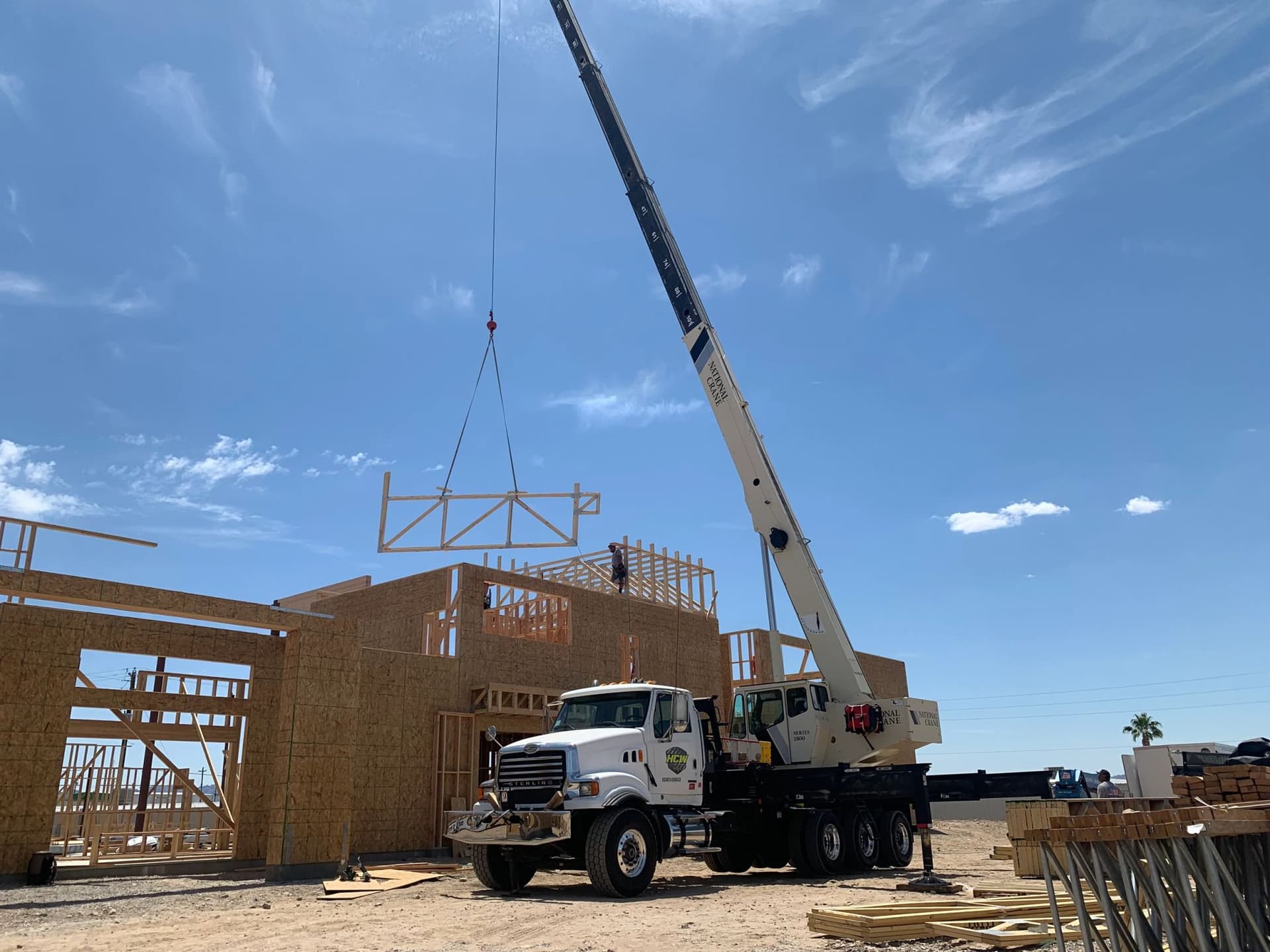
Roof truss lifting means handing trusses from a delivered bundle to a framing crew on the wall, one at a time and in sequence. Trusses are flexible across their span, so pick points are spread at panel points and long spans use a spreader bar. HCW supplies the crane, operator, and rigging.
Why a Truss Needs More Than One Pick Point
A truss carries load in its own plane. Turn that force sideways and it has very little to give. Lift a long truss from a single point in the middle and the ends sag, the whole thing bows, and the plates at the joints take stress they were never designed for.
So pick points get spread along the top chord at panel points, where the webs meet the chord, and long spans get a spreader bar so the sling legs pull straight up rather than inward. On short garage or casita trusses a simple two-point pick is often fine. On a long great-room truss it is not.
How the truss hangs also decides how the crew receives it. A truss that arrives level and in plane can be walked into position and braced. One that arrives twisted has to be fought, and fighting a truss on top of a wall is where people get hurt.
The Bundle, the Bands, and the Order
Trusses arrive banded in bundles, stacked in whatever order suited the truck. Nobody loads them in the sequence you want to set them, so the first job is figuring out which truss is on top and which one you need next.
Bands come off at the pile, deliberately, with the bundle stable on the ground and nobody in the way. A band under tension releases fast. What we do not do is cut a band on a bundle that is hanging, which is the shortcut that turns into an incident.
The gable end usually goes first, then the run works across with temporary bracing following. If the sequence in the bundle is wrong for that, we spend twenty minutes restacking at the pile rather than repeatedly digging for the right member all morning.
Hip sets are the other thing to flag early. A hip roof means a lot of short members going up in a fixed order with more handling per truss, so the day runs differently from a straight gable run of the same square footage.
Handing Off to the Wall
The framing crew is on the top plate waiting. The crane brings the truss up and holds it just above bearing while they align the heel to the layout mark and set it. The crane keeps tension until the truss is braced to the previous one or to a ground brace.
One person signals. On a wide house the operator often cannot see the far end of the truss, so the signal person is standing where he can see both ends and the crane. Everyone else stays off the radio.
Speed comes from rhythm, not from rushing individual picks. A crew that braces as it goes and has the next layout mark ready sets trusses steadily. A crew that stops to hunt for bracing between every member spends the day watching the crane idle.
Gable ends and girder trusses deserve their own mention. They are heavier, often doubled or tripled, and they carry the load of everything that hangs off them. Those are the members where the weight actually matters, and they are worth calling out to us in advance rather than discovering at the pile.
Wind on a Partly Framed Roof
A truss is a big flat sail. Hanging from a crane it wants to rotate, and standing on a wall with two nails and a brace it wants to go over. Both of those get worse fast as the wind builds.
Two tag lines are standard on anything with real span. They give control over rotation without anybody putting hands on the member while it is above the wall.
In monsoon season and on gusty spring afternoons we start early and plan the day so the roof reaches a fully braced stopping point. Leaving a run of unbraced trusses standing overnight in Havasu wind is not a risk worth taking to finish one more member.
How the job runs
Our Process
Step 1: Sequence and Layout First
We go through the set order with the crew lead, check the bundle against it, and restack at the pile if the order is wrong. Layout marks on the top plate should be done before the first pick.
Step 2: Position for Pile and Wall
Best case is one crane position that reaches both the truss pile and the whole roof. On long houses that sometimes means one reposition planned in advance rather than discovered at noon.
Step 3: Rig at Panel Points
Spread pick points along the top chord, spreader bar on long spans, two tag lines attached at the pile. Bands cut on the ground with the bundle stable.
Step 4: Set and Hold
The truss comes to bearing, the crew aligns to the mark, and the crane holds tension until it is braced. Then we come off and go back for the next one.
Step 5: Finish Braced
The day ends where the standing roof is fully braced. If wind builds, we stop setting and let the crew get ahead on bracing instead.
Scope
What Is Included
- Crane and operator for the framing day
- Spreader bar and multi-point rigging for long-span trusses
- Two tag lines for rotation control above the wall
- Restacking at the pile when the bundle order is wrong
- Hold time on every truss until the crew has it braced
- Coordination with your truss delivery on staging position
- Early start scheduling to work the calm part of the day
Real HCW jobs
From the Job Site
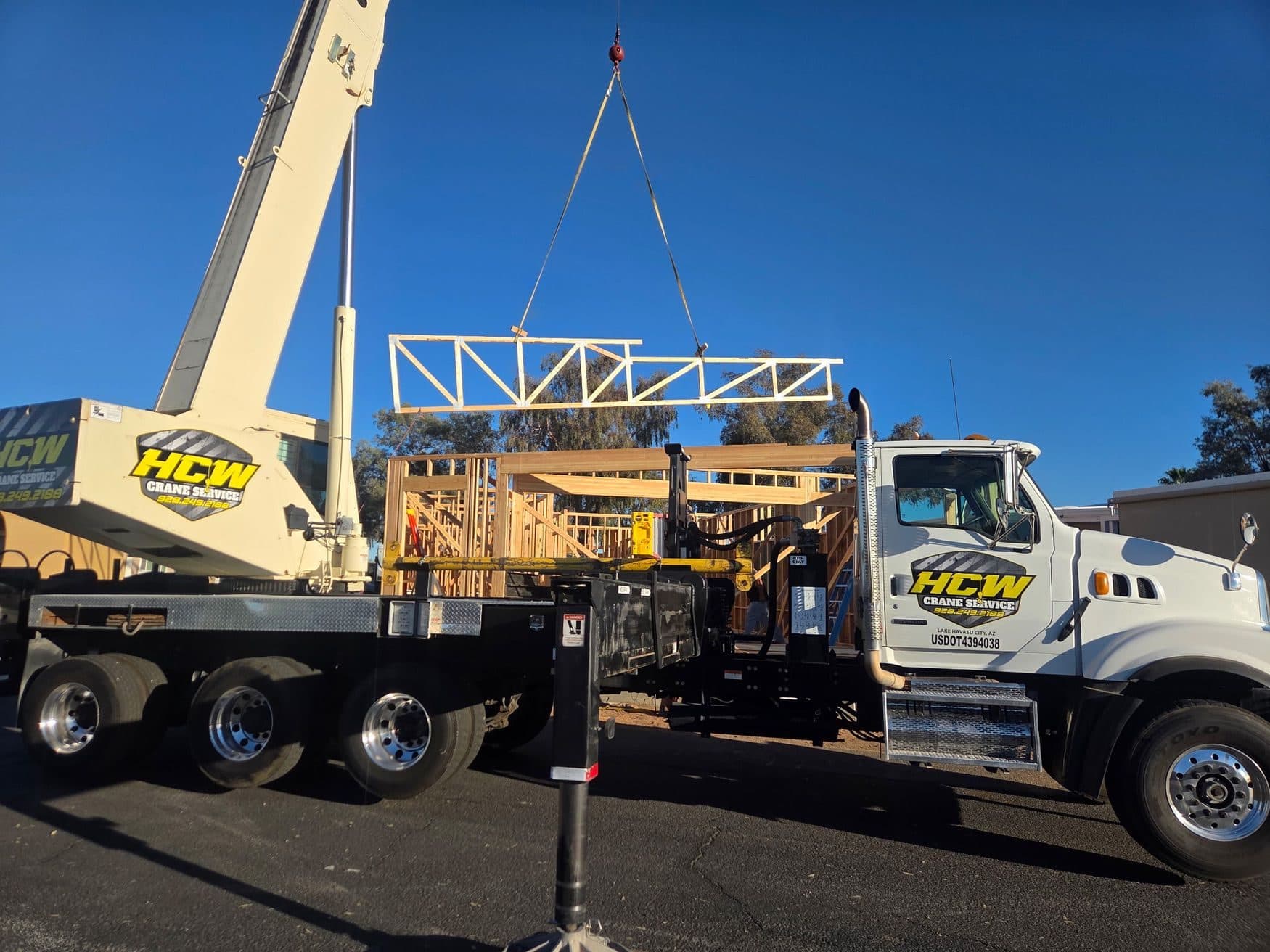
Roof truss lifted over new framing 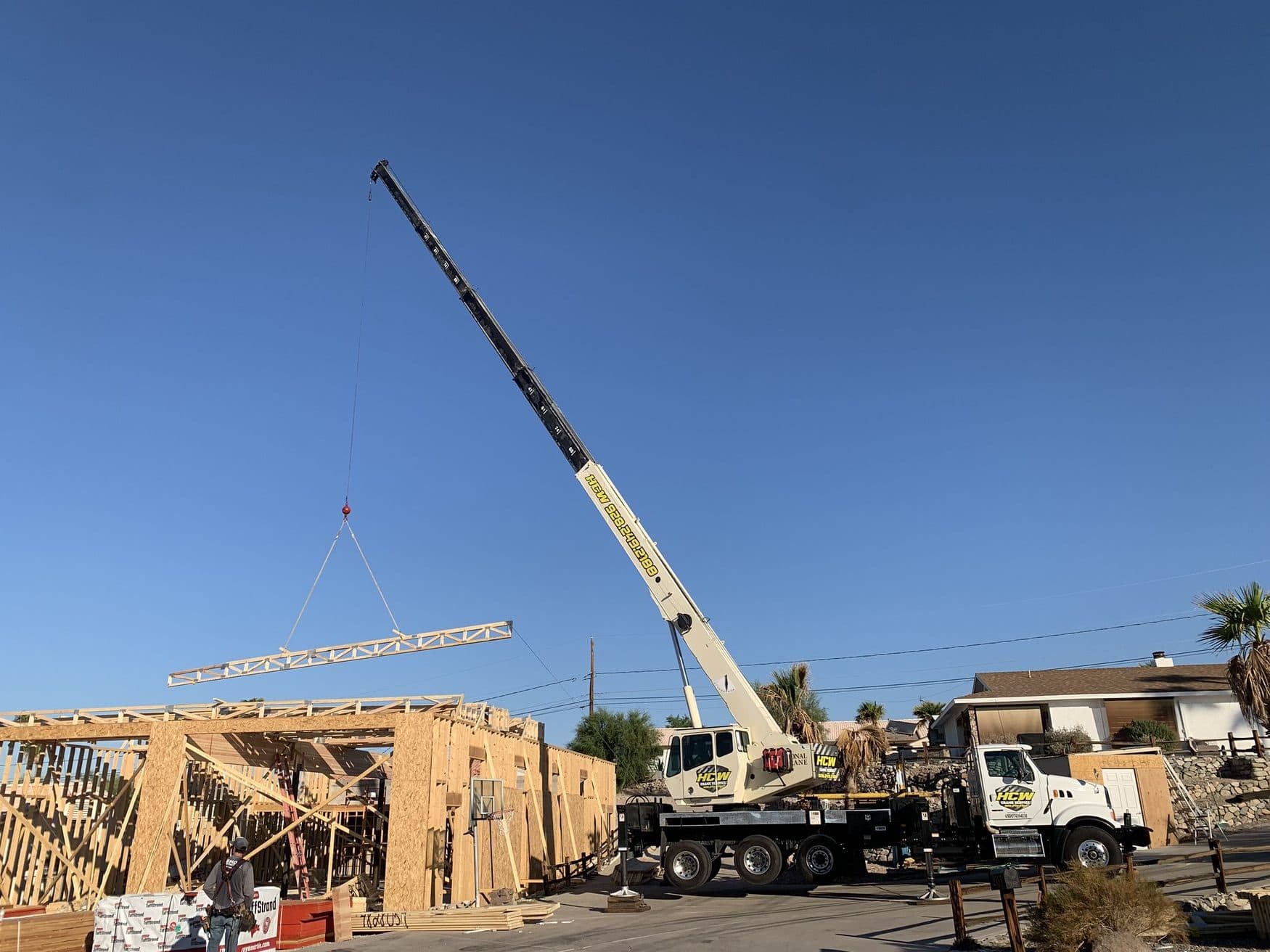
Roof truss lifted over new walls 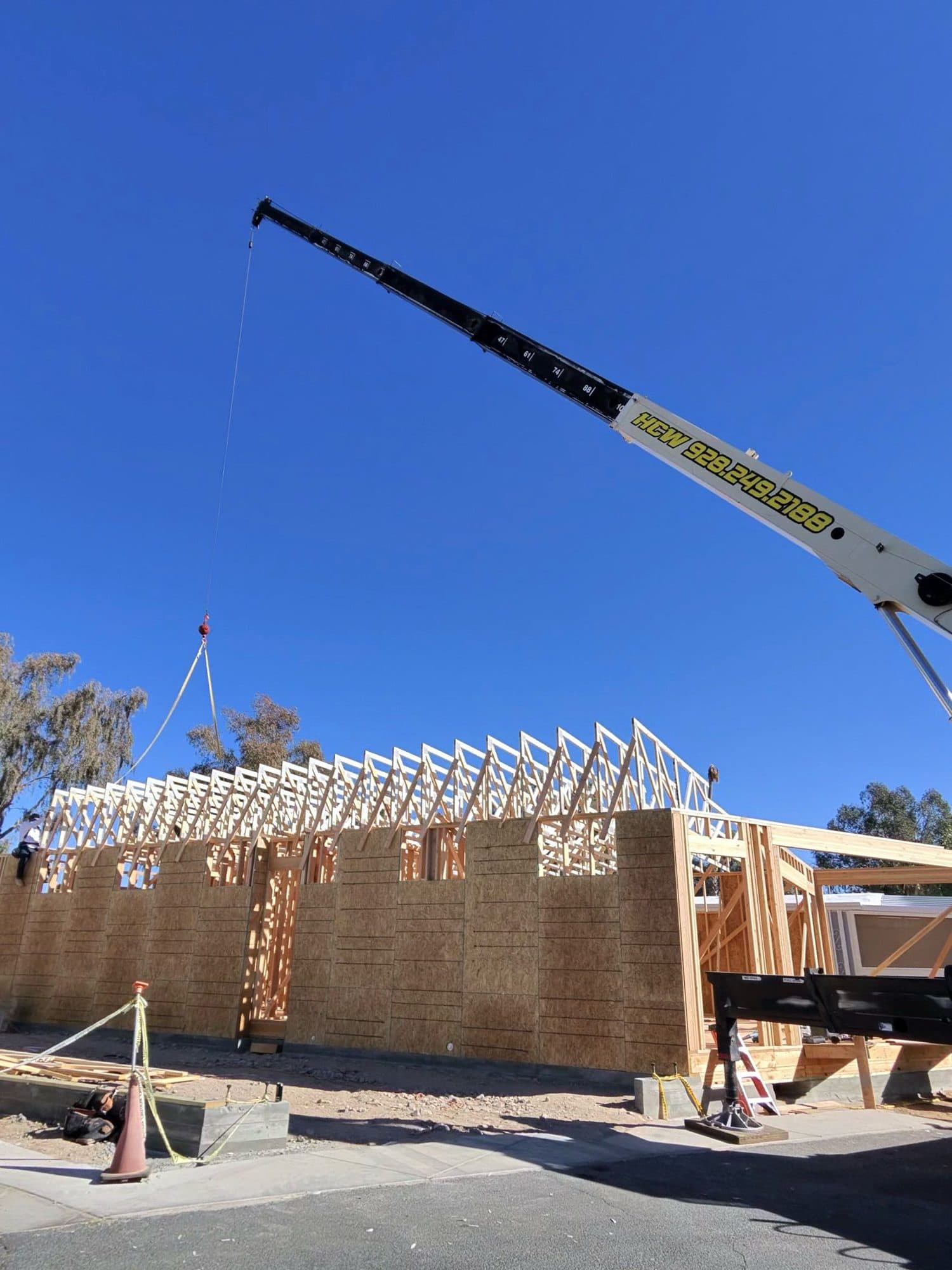
HCW boom over freshly set trusses 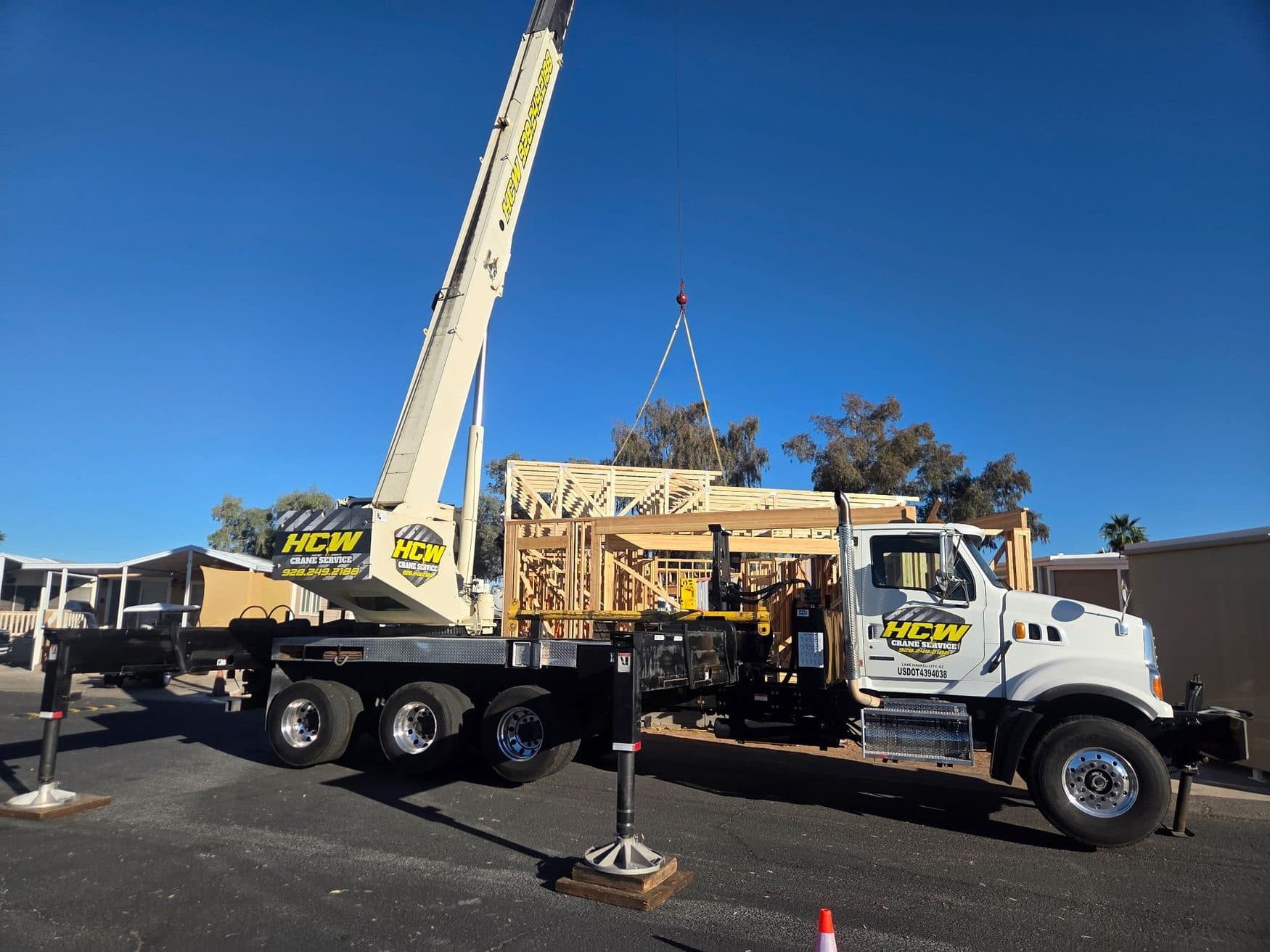
Full rig set up for a truss lift
Answers
Frequently Asked Questions
Do you need the truss layout drawing?
It helps a lot. It tells us the spans, the heaviest members, and the sequence. At minimum we need the longest span and the heaviest truss, since those two set the machine.
How many people should be on the wall?
That is your crew lead's call, but a truss set moves at the pace of the crew that receives and braces. Being short-handed slows the day more than anything on the crane side.
Can you set trusses on a two-story house?
Yes. Height and setback decide which machine comes out. The 40-ton reaches up to 142 feet, which covers two-story work on deep lots comfortably.
Who cuts the bands on the bundles?
It gets done at the pile with the bundle stable on the ground, by someone standing clear. Never on a hanging bundle. We will hold up the pick until that is done properly.
What if a truss is damaged in the bundle?
Set it aside and call your truss supplier. We are not going to install a damaged member, and a broken plate or a cracked chord is not something to work around on the wall.
Related Services
- Beam and Column PlacementGlulam and steel beams onto post seats, columns plumbed on anchor bolts. The crane holds the member while your crew makes the connection.
- Structural Component LiftsCanopies, stair sections, mezzanine framing, headers, awnings, and retrofit steel. The odd structural pieces that do not fit a standard category.
- Truss and Structural PlacementRoof trusses, beams, columns, steel, precast, and modular sections set to your framing crew's pace.
- Beam and Column PlacementGlulam and steel beams onto post seats, columns plumbed on anchor bolts. The crane holds the member while your crew makes the connection.
- Steel Member PositioningPurlins, joists, tube steel, and framing members positioned for bolted connections. Drift pins, tight tolerances, and steel that gets hot to touch.
- Precast Panel PlacementPrecast panels are heavy, flat, and all sail. Rated inserts, panels kept vertical, and bracing to the slab before the crane ever comes off.
- Modular Section PlacementFactory-built sections set onto foundations and piers. One pick per section, alignment marks that have to match, and rigging that will not rack the box.
- Structural Component LiftsCanopies, stair sections, mezzanine framing, headers, awnings, and retrofit steel. The odd structural pieces that do not fit a standard category.
Ready to schedule your lift?
Tell us the load, the site and the timing. We will confirm capacity, access and a window.