Industries We Serve
Crane Support for HVAC and Mechanical Contractors
2 min readUpdated July 2026
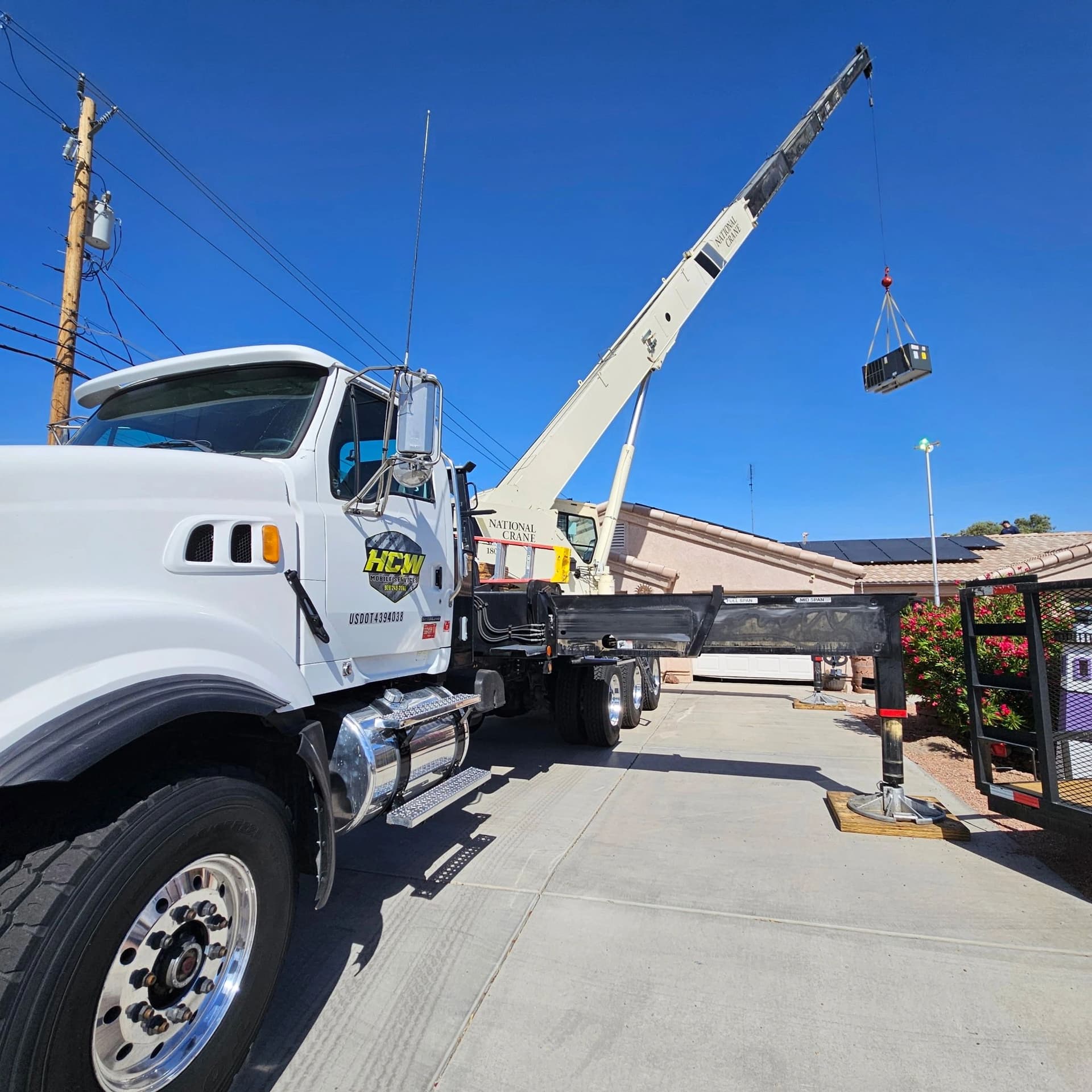
HCW Crane Service lifts rooftop and ground-level HVAC equipment for mechanical contractors in Lake Havasu City. The old unit comes off and the new one goes on from a single outrigger setup, and the curb adapter or equipment stand goes up on the same setup so the new unit lands on it.
Changeout Day Runs on the Crane
You control your crew, your truck, your parts and your customer. The one thing you do not control is the crane. If it lands at ten instead of seven, two techs are standing in a driveway on the clock and a homeowner is sitting in a hot house asking questions you cannot answer.
That is the real problem a mechanical contractor is solving when he calls for a lift. Not tonnage. Not reach. Whether the machine shows up inside the window it promised, and whether the operator has set a package unit before or is working it out on your roof.
So you get a window, not a day. If anything moves, you hear it from the person running the crane, and you hear it early enough to move your crew somewhere useful.
Old Unit Out and New Unit In on One Setup
Most changeouts are two picks, not one. The dead unit comes off the curb and the replacement goes down in its place. Both happen from the same outrigger position when the setup is planned for it.
That planning is mostly about where the old unit lands. It needs a spot clear of your truck, clear of the customer's parking, and reachable by whoever is hauling it off. We settle that before the boom comes up, because moving a dead unit twice is time nobody billed for.
We also need the curb open and the disconnect finished before we pick. A crane sitting on outriggers while a tech finishes a wiring pull is the most expensive way to run a changeout.
Summer Heat and the Early Start
From May through September in Lake Havasu, roof work stops being a scheduling question and turns into a physical one. Membrane goes soft, tools get too hot to hold, and your techs slow down whether they mean to or not.
So we start early. Setting a unit at six in the morning is a different job than setting the same unit at two in the afternoon, even though it is identical on paper. We would rather be packed up before the roof becomes unworkable.
Monsoon wind is the other calendar item. It builds fast in July and August, and a package unit is a large flat sail. If it is gusting past what we are willing to fly, we say so and we move the date. That call is ours and we make it early enough that you can reassign the crew.
When the Curb or the Stand Does Not Match
The new unit is rarely the exact footprint of the old one. Sometimes the adapter is on order. Sometimes it is sitting on the ground next to the new unit and nobody planned a pick for it.
If a ground-level condenser needs a rail, if a stand has to go up first, if a curb adapter has to sit on the roof before the unit lands, tell us on the first call. It goes up on the same setup as the unit. No second mobilization, no second schedule slot.
Most contractors discover the mismatch on the roof with the crane running. Asking about the adapter before the day is the difference between an hour and a week.
How the job runs
Our Process
Step 1: Call With the Unit and the Address
Weight, model, where it sits now and where a truck can park. A photo from your last visit tells us more than a description does.
Step 2: We Confirm the Window
You get a set arrival time rather than a vague morning. If the day before changes anything, the call comes to you.
Step 3: Setup Before the Crew Is on the Roof
We arrive ahead of the lift, walk the pad, set outriggers on cribbing and clear the swing path before anyone is waiting on us.
Step 4: Old Out, New Set, Then We Confirm
The dead unit lands where the hauler can reach it. The replacement goes on the curb square. We do not break down until your tech says it sits right.
Scope
What Is Included
- Rooftop package unit removal and replacement
- Split system condenser and air handler placement
- Ground-level pad and side-yard equipment sets
- Curb adapter and equipment stand lifted on the same setup
- Early start times through the hot months
- Same day and overnight response when a unit fails
Answers
Frequently Asked Questions
How much notice do you need for a changeout?
A few days is comfortable and same day happens often. The deciding factor is not the calendar. It is whether we know the weight, the setup spot and the roof height before we roll.
Can you set a unit if the street is the only place to park?
Usually yes. Plenty of Havasu lots leave no room beside the house, so the pick gets made from the street over the roofline. Tell us in advance, because it changes which truck comes and how much of the street we occupy.
Do you handle the disconnect or the curb work?
No. We rig, lift and place. Your techs do the mechanical and electrical. What we ask is that the disconnect and the curb are ready when we arrive so the crane is not idling on your dime.
What happens if it gets too windy?
We wait it out or we move the date, and we tell you as early as we can see it coming. A flat-sided package unit catches wind badly and nobody wants to explain a swinging unit to a homeowner.
Can you reach a unit behind a block wall?
That is most of this town. With reach available to 142 feet we can generally work over a wall and a roofline from the front. The limit is rarely height. It is how far the load sits out from the truck.
Do you work with commercial mechanical contractors too?
Yes. Restaurants, retail buildings and multi-tenant properties are regular work, often scheduled after hours so the business never has to close for it.
Other Industries
- Facility Managers and Maintenance TeamsA failed rooftop unit is a continuity problem. Overnight and early lifts, tenant-aware setups, and photo records you can put straight into your building file.
- Commercial Property and FacilitiesSigns, light poles, canopies, containers and roof equipment for Lake Havasu commercial property. Scheduled so the business stays open while the work happens.
- Builders and Project ManagersOne late crane moves five trades. Confirmed arrival windows, the owner as your point of contact, and weather calls made early enough to act on.
- On Time and Clear CommunicationArrival windows instead of day ranges, a confirmation call the day before, and one phone number that reaches the person driving the truck to your job.
- General and Residential ConstructionTruss days, beam sets and material staging for builders in Lake Havasu City. Cribbed outriggers for raw pads, and roofing load-ups on the same visit.
- Facility Managers and Maintenance TeamsA failed rooftop unit is a continuity problem. Overnight and early lifts, tenant-aware setups, and photo records you can put straight into your building file.
- Homeowners With Specialty Lift NeedsNever hired a crane before? Here is what happens in your driveway, what the truck touches, and how a load clears a block wall without hitting anything.
- Builders and Project ManagersOne late crane moves five trades. Confirmed arrival windows, the owner as your point of contact, and weather calls made early enough to act on.
- Structural Steel, Precast and ModularPiece weight and radius decide the setup, not the badge on the truck. Steel, precast and modular sections set with margin and held until your crew connects.
- Industrial and ManufacturingMachinery moves, equipment swaps and rigging for light industry around Lake Havasu. Work scheduled into your downtime window, day, night or weekend.
Ready to schedule your lift?
Tell us the load, the site and the timing. We will confirm capacity, access and a window.