
Resources
The Person Who Guides a Lift the Operator Cannot See
In Short
When the operator cannot see the landing, one signal person directs the pick. Hand signals with radio backup. Anyone on site may give the stop signal.
3 min readUpdated July 2026
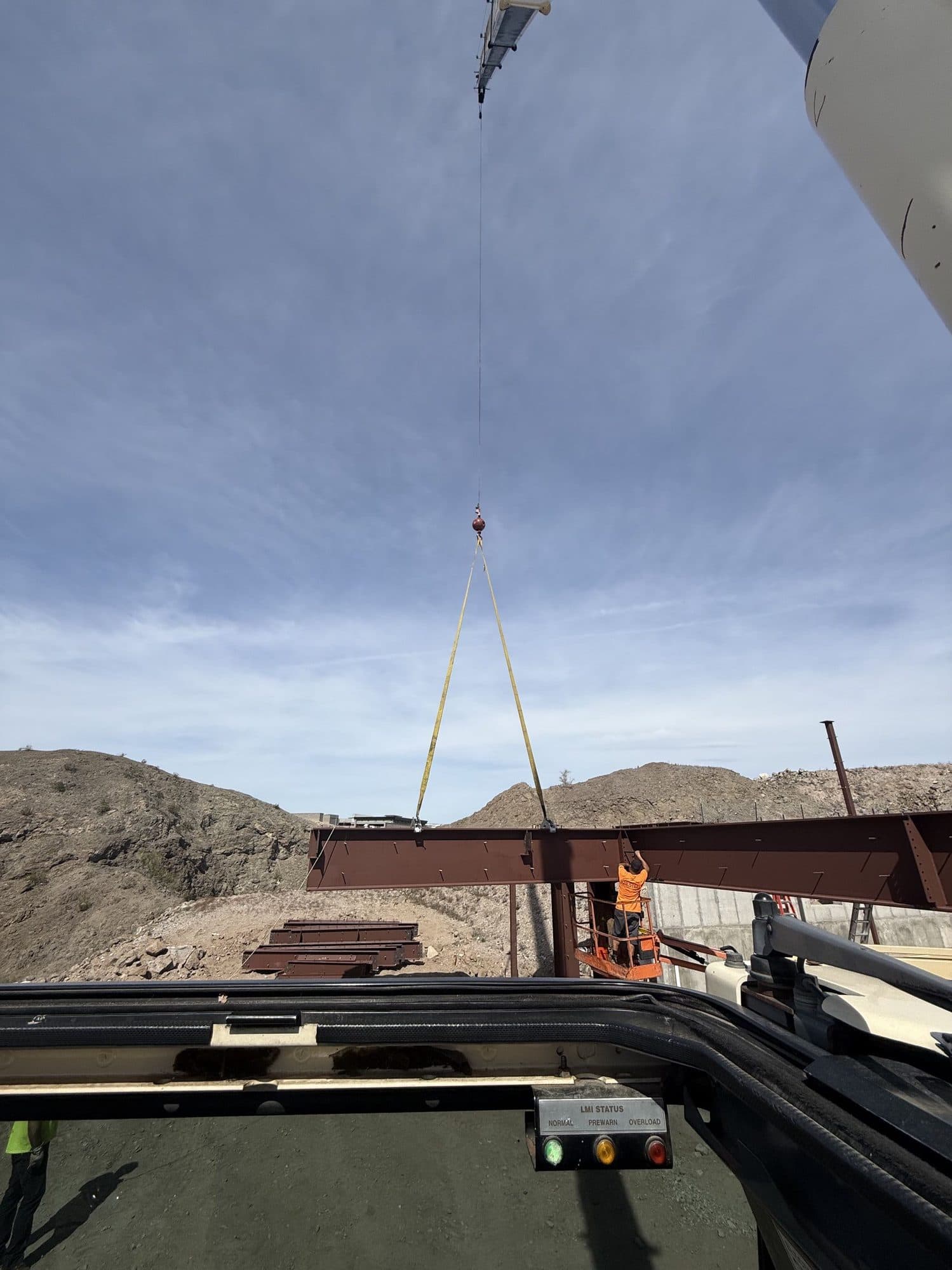
A signal person guides the operator when the load or the landing zone is out of sight. One person holds that job for the whole pick, using standard hand signals with a radio as backup. Anyone on site may give the stop signal, but only the assigned signal person directs movement.
One Voice, One Set of Hands
Plenty of picks around here are blind for part of their travel. A unit goes over a two story roof and disappears from the operator's view on the way down the far side. A spa clears a block wall into a backyard the operator has never stood in. Anything that lands behind a structure ends with the load somewhere the person on the controls cannot see it.
For those, one person is named signal person and holds the job for the whole pick. Not two people taking turns. Not whoever happens to have a clear angle at that moment. The operator watches one person and takes direction from nobody else, which means a well-meaning bystander waving from the patio changes nothing.
That single-source rule is the entire point. Two people signalling is worse than none, because contradictory instructions arrive at a machine holding several thousand pounds in the air.
The Signals Themselves
The hand signal set is standard across the trade and it is deliberately simple, because it has to be readable at distance, in glare, with a machine running. Hoist and lower, boom up and boom down, swing, telescope in and out, move slowly, and stop.
Slow is its own signal, not a softer version of the main one. One hand is placed over the hand giving the motion signal, which tells the operator to make the same movement at a fraction of the speed. The last few inches of most sets are done that way.
The stop signal is different from the rest. Everyone on site is told it before the lift begins, and everyone is allowed to give it. Arm extended, palm down, moved side to side. The emergency version uses both arms. The operator obeys a stop from any person, then finds out who gave it and why.
Radios back the hand signals up rather than replacing them. On a long pick, or where the signal person is over a roofline, voice is the only workable channel. The rule that comes with it is continuous contact: if the radio goes quiet mid-movement, the operator stops. Silence is never read as permission to keep going.
- Hoist, lower, boom up, boom down, swing, telescope
- Move slowly, given as a hand over the motion signal
- Stop, and the two-arm emergency stop
- Radio backup with a dedicated channel and continuous contact
- Stop on lost communication, without exception
Why the Homeowner Is Usually Wrong for It
People offer, and the offer is genuinely kind. It is still usually a no.
A signal person needs to know the standard signals cold, judge clearances in three dimensions from an angle the operator does not have, and stand in a place that is both visible and outside the fall zone. Most people volunteering have never done any of it, and the moment that exposes them is the moment something goes slightly wrong. That is precisely when improvised gestures make everything worse.
There is also the eyes problem. A good signal person is not watching the load. They are watching the gap: the corner of the roof the load is about to pass, the parapet, the edge of the block wall, the eave, the space between the item and the thing it must not touch. They call the movement based on the gap closing, not on where the load appears to be.
What you can do instead is far more useful. Walk the operator through your property before setup. Point out the septic lid, the shallow irrigation line, the section of wall with a loose cap, where the neighbor's fence actually sits. Then stand where you were asked to stand and watch. If you see something wrong, give the stop signal. That authority is real and it is yours.
How the job runs
Our Process
Step 1: Name One Signal Person
Before setup, one person is assigned and everyone hears who it is. The operator takes movement direction from that person only, for the duration of the pick.
Step 2: Agree the Signal Set
Hand signals are confirmed at the briefing, including slow and stop. If radios are in use, the channel is set and both units are tested before the load leaves the ground.
Step 3: Take a Position With Line of Sight
The signal person stands where the operator can see them and where the load and landing zone are both visible, while staying clear of the area under the load.
Step 4: Keep Eyes on the Load and the Gap
Attention stays on the clearance between the load and whatever it must not touch. Movement is called as the gap closes, with slow signals through the last stretch of the set.
Scope
What Is Included
- One assigned signal person for the whole pick
- Standard hand signals confirmed with everyone before the lift
- Radio backup with a set channel where line of sight is limited
- A stop-on-lost-communication rule the operator follows every time
- Stop signal authority explained to every person on site
Answers
Frequently Asked Questions
Do you need help from me on the ground?
Usually not for signalling. What helps most is a walkthrough before setup, moving vehicles, keeping the area clear, and being reachable by phone. If a helper is genuinely needed for a specific job, we will say so when we schedule it.
Can I signal the crane for you?
Generally no. Signalling means knowing the standard set, judging clearances in three dimensions and holding a safe position. If you see a problem, though, give the stop signal. Every person on site has that authority.
What if the radio cuts out during the lift?
The operator stops. Loss of communication is treated as a stop signal, every time. Nothing continues on the assumption that it is probably fine. Contact is reestablished, positions are confirmed, and the pick resumes.
How does the operator see a load going over a roof?
Often they cannot, which is exactly why a signal person is positioned where the landing zone is visible. The operator moves on called signals only, with slow signals through the last part of the set.
Why does only one person signal?
Because two sets of instructions arriving at once is worse than none. A single source removes any question about which direction to follow. Everyone else keeps clear and keeps their hands down unless they are calling a stop.
More Guides
- Pre-Lift Safety BriefingPre lift safety briefing in Lake Havasu City. Roles, signals, exclusion zone, stop authority and the abort plan agreed out loud before the outriggers go down.
- Rigging FundamentalsHow slings, shackles and spreader bars attach a load to the hook. Sling angle, center of gravity, gear inspection, and who supplies the rigging.
- What to Expect on Lift DayA walkthrough of lift day from arrival to departure, including how long each stage takes, what you can do, and why setup takes longer than the pick.
- Over-Structure PlacementHow a crane lifts a load over a house, garage or block wall and lands it on the far side when there is no ground route into the yard.
- How Mobile Crane Service WorksA mobile crane brings the machine and the operator to your site. Here is what happens from the first phone call through setup, the pick and pack up.
- Capacity and Reach ExplainedA 40-ton crane will not lift 40 tons at full boom. Here is what capacity ratings, load radius and 142 feet of reach actually mean for your job.
- Site Preparation ChecklistWhat to clear, move, unlock and check before a crane arrives. A prepared site keeps the visit short and stops problems being found at the worst moment.
- What to Expect on Lift DayA walkthrough of lift day from arrival to departure, including how long each stage takes, what you can do, and why setup takes longer than the pick.
- HVAC Unit Crane Placement GuideHow rooftop package units and condensers get craned on and off, how the work is sequenced with your HVAC contractor, and what a curb mismatch means.
- Truss Lifting Process and SafetyHow roof trusses get set with a boom truck: staging bundles, spreader bars, bracing, wind limits and keeping the crane in one position along the wall line.
Ready to schedule your lift?
Tell us the load, the site and the timing. We will confirm capacity, access and a window.