
Spas and Residential
How a spa gets lifted over a block wall
In Short
A spa is light for its size and easy to damage. The wall sets the height, the yard sets the radius, and soft slings protect the shell.
June 16, 20264 min read955 words
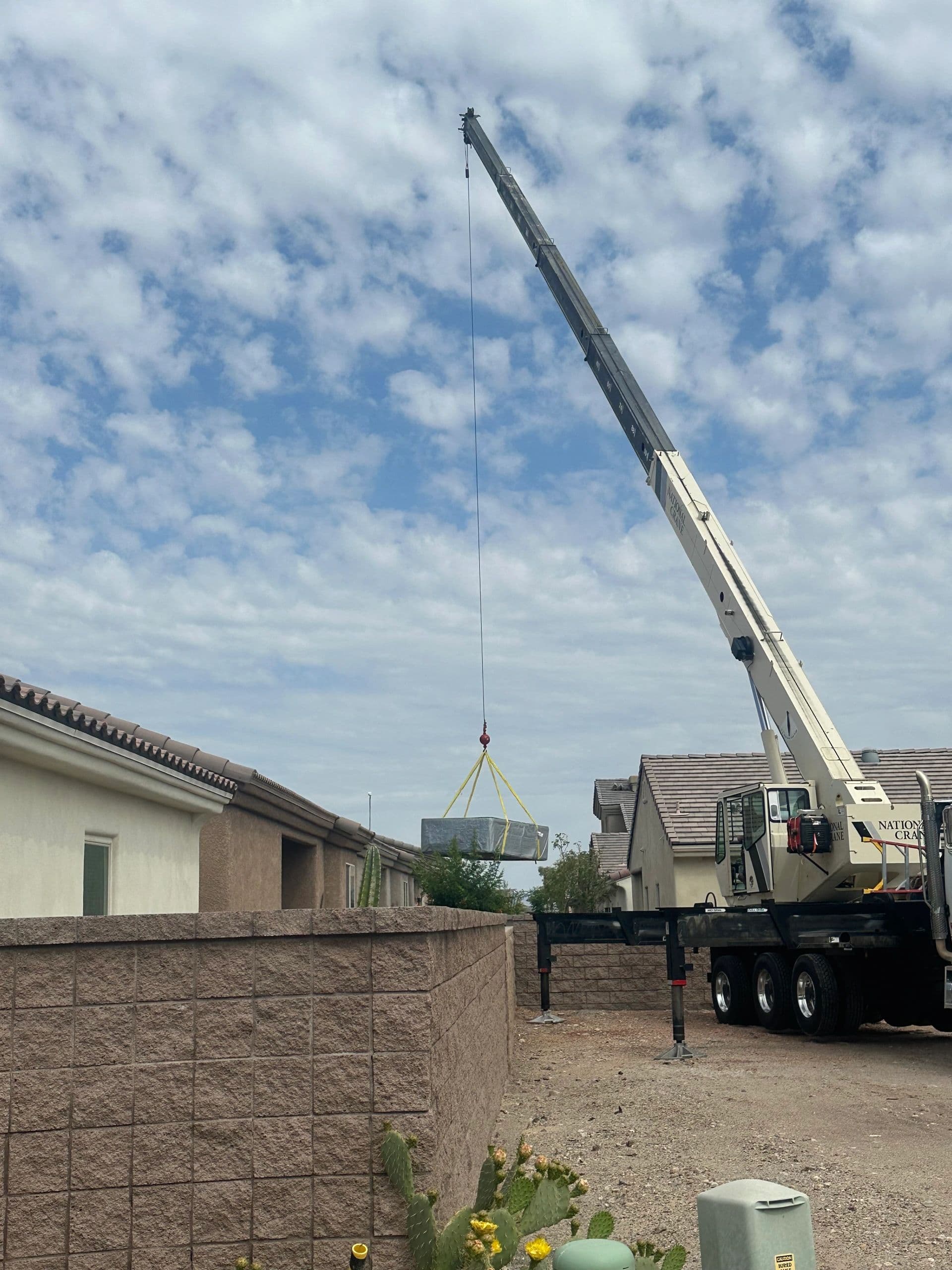
A spa is picked from the delivery truck on wide soft slings, lifted high enough to clear the block wall plus the rigging above it, swung over the wall on tag lines, and lowered onto its pad. The wall height sets the minimum lift. The distance from the street to the pad sets the crane.
Why Almost Every Havasu Spa Needs a Crane
Nearly every backyard in this town is enclosed by block. That is a good thing for privacy and wind, and it means a spa cannot be rolled in. Side yards are narrow, gates are three feet, and the wall is continuous.
The alternatives are worse. Taking down a section of block and rebuilding it is a bigger job than the lift. Removing a gate post rarely gains enough width. Dragging a spa across a finished patio on rollers damages the patio and sometimes the spa.
So the crane goes over the top. It is the cleanest answer and on a prepared site it is a short visit.
A Spa Is Light and Fragile at the Same Time
An empty spa is not a heavy load by crane standards. What it is, is large, awkwardly shaped, top-heavy in some designs, and finished on every visible surface. The failure mode is not dropping it. The failure mode is marking it.
The acrylic shell is supported by the cabinet and the frame underneath. Load it in the wrong place and you can flex the shell or crack a cabinet panel. Squeeze it too hard with slings across the top and you can distort it.
The equipment bay is the other sensitive area. Pumps, heater, and plumbing all live in one corner, which is also why the weight is not evenly distributed. That corner has to be respected both in how it is slung and in how the spa is set down.
How It Gets Rigged
Wide soft slings under the base, positioned according to what the manufacturer says about pick points. Most spas have designated locations, and the delivery paperwork or the underside of the cabinet usually tells you where.
Wide matters. A narrow sling concentrates pressure on a small section of cabinet and will crush it. Soft matters too, because a chain or wire rope against an acrylic lip is a scratch at best.
On many spas a spreader keeps the slings from squeezing inward at the top of the cabinet. Blankets or padding go anywhere a sling touches a finished edge. And the spa gets lifted a few inches first and held, so we can see how it hangs before it goes anywhere. A spa that hangs off level tells you the pick points are wrong, and that is a thing to learn six inches up rather than at wall height.
The Wall Sets the Height, the Yard Sets the Reach
Two independent numbers decide the machine. The first is how high the load has to go, which is the wall height plus the depth of the spa hanging below the hook plus the rigging plus clearance margin. That adds up faster than people expect.
The second is radius, which is the horizontal distance from the center of the crane to where the spa lands. If the truck sits on the street and the pad is at the back of a deep lot, that radius can be substantial, and radius is what eats crane capacity.
A crane's capacity falls off as the load moves away from the machine. That relationship is what a load chart describes. Nobody needs to memorize a chart, but everybody involved should understand that a spa which is trivially light close in can be a real pick at the back of a long lot, and that is why we ask how far it has to go.
Setting Up on the Street
The truck usually works from the street in front of the house. Outriggers come down onto mats, the machine is leveled, and the setup position is chosen so the swing path misses the service drop, the roof edge, and the neighbor's tree.
Cars have to be off the street in front of the house and usually next door as well. That is the number one thing that delays a residential spa lift, and it is entirely fixable the day before.
From the street the operator often cannot see the pad at all. The wall is in the way, and sometimes the house is too. That is normal. One person stands in the yard where they can see both the spa and the pad, and gives the signals for the last part of the set.
The Landing
The pad has to be ready before the spa arrives, not being worked on while the crane waits. Level, cured, and clear. A spa set on a pad that is out of level puts stress on the shell and gives you a water line that is visibly crooked forever.
The set itself is slow on purpose. The spa comes down to a few inches above the pad and stops. Position gets checked against the intended footprint, the equipment door orientation gets checked against where the access panel needs to face, and then it comes down the last few inches under control.
It stays in the slings until whoever is receiving it confirms it is where it needs to be. Pulling slings out from under a set spa is easy if you planned for it and awkward if you did not, which is why the slings get positioned with the removal in mind before the lift starts.
What Goes Wrong
Almost every spa lift that goes badly goes badly for one of a small number of reasons, and every one of them is a planning item rather than a lifting item.
- The pad is not finished or not cured on the day of the lift
- Cars are still parked where the crane needs to set up
- Nobody told us about the tree or the service drop in the flight path
- The gate or a section of fence needs to come out and has not
- Patio furniture and planters are still in the landing area
- The spa arrives on a delivery truck hours after the scheduled lift time
- Nobody from the spa company is there to receive it and confirm placement
Filed under Spas and Residential. Published June 16, 2026.
Answers
Frequently Asked Questions
How high can you lift a spa over?
Wall height is almost never the limiting factor on a residential spa. Distance is. If the pad is a long way back from where the truck can sit, that is what determines the machine, not the height of the block.
Will the crane damage my wall or my patio?
The load never touches the wall. It goes over it with margin. In the yard, the thing to protect is the patio surface, which is why the landing area needs to be clear and why we plan where the slings come out.
Do you set the spa or does the spa company?
We set it. Somebody who knows the spa should be there to confirm the placement and the orientation of the equipment access panel before we come off the load, because moving it afterward is a second job.
Can you move an existing spa out of a backyard?
Yes, and it is the same operation in reverse with two extra steps. It has to be fully drained and the plumbing has to be clear, because water left in the lines adds weight in unpredictable places and makes it hang badly.
How long does a spa lift take?
On a prepared site with the street clear, it is usually a short visit. Setup takes longer than the pick. Most of the day's variability is delivery timing and site readiness, not the lift.
Keep Reading
- What to do before your hot tub arrivesThe pad, the power, the access, and the neighbors. What a homeowner needs to have done before delivery day so the spa goes in on one visit.
- Why your driveway needs mats under the outriggersAn outrigger puts the weight of the crane and the load through a small pad. Mats spread that out. Here is what happens to concrete and pavers without them.
- Tight access lifts in Havasu neighborhoodsNarrow streets, hillside grade, block walls, and overhead service drops. What actually makes a Lake Havasu residential lift tight, and how it gets solved.
- Spa and Residential Specialty LiftsSpas, hot tubs, and awkward residential loads flown over block walls into finished backyards.
- Site Preparation ChecklistWhat to clear, move, unlock and check before a crane arrives. A prepared site keeps the visit short and stops problems being found at the worst moment.
- Capacity and Reach ExplainedA 40-ton crane will not lift 40 tons at full boom. Here is what capacity ratings, load radius and 142 feet of reach actually mean for your job.
Ready to schedule your lift?
Tell us the load, the site and the timing. We will confirm capacity, access and a window.