
Spas and Residential
Why your driveway needs mats under the outriggers
In Short
An outrigger concentrates enormous force into a small pad. Mats spread it. Without them, pavers sink, slab edges crack, and decorative surfaces chip.
April 28, 20264 min read965 words
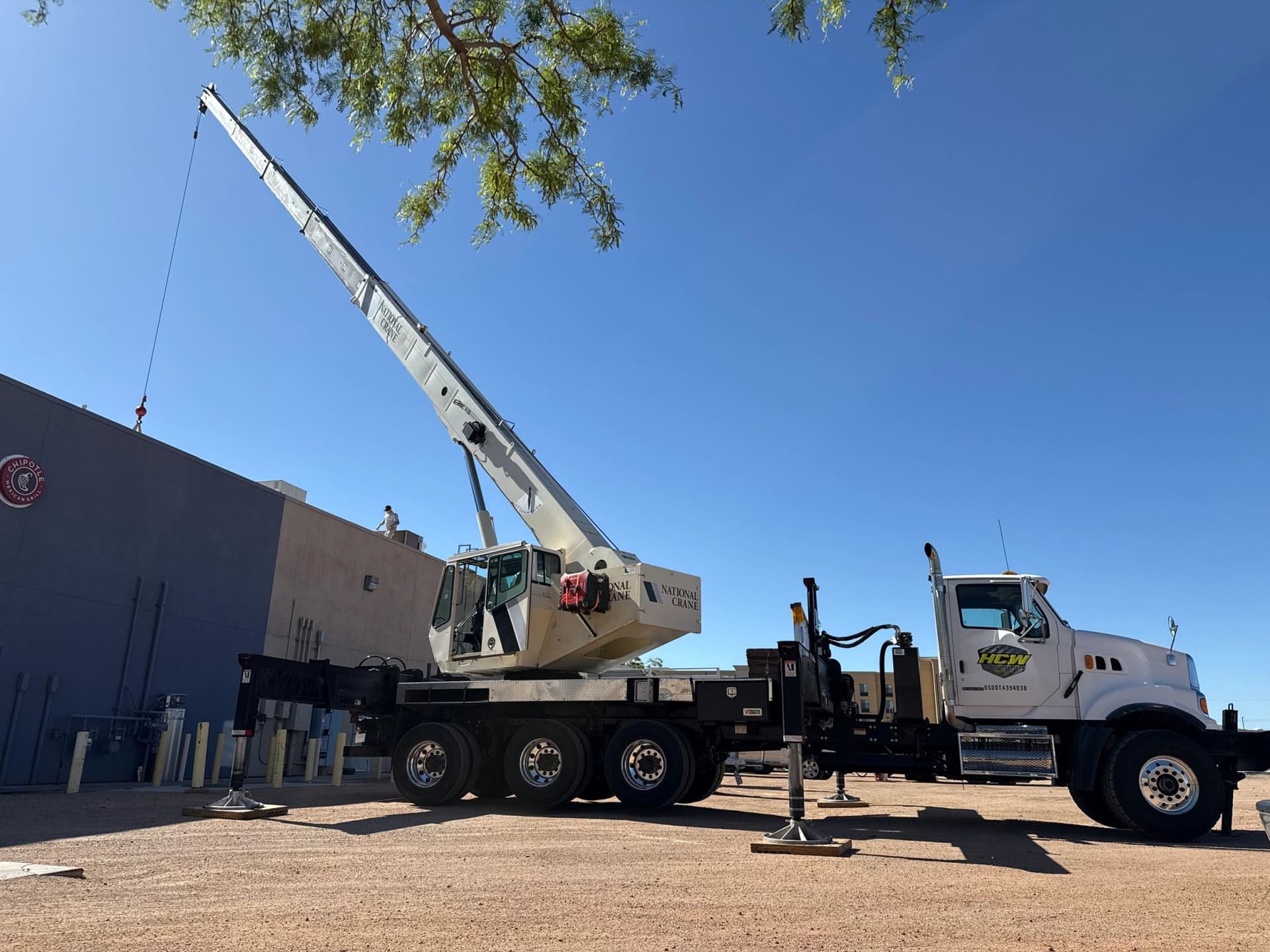
An outrigger transfers a large share of the crane's weight and the load through a pad the size of a dinner plate. That is a very high pressure over a small area. Mats and cribbing spread the same force across a larger footprint, which is what keeps concrete, pavers, and decorative surfaces intact.
Point Loading Is the Whole Idea
A crane on outriggers is not resting evenly on the ground the way a parked truck is. The tires come off the work and the entire machine, plus the load, plus the leverage the load creates, is carried on four pads.
Worse, it is not shared evenly. When the boom swings over one side, the outriggers on that side take dramatically more than the ones on the other. So the peak pressure under one pad during a pick is far higher than a simple division of weight would suggest.
That is what point loading means. A lot of force through a small area. Everything about how the crane is supported is an attempt to manage that number, and mats are the simplest tool for it.
What Mats Actually Do
A mat is a rigid plate under the pad. Timber, composite, or steel. Its job is to take the concentrated force from the pad and spread it over a bigger area of ground or surface.
The physics is straightforward. Same force, larger area, lower pressure. A pad that would push through a soil crust or crack a slab may be perfectly fine when the same force is spread across several square feet.
Rigidity is what makes it work. A flexible sheet just conforms to the pad and transmits the same concentration underneath. A proper mat has to resist bending in order to distribute anything.
Cribbing is the same idea applied differently. Layers of timber stacked in a pattern to build height and spread load, used where the ground under one leg is lower or softer than the others.
What Happens to Concrete Without Them
Concrete is strong in compression and weak in tension. It handles being pushed on. It handles being bent much less well, and a point load near an unsupported edge bends it.
So the failures are predictable. A pad set within a foot or two of a slab edge cracks the edge off, because there is nothing under the concrete on the outboard side to resist. A pad set over a void, which is common where soil has settled under an old driveway, punches through into the gap.
Control joints are another. A pad straddling a control joint loads two panels that can move independently, and it does exactly what the joint was designed to allow.
Decorative concrete adds a cosmetic failure on top of a structural one. Stamped and colored surfaces have a thin decorative layer, and a steel pad bites right through it. The slab may be fine and the driveway still looks damaged.
Pavers Are the Worst Case
Paver driveways are common here and they are the surface that gives the most trouble. A paver system is individual units on a bedding layer over a compacted base. It gets its strength from every unit being wedged against its neighbors.
A concentrated load pushes individual pavers down into the bedding sand. They do not come back up. Now you have a dip, and the surrounding pavers have lost their interlock and start to shift too.
Mats are essential over pavers, and often more of them than you would use on concrete. The goal is to load a large enough group of units that they act together rather than individually.
Tell us in advance if the setup area is pavers. It changes what comes on the truck and it may change where we choose to sit.
What Is Under Havasu Dirt
Off the pavement it is a different problem. Native ground here is often caliche, which is genuinely good bearing material when it is intact. The trouble is that it is not uniform.
A caliche crust over softer material behaves fine right up until it does not, and the failure is sudden rather than gradual. Blow sand is loose and will not hold a concentrated load at all. Imported fill on a graded pad, particularly near the edges, is only as good as its compaction, and edges are always the least compacted part.
Then there is everything buried. Irrigation lines close to the surface. Septic tanks and their lids, which are a serious hazard because a lid is a thin span over a void. Utility trenches that were backfilled recently and have not settled. Pool plumbing. Any of those under an outrigger pad is a failure waiting to be triggered by the first swing over that corner.
This is why we ask what is buried and where. You know your property and we do not.
How We Set Up on a Residential Driveway
The setup position gets chosen with the surface in mind, not just the geometry. Sometimes that means the truck sits further out into the street and uses more boom, which is a better trade than sitting on a paver apron.
Then every pad gets a mat as a matter of course, edges get avoided, joints get avoided, and anything questionable gets probed or looked at before weight goes on it.
- Tell us the driveway surface when you call: concrete, pavers, stamped, or dirt
- Point out irrigation, septic lids, and recent trenching
- Say whether the slab has visible cracks or settled areas already
- Clear the setup area of vehicles the day before
- Leave the sprinklers off the morning of the lift
- Expect mats under every pad, and expect the truck to sit where the ground is best
If a Surface Cannot Take It
Occasionally the answer is that a particular spot should not be loaded at all. A very old thin slab, a driveway over a known void, or a bridge deck over a drainage structure.
That is not the end of the job. It is a reason to move the setup position, use more mats and cribbing to spread the load much wider, or work from a different side of the property with a longer radius.
The one thing we will not do is set up on something because it is convenient and hope. Repairing a driveway costs more than moving a truck.
Filed under Spas and Residential. Published April 28, 2026.
Answers
Frequently Asked Questions
Will the crane crack my driveway?
Not if it is set up properly with mats and the pads are kept away from edges and joints. Tell us the surface in advance so the right amount of matting comes on the truck.
Can the crane set up on my paver driveway?
Often yes, with enough matting to load a large group of pavers together instead of a few individually. Sometimes the better answer is to sit on the street and use more boom.
Do you need to know where my septic is?
Yes. A septic lid is a thin span over a void and it is one of the few things that can fail suddenly under an outrigger. Same for irrigation lines and any recently backfilled trench.
Does it matter that my driveway is on a slope?
Yes. The crane has to be level, and outriggers can take up only so much difference in height. A steep driveway often means working from the street instead.
What if the ground is just dirt?
That is frequently better than a thin slab, as long as it is firm. Caliche bears well. Blow sand and loose fill do not. We probe and mat and, on anything questionable, choose a different spot.
Keep Reading
- Tight access lifts in Havasu neighborhoodsNarrow streets, hillside grade, block walls, and overhead service drops. What actually makes a Lake Havasu residential lift tight, and how it gets solved.
- How a spa gets lifted over a block wallThe standard Havasu backyard problem, start to finish. How a spa is rigged, how high it has to go, and what decides where the crane parks.
- What happens in a pre-lift briefingBefore anything comes off the ground, everyone on site gets the same short conversation. Here is exactly what gets covered and why each item is on the list.
- Ground Conditions and OutriggersA crane puts its weight through four small pads. Here is what makes ground good or bad for outriggers, and what caliche and buried trenches mean here.
- Site Preparation ChecklistWhat to clear, move, unlock and check before a crane arrives. A prepared site keeps the visit short and stops problems being found at the worst moment.
- Spa and Residential Specialty LiftsSpas, hot tubs, and awkward residential loads flown over block walls into finished backyards.
Ready to schedule your lift?
Tell us the load, the site and the timing. We will confirm capacity, access and a window.